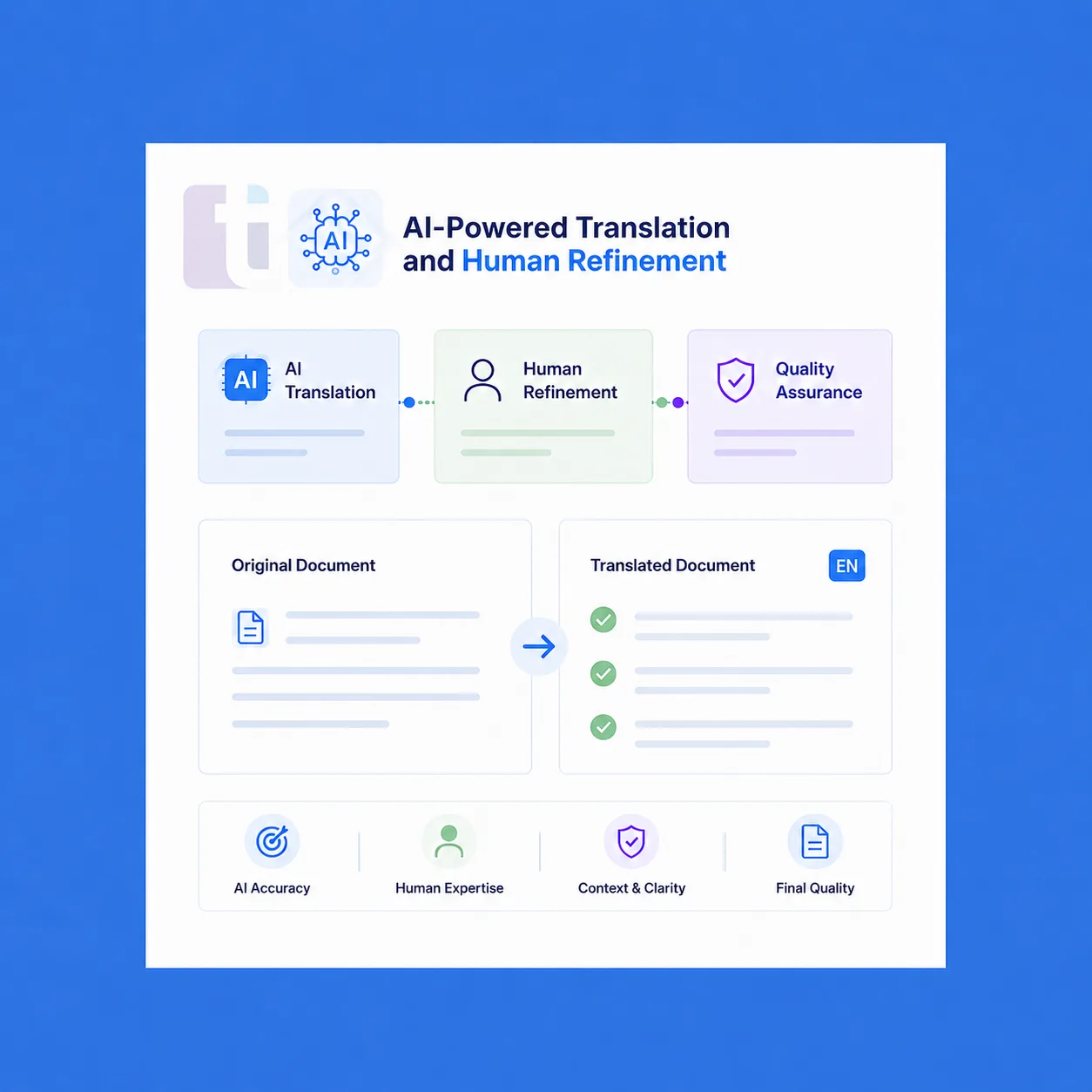
The global marketplace has never been more accessible, yet one fundamental barrier remains: language. As businesses expand across borders, content creators reach international audiences, and healthcare providers treat diverse patient populations, the demand for seamless, accurate communication has skyrocketed. Enter AI-powered translation—a technological revolution that is fundamentally reshaping how we interact on a global scale.
However, while automated language translation has achieved unprecedented speeds and impressive accuracy, it is not a standalone magic bullet. Language is deeply human, steeped in culture, emotion, and context. To achieve true resonance and flawless accuracy, the speed of artificial intelligence must be paired with the nuanced understanding of human refinement.
This comprehensive guide explores the evolution, mechanisms, industry applications, and inevitable limitations of translation technology. We will dive deep into why the most successful global communication strategies rely on a hybrid approach, blending the raw computational power of AI with the irreplaceable expertise of a human editor.
The Evolution of Translation Technology
To understand where we are today, we must look at how far machine translation software has come. The journey from early, clunky algorithms to today’s highly sophisticated language AI tools is a testament to the rapid advancement of artificial intelligence.
Neural Machine Translation vs Statistical Machine Translation
For decades, the industry standard was Statistical Machine Translation (SMT). SMT systems generated translations based on statistical models derived from vast quantities of bilingual text. If a certain word or phrase in English was translated to a specific word in Spanish 80% of the time in the training data, the SMT would blindly apply that probability. The result? Sentences that were often robotic, grammatically fractured, and lacking any contextual awareness.
The breakthrough came with the transition to Neural Machine Translation (NMT). Rather than breaking sentences into isolated words or phrases, NMT utilizes deep learning architectures for linguistics to analyze the entire sentence as a single cohesive unit. By employing artificial neural networks that mimic the human brain, NMT can predict sequences of words based on the context of the entire input.
This shift from Statistical Machine Translation to Neural Machine Translation revolutionized the industry. Suddenly, translations became smoother, more grammatically sound, and significantly closer to human speech. Today, large language models for multilingual communication—like those powering advanced generative AI—have pushed these boundaries even further, allowing for dynamic translations that can adjust to specific tones, formats, and stylistic guidelines.
Decoding the Modern AI Translation Engine
Modern AI translation solutions do much more than swap words from a source language to a target language. They process complex linguistic structures in milliseconds.
Context-Aware Translation Engines
One of the most significant advancements in recent years is the development of context-aware translation engines. Early AI models suffered from a "sentence-level memory limit." If a pronoun was introduced in the first sentence, the AI might forget the gender or subject by the third sentence, leading to confusing errors. Today’s context-aware engines analyze entire paragraphs or documents simultaneously. They remember the subject matter, the tone, and the relationships between entities throughout the text, ensuring a cohesive and consistent narrative flow.
Real-Time Processing and Speech Capabilities
We are no longer limited to text. The implementation of real-time language processing technology has enabled seamless verbal communication across language barriers. We see this actively deployed in AI powered translation earbuds, which can listen to a spoken language, process the audio, translate the text, and synthesize it back into speech in the user's ear. This requires remarkably low latency speech-to-speech translation, a feat made possible by edge computing and highly optimized neural networks that can process linguistic data in a fraction of a second.
The Business Case for AI Translation Solutions
For modern enterprises, localizing content is not just a nice-to-have; it is a critical growth driver. However, traditional human translation is time-consuming and expensive. This is where AI language services provide a massive competitive advantage.
Drastically Reducing Translation Costs for Businesses
Translating a comprehensive software manual, an e-commerce catalog with millions of SKUs, or a massive legal repository using exclusively human translators can cost hundreds of thousands of dollars. AI-powered translation slashes these initial costs. By allowing AI to do the "heavy lifting" of the first draft, businesses can allocate their localization budgets much more efficiently, paying human experts only for the final review and polish.
Integrating Translation APIs into Workflows
The true power of AI translation lies in its interoperability. Businesses are heavily focused on integrating translation APIs into workflows to automate the localization process from end to end.
Customer Support: Integrating AI into platforms like Zendesk or Salesforce allows support agents to receive tickets in Spanish, read them in English, and reply in English, while the customer receives a flawless Spanish response.
Content Management Systems (CMS): E-commerce brands can connect their CMS to translation APIs, ensuring that the moment a new product description is uploaded in the source language, it is instantly translated and published in a dozen target languages.
Software Development: Developers use APIs to automatically translate user interfaces during the continuous integration and deployment (CI/CD) cycle.
To manage this complex web of content, companies utilize the best enterprise localization tools—platforms like Phrase, Lokalise, or Smartling. These tools act as centralized hubs where AI translation tools and human editors collaborate seamlessly, tracking progress and maintaining translation memories.
Where AI Shines: Industry-Specific Applications
Different industries have vastly different linguistic requirements. AI translation adapts to these varied needs, though the level of human oversight required fluctuates based on the stakes involved.
Technical Translation
Technical translation involves highly specialized texts such as user manuals, engineering specifications, and software documentation. These texts are typically straightforward, repetitive, and devoid of emotional nuance. AI Translation excels here. Because technical writing relies heavily on standardized terminology, AI can be trained on specific corporate glossaries to ensure absolute consistency across thousands of pages.
Medical Translation
In medical translation, the stakes are literally life and death. Translating patient records, clinical trial protocols, dosage instructions, and medical device manuals requires zero margin for error. While AI is highly capable of processing the dense, specialized vocabulary of the medical field (often better than a non-specialized human), a human expert must always verify the output. A mistranslated decimal point or a misunderstood contraindication can have catastrophic real-world consequences.
Certified Translation
Certified translation is required for official documents—birth certificates, immigration papers, court transcripts, and legal contracts. These documents must be submitted to governmental or legal bodies with a signed guarantee of accuracy. While AI can rapidly generate the initial translation of these heavily structured documents, a certified human translator must perform a rigorous review before applying their stamp and signature. The AI provides the speed; the human provides the legal accountability.
The Glass Ceiling: Limitations of Automated Language Conversion
Despite the profound advancements in AI-powered translation, we must address the limitations of automated language conversion. AI operates on mathematics, patterns, and data. It does not possess a soul, a cultural background, or lived experience.
The Challenge of Cultural Nuance
One of the most complex hurdles in localization is overcoming cultural nuances in automated translation. Language is inextricably linked to culture. Idioms, humor, sarcasm, and metaphors rarely translate directly. For example, the English idiom "bite the bullet" makes no sense if translated literally into Mandarin or French. An AI might successfully translate the individual words, but the meaning—to endure a painful situation—will be entirely lost on the target audience. Furthermore, different cultures have different expectations regarding formality. In languages like Japanese or Korean, using the incorrect honorific can deeply offend the reader. While AI is getting better at adjusting to formal versus informal tones, it still struggles to instinctively grasp the subtle social dynamics that a human native speaker navigates effortlessly.
Creative and Emotional Content
If you are translating an instruction manual for a blender, AI is perfect. If you are translating a creative marketing campaign, a poignant novel, or a persuasive sales pitch, AI falls short. These texts rely on rhythm, wordplay, emotional resonance, and brand voice. An AI might produce a technically accurate translation of a marketing slogan, but it will likely strip away the cleverness and emotional hook that made the original slogan effective.
The Power of Human Refinement: A Hybrid Approach
Because of the limitations outlined above, the gold standard for global communication is no longer just "human translation" or "machine translation." It is a synergistic model: AI-powered translation combined with human refinement.
The Role of the Human Editor
In the modern localization pipeline, the linguist's role has evolved. Instead of translating from scratch, they often act as a human editor or a post-editor. Their job is to take the raw output generated by machine translation software and refine it. They inject cultural relevance, fix awkward phrasing, ensure brand voice consistency, and catch the subtle contextual errors that the AI missed.
Benefits of Machine Translation Post-Editing (MTPE)
The benefits of machine translation post-editing are immense.
Speed: MTPE is generally 30% to 50% faster than translating text from scratch.
Cost-Efficiency: Because linguists can process more words per hour, post-editing rates are lower than standard translation rates.
Quality: The final output is virtually indistinguishable from a purely human translation, as the human editor corrects any robotic phrasing or literal mistranslations.
Scalability: Businesses can localize vast amounts of content rapidly without sacrificing their brand’s reputation for quality.
Implementing Human-in-the-Loop Translation Workflows
To maximize efficiency, leading organizations employ human-in-the-loop translation workflows. In this model, the AI and the human work in a continuous feedback loop. When the AI generates a translation, the human editor corrects it. Those corrections are then fed back into the AI’s training data. Over time, the AI learns from its mistakes, adapts to the specific stylistic preferences of the human editor, and produces increasingly accurate initial drafts. This workflow transforms generic AI into a highly tailored, brand-specific localization engine.
How to Evaluate Translation Accuracy
When utilizing a hybrid AI-human model, quality control is paramount. Knowing how to evaluate translation accuracy is critical for ensuring your global message is landing correctly. Relying solely on automated metrics is insufficient; a holistic approach is required.
Automated Metrics (BLEU, METEOR): In the early stages of testing an AI model, developers use algorithms like BLEU (Bilingual Evaluation Understudy). These tools compare the AI's output against a set of high-quality human reference translations. While useful for rapid, large-scale technical evaluations, they cannot judge tone, style, or cultural appropriateness.
Adequacy and Fluency: Human evaluators typically score translations on two distinct axes. Adequacy measures whether the core meaning of the source text was preserved. Fluency measures whether the text reads naturally to a native speaker, without sounding like a clunky translation.
MQM (Multidimensional Quality Metrics): This is a standardized framework used by professional human editors to categorize and penalize errors. Errors are tagged by type (e.g., terminology, grammar, style) and severity (minor, major, critical). This provides businesses with a quantifiable, actionable scorecard for their localization efforts.
In-Country Review (ICR): The ultimate test of translation accuracy is having native employees or stakeholders within the target market review the final content. They can verify if the marketing copy resonates with local trends and cultural sensitivities.
Actionable Tips for Building a Modern Localization Strategy
If your business is ready to scale globally, relying entirely on manual translation will hold you back, but relying entirely on raw AI will damage your brand. Here is how to implement a successful hybrid strategy using AI and human refinement.
1. Segment Your Content Strategically
Not all content requires the same level of human touch. Triage your content based on its visibility and impact.
Raw Machine Translation (No Human): Internal company emails, user-generated content (like product reviews), and basic knowledge base articles. The goal here is general comprehension, not perfection.
Light Post-Editing: E-commerce product descriptions, FAQs, and standard technical documentation. The human editor simply ensures the text is accurate and free of glaring grammatical errors, without worrying about stylistic flair.
Heavy Post-Editing / Full Human Translation: Homepage copy, high-level marketing campaigns, legal contracts, and medical translation. This content represents your core brand and carries high risk; it requires meticulous human refinement.
2. Invest in Glossaries and Translation Memories
AI translation engines are only as smart as the data you feed them. Create a robust corporate glossary that defines your industry-specific terms, brand names, and slogans. Integrate this glossary into your machine translation software so the AI automatically applies the correct terminology, saving the human editor hours of repetitive corrections.
3. Choose the Right Enterprise Tools
Do not rely on consumer-grade translation apps for enterprise workflows. Invest in the best enterprise localization tools that support API integrations, translation memory, glossary management, and seamless collaboration between the AI engine and your human editors.
4. Provide Context to Your Linguists
When handing AI-translated text over to a human editor, provide them with comprehensive context. Give them style guides, target audience personas, and visual references (like screenshots of the software UI or page layouts). A human editor can only refine the AI’s output effectively if they understand exactly who the content is for and where it will live.
The Future of Neural Linguistic Modeling
As we look to the horizon, the trajectory of translation technology is awe-inspiring. The future of neural linguistic modeling lies in multimodal AI—systems that can simultaneously process text, audio, video, and visual context. Imagine an AI that doesn't just translate a video’s subtitles, but analyzes the speaker's facial expressions and tone of voice to choose the most emotionally accurate translated words.
Furthermore, we will see highly personalized AI models. Instead of relying on a generic global AI, companies will train proprietary, hyper-specialized AI engines on their own historical data. These localized models will instantly adopt the company’s unique brand voice, reducing the heavy lifting required during the post-editing phase.
However, even as these deep learning architectures for linguistics become unimaginably advanced, the fundamental nature of language ensures that the human element will never become obsolete. Language is not a fixed mathematical equation; it is a living, breathing reflection of human society. It evolves daily with new slang, shifting cultural paradigms, and creative innovations. AI can learn the rules of a language, but only humans can understand the soul behind it.
Final Thoughts
The intersection of AI-powered translation and human refinement represents the pinnacle of modern global communication. By leveraging sophisticated automated language translation, businesses can achieve unprecedented scale, slash costs, and integrate seamless multilingual experiences directly into their digital ecosystems. Yet, it is the discerning eye of the human editor that bridges the gap between mechanical accuracy and true cultural resonance.
Embracing this hybrid approach—where artificial intelligence provides the speed and human experts provide the polish—is no longer just a best practice; it is a necessity for any organization looking to thrive in a borderless world. By understanding the strengths of AI and respecting the irreplaceable value of human nuance, you can ensure your message is not just translated, but truly understood, anywhere in the world.