Key Takeaways
- AI translation and interpretation can help healthcare providers reduce language barriers and improve communication with patients who do not speak English fluently.
- AI translation supports written healthcare materials such as intake forms, discharge instructions, electronic health records, and prescription guidance.
- AI interpretation supports real-time spoken communication between patients and clinicians, especially in telehealth, triage, and routine clinical interactions.
- Medical AI tools can improve access to care by offering faster language support, especially in emergencies, rural settings, after-hours care, and underserved communities.
- Human interpreters remain essential for sensitive or high-stakes situations, including serious diagnoses, end-of-life discussions, complex consent conversations, and emotionally difficult encounters.
- A hybrid model can be the safest approach, with AI handling lower-risk communication and human professionals reviewing or managing critical medical language needs.
- Hospitals must prioritize HIPAA-compliant tools, secure data handling, staff training, and clear escalation rules before implementing AI translation systems.
- AI language tools can also support healthcare marketing and community outreach by helping providers communicate with diverse local populations in their preferred languages.
- Responsible use of AI translation and interpretation can support health equity by helping more patients feel heard, understood, and included in their care.
Imagine sitting in a brightly lit examination room, anxious and in pain, while a doctor delivers a critical diagnosis in a language you do not understand. For millions of patients worldwide, this scenario is a terrifying reality. Language barriers in clinical settings routinely lead to misdiagnoses, improper medication adherence, and severe patient anxiety.
However, we are in the midst of a technological revolution. The widespread adoption of ai in healthcare is rapidly changing how providers interact with diverse patient populations. When exploring AI in Healthcare: how AI translation and interpretation can facilitate better care, it becomes clear that artificial intelligence is not just a tool for analyzing data—it is a vital bridge for human connection. By leveraging advanced language models, medical facilities are breaking down communication silos, ensuring that every patient, regardless of their native tongue, receives world-class treatment.
Here is a deep dive into how digital linguist tools are reshaping the medical landscape, the technologies driving these changes, and how hospitals can implement them to improve patient outcomes.
The Urgent Need for Medical Language Barrier Solutions
Clear communication is the bedrock of effective medical care. When patients and providers do not share a common language, the quality of care inherently drops. Traditional medical language barrier solutions have relied heavily on in-person human interpreters or phone-based translation services. While valuable, these services are often subject to long wait times, high costs, and availability constraints, especially during nighttime emergencies or in rural areas.
This is where enhancing health equity through technology comes into play. Health equity means ensuring everyone has a fair and just opportunity to be as healthy as possible. By integrating digital health ai, hospitals can provide immediate, accessible language support to marginalized communities. Understanding how AI improves patient communication requires looking at the tangible benefits: patients can fully understand their treatment plans, provide informed consent without hesitation, and articulate their symptoms accurately, leading to a drastically elevated standard of ai patient care.
Breaking Down the Technology: AI Translation vs. AI Interpretation
To fully grasp the impact of these technologies, it is important to distinguish between the two primary linguistic pillars of ai in medicine: translation and interpretation.
AI Translation deals with written text. In a clinical setting, this involves instantly converting patient intake forms, electronic health records (EHRs), discharge instructions, and prescription guidelines into a patient's native language.
AI Interpretation deals with spoken language. This is the real-time, dynamic conversion of a conversation between a doctor and a patient.
Powering both of these functions are intelligent healthcare systems driven by complex algorithms. The foundation of these systems relies heavily on machine learning for medical linguistics. Unlike standard translation apps that might struggle with the difference between "benign" and "malignant," models trained specifically on medical databases understand clinical context.
Furthermore, natural language processing in clinical settings allows computers to comprehend the nuances of human speech, including slang, colloquialisms, and regional accents. By utilizing machine learning healthcare models that continuously learn from millions of medical dialogues, these systems are becoming unprecedentedly accurate.
Transforming the Patient-Provider Experience
The practical applications of these ai health innovations are vast and transformative. Here is how they are currently being utilized to facilitate better care:
Elevating Telehealth with AI
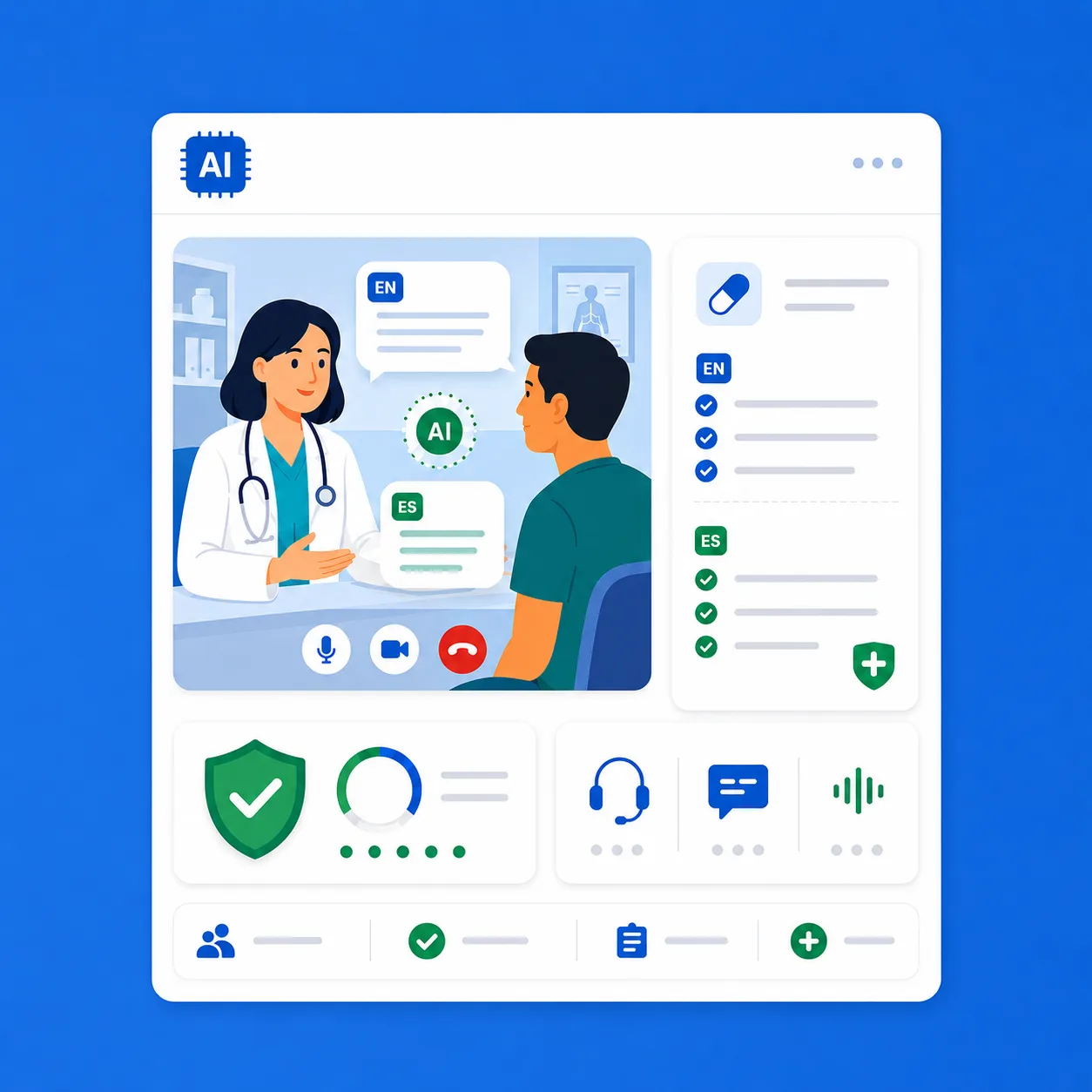
The boom in virtual care has necessitated new communication tools. AI translation for telemedicine consultations allows platforms to generate real-time multilingual closed captions during video calls. If a Spanish-speaking patient is consulting with an English-speaking neurologist, the AI seamlessly translates the dialogue on the screen, ensuring that distance and language are no longer barriers to specialized care.
Empowering Clinicians at the Bedside
In busy emergency rooms, doctors don't always have time to wait for a human interpreter to arrive. Voice-to-voice translation for clinicians acts as an immediate stopgap. Using secure, real-time medical translation apps on hospital-issued tablets, doctors can speak naturally into the device, which then reads the translation aloud to the patient in a synthesized, calming voice. This instant exchange is proving critical in emergency triage, significantly improving health outcomes with AI translation.
Conversational AI and Virtual Assistants
The introduction of conversational ai in healthcare has taken administrative and triage burdens off the shoulders of burnt-out staff. AI agents in healthcare can interact with patients via hospital websites or phone systems in dozens of languages.
A dedicated ai voice agent in healthcare can ask a patient about their symptoms, schedule appointments, and provide pre-operation instructions in the patient's preferred language. These autonomous ai healthcare solutions ensure that non-English speakers do not abandon their pursuit of care simply because they cannot navigate a hospital’s automated phone tree.
The Great Debate: AI vs Human Medical Interpreters
As these healthcare ai technology tools become more prevalent, a natural question arises: will AI replace human interpreters? The short answer is no; rather, they will augment them.
When analyzing AI vs human medical interpreters, it is essential to look at the strengths of both. AI offers unmatched speed, 24/7 availability, and scalability. However, human interpreters bring empathy, cultural competence, and the ability to read non-verbal cues—things AI cannot yet replicate.
A common concern among medical professionals is: can AI translate medical terminology accurately? While general-purpose translation engines often fail at this, specialized medical AI boasts accuracy rates that rival human professionals. However, the stakes in medicine are life and death. Because of the challenges of AI in medical interpretation—such as handling highly emotional situations or obscure regional dialects—the industry is moving toward a hybrid model.
This hybrid approach is known as Human-Refined AI Translation for Healthcare. In this model, AI handles immediate, low-stakes communication (like dietary preferences or basic intake questions) and drafts written translations of discharge papers. Human linguists then review and refine these documents for absolute clinical accuracy, reserving human interpreters for high-stakes scenarios like delivering a severe diagnosis or discussing end-of-life care.
Weighing the Pros and Cons of AI in Healthcare Language Services
To fully understand the landscape of ai medical applications, healthcare administrators must take an objective look at the benefits and limitations.
Pros:
Immediate Access: Eradicates the wait time for interpreters in emergency situations.
Cost-Efficiency: Significantly reduces the hourly costs associated with third-party language lines.
Consistency: Standardized medical terms are translated consistently across all patient documentation.
Broad Coverage: Supports hundreds of rare languages and dialects that human agencies might not staff.
Cons:
Lack of Emotional Intelligence: AI cannot comfort a grieving family or pick up on the subtle tone of a patient's voice.
Technological Reliance: Requires strong internet connectivity and functional hardware.
Privacy Concerns: If not properly vetted, cloud-based AI could expose sensitive patient data.
Implementing AI Translation in Hospitals: Practical Steps
For clinical leaders ready to adopt these systems, implementing AI translation in hospitals requires a strategic, phased approach. It is not as simple as downloading an app onto a clinician's smartphone.
1. Prioritize Data Security and Compliance
The absolute non-negotiable factor in deploying ai in healthcare is patient privacy. Facilities must utilize HIPAA compliant translation software. This ensures that voice recordings and text data are encrypted, anonymized, and never stored on public servers or used to train public, open-source AI models without consent.
2. Conduct a Cost-Benefit Analysis
Administrators must evaluate the cost-benefit of AI medical translation. While the initial integration of enterprise-grade AI software requires a financial investment, the long-term ROI is substantial. Hospitals save money by reducing interpreter wait times, minimizing the lengths of patient stays (as care is delivered faster), and avoiding malpractice lawsuits stemming from miscommunication.
3. Comprehensive Staff Training
Technology is only as effective as the people using it. Clinicians must be trained on how to speak clearly to the AI, how to verify the AI's understanding, and when to escalate a conversation to a human interpreter. For hospital leaders and IT managers, enrolling in an ai in healthcare course can provide vital insights into the ethical deployment and technical maintenance of these systems.
Beyond the Clinic: AI in Healthcare Marketing
Interestingly, the benefits of multilingual AI extend beyond the examination room and into the realm of community outreach. AI in healthcare marketing is revolutionizing how hospitals connect with diverse local populations.
By utilizing AI translation tools, marketing teams can easily localize their community health campaigns, preventative care newsletters, and social media content into the languages most spoken in their surrounding zip codes. When a healthcare provider advertises its services in a community’s native language—and promotes the fact that they offer seamless, AI-assisted multilingual care—it builds immense trust. It signals to minority populations that the hospital is a safe, inclusive, and technologically advanced place to seek care.
The Future of Global Health Equity
The rapid evolution of pros and cons of ai in healthcare shows that while artificial intelligence is not a flawless magic wand, it is an indispensable tool in the modern medical arsenal. The integration of robust language models into clinical workflows represents one of the most exciting ai medical applications of our time.
By embracing these tools, healthcare providers are doing much more than upgrading their IT infrastructure; they are making a profound commitment to human dignity. They are ensuring that the fundamental right to health and healing is not dictated by the language a person happens to speak.
When we step back and look at AI in Healthcare: how AI translation and interpretation can facilitate better care, the takeaway is incredibly hopeful. Through the responsible use of conversational AI, secure medical translation apps, and hybrid human-AI systems, we are inching closer to a truly equitable global healthcare system—one where every patient is heard, understood, and given the best possible chance to heal.