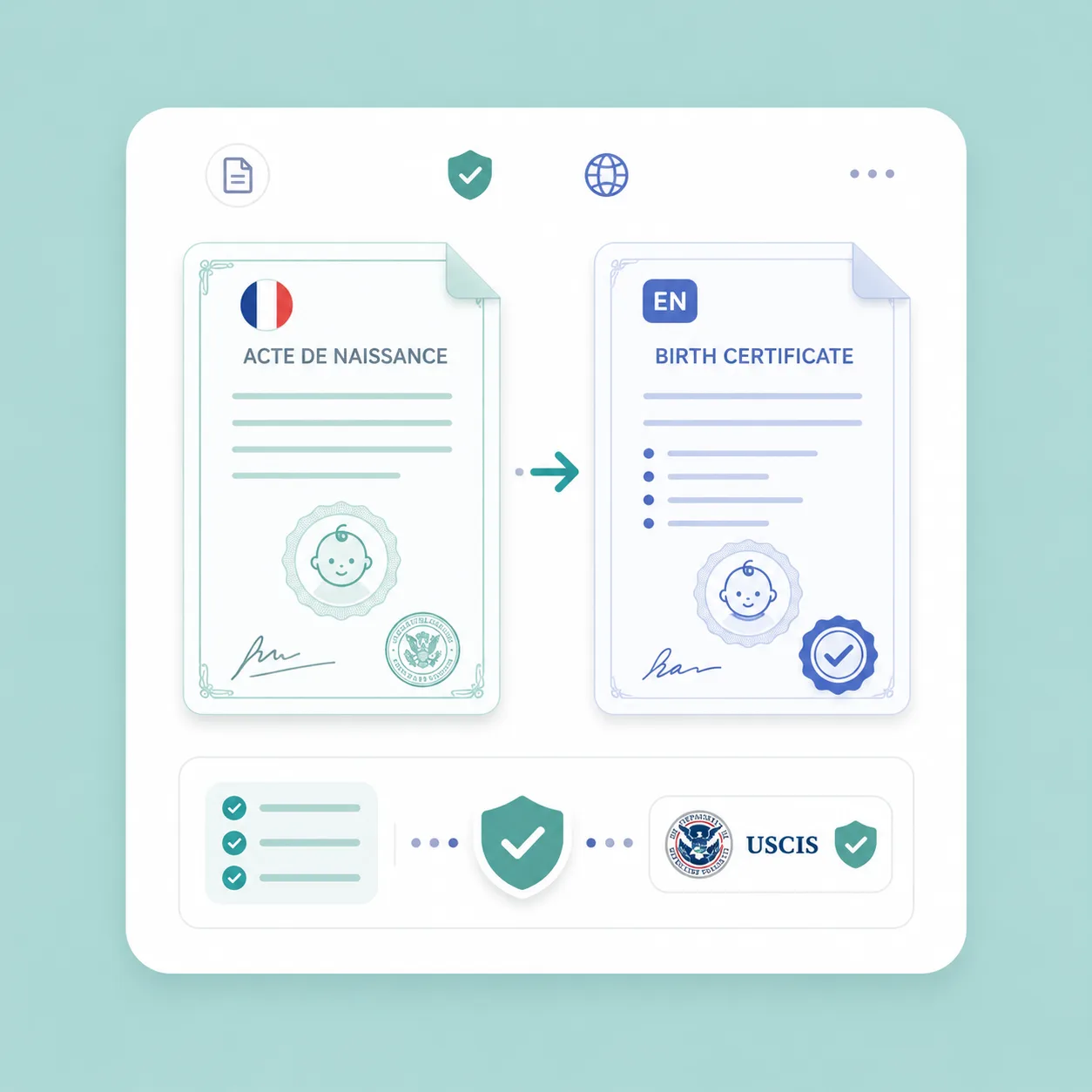
Key Takeaways
- Birth certificate translation is often required for immigration, foreign marriage, school enrollment, citizenship by descent, visa applications, passports, and other international legal processes.
- A birth certificate is a foundational identity document because it verifies a person’s name, birth details, parentage, and nationality.
- Certified translation includes a signed Certificate of Accuracy confirming that the translation is complete and accurate.
- Certified translation, notarized translation, official translation, and sworn translation are not the same, and the correct requirement depends on the receiving authority.
- USCIS requires a full English translation for any foreign-language document submitted with an immigration application.
- A proper USCIS birth certificate translation should include all text, seals, stamps, signatures, notes, and illegible elements from the original document.
- Applicants should not translate their own birth certificates or rely on family members because official agencies generally require an impartial third-party translator.
- Some countries may require sworn translation, Apostille, legalization, or physical wet-ink copies, especially for consular or international submissions.
- Digital certified translations may be acceptable for many USCIS filings, while foreign consulates and passport authorities may require physical copies.
- Clear scans are essential because cropped corners, blurry text, missing seals, or unreadable signatures can cause translation delays or rejection.
- Translation cost depends on page count, language pair, urgency, notarization, formatting, and shipping requirements.
- Before submission, applicants should review names, dates, places, spellings, seals, stamps, and formatting to make sure the translation matches the original document accurately.
Whether you are applying for a visa, getting married in a foreign country, enrolling your child in school abroad, or claiming ancestry, your birth certificate is the ultimate key to unlocking these milestones. However, when you cross borders, this single piece of paper often hits a language barrier. This is where a precise, professional birth certificate translation becomes not just helpful, but absolutely mandatory.
Navigating the bureaucratic maze of immigration and foreign affairs is stressful enough without having your documents rejected over a minor translation error. Government bodies demand absolute precision, and failing to meet their stringent standards can result in costly delays, denied applications, or even legal complications.
In this comprehensive guide, we will explore everything you need to know about preparing your vital records for official use. From understanding certification rules to navigating costs and timelines, here is your roadmap to stress-free document translation.
Why a Flawless Birth Certificate Translation Matters
A birth certificate does more than just state when and where you were born. It establishes your identity, your parentage, and your nationality. Because it serves as the foundational document for almost all other legal identities (like passports and driver's licenses), foreign government agencies scrutinize it heavily.
For instance, if you are looking into obtaining citizenship by descent documentation requirements, you will likely need to present your parents' or grandparents' birth certificates to a foreign consulate. If these records are not in the consulate's official language, they must be translated. A single misspelled name, an incorrect date format, or a misinterpreted stamp can break the lineage chain, leading to instant rejection.
Decoding the Jargon: Certified, Official, and Sworn Translations
When you begin researching translation options, you will quickly encounter a storm of industry jargon. Understanding these terms is crucial to ensuring your documents are accepted by the requesting authority.
What is a Certified Translation?
A certified translation is a translated document accompanied by a signed statement from the translator or translation agency. This statement, often called a certificate of accuracy for translated records, attests that the translation is a complete and accurate representation of the original text.
For nearly all immigration and legal purposes in the United States and the UK, you will need a certified english translation.
Official Translation vs. Sworn Translation
An official translation is a broad term referring to any translation that is legally valid for submission to a government body. However, the exact requirements vary by country.
In many European and South American countries, you must meet strict accuracy requirements for sworn translation. A sworn translator is an individual who has been officially appointed by a government or court to translate legal documents. They apply a personal stamp and signature to the document, making it legally binding.
Certified vs Notarized Translation
One of the most common points of confusion is understanding the difference between certified vs notarized translation for immigration.
Certified: Focuses on the accuracy of the translation. The translator signs a statement guaranteeing they are competent to translate the document.
Notarized: Focuses on the identity of the person signing the certificate of accuracy. A Notary Public witnesses the translator signing the certification and stamps the document. The Notary does not verify the quality of the translation itself.
While some universities and local courts may require notarization, standard certified translations are usually sufficient for federal immigration purposes in the U.S.
Navigating U.S. Immigration: The USCIS Standard
If you are migrating to the United States, dealing with the United States Citizenship and Immigration Services (USCIS) requires strict adherence to their rules.
USCIS Requirements for Foreign Language Documents
The USCIS requirements for foreign language documents explicitly state that any document containing foreign text submitted to the agency must be accompanied by a full English translation. The translator must certify that the translation is complete and accurate, and that they are competent to translate from the foreign language into English.
If you are wondering how to translate foreign vital records for green card applications, follow this basic checklist:
Do not summarize: The translation must be a word-for-word extraction. Everything, including seals, stamps, and signatures, must be translated or noted (e.g., "[Illegible signature]").
Keep the format similar: The translated document should visually mirror the original as closely as possible to help the reviewing officer compare the two.
Include the certification block: The translator must include their name, signature, address, date, and a specific statement of accuracy.
When translating non-English certificates for government agencies, precision is paramount. A minor discrepancy-such as translating a "municipality" as a "state"-can cause an officer to issue a Request for Evidence (RFE), delaying your green card by months.
The Legal Side: Global Rules and Authentications
When moving documents out of your home country to use internationally, the rules change entirely. You are no longer just dealing with translation; you are dealing with legal verification.
Apostille and Legalization
Before a foreign country will accept your birth certificate, they need proof that the document itself is genuine. This brings us to apostille and authentication for international use.
An Apostille is a specialized certificate issued by the Secretary of State (or equivalent foreign body) that verifies the authenticity of the signature and seal on your original public document. If the destination country is part of the 1961 Hague Convention, an Apostille is sufficient. If they are not, you must go through a longer process of legalizing foreign public documents for domestic use via embassy consular legalization.
Translating the Extract
In some European jurisdictions (like France or Germany), you might not need to translate your entire long-form birth certificate. Instead, you can request an official extract of civil status record (often issued on a multilingual standard form). If your home country does not issue multilingual forms, you must have the Apostille and the birth certificate translated together by an approved professional.
Common Pitfalls: The "DIY" Dilemma
A question frequently asked by bilingual applicants is: "Can I translate my own documents for official use?"
The short answer is: No.
Even if you are fluent in both languages, almost all government agencies, including USCIS, prohibit applicants from translating their own vital records. The same rule applies to your spouse, parents, or children. Governments require an objective, third-party professional to ensure there is no conflict of interest or intentional alteration of the facts. Relying on yourself or a family member is the fastest way to have your application rejected.
Digital vs. Physical Documents
In our increasingly paperless world, the rules surrounding physical paperwork are shifting, though sometimes slowly.
When it comes to the validity of digital versus physical certified copies, the acceptance depends entirely on the receiving agency.
USCIS: Generally accepts scanned, digital PDF copies of certified translations for initial online and paper filings. (You just print out the digital translation and mail it with the photocopy of your original).
Foreign Consulates & Passports: Often require wet-ink (physical) signatures and original stamps. If you are applying for a passport or a foreign visa, they usually demand the physical translated document mailed to you by the translator.
Always check the specific guidelines of the agency you are submitting to before paying for expensive overnight shipping of physical documents.
Time and Money: What to Expect
Budgeting for immigration or international travel involves factoring in administrative costs. So, what is the cost of professional document translation services?
Pricing typically relies on three factors:
Word Count / Page Count: Most certified translations are priced per page (usually defined as 250 words) or per word. A standard birth certificate translation ranges from $25 to $50 per page.
Language Pair: Common languages like Spanish or French to English are usually less expensive than rare dialects or languages utilizing different alphabets (like Arabic, Mandarin, or Cyrillic scripts).
Notarization and Shipping: If you require wet-ink copies or notarization, expect to pay an extra $15 to $30 for the notary fee, plus physical shipping costs.
Turnaround Times
If you are racing against a visa deadline, time is of the essence. The standard turnaround time for official translation of a basic one-to-two page birth certificate is usually 24 to 48 hours. Many high-quality agencies offer expedited services (within 12 hours) for an additional rush fee.
How to Find Reliable Translation Services
Finding the right professional ensures your paperwork sails through the approval process. You have several options when seeking out official translation services.
1. ATA Certified Translators
The American Translators Association (ATA) is the most respected credentialing body for translators in the United States. While USCIS does not legally require the translator to be ATA-certified (they only require a standard certification of accuracy), using an ATA professional guarantees high quality. If you are wondering where to find ATA certified translators, you can use the online directory on the official ATA website to search by language pair and specialty.
2. Specialized Agencies
Using certified document translation services through a reputable online agency is often the easiest route. These agencies specialize in immigration and legal documents. They have strict quality control processes, guaranteeing that their formatting and certificates of accuracy meet USCIS or international standards. Furthermore, they usually offer lifetime guarantees on their translations'-meaning if USCIS rejects it, they will revise it for free.
3. Local Providers
Sometimes, peace of mind comes from speaking to someone face-to-face, especially if you have complex legalisation needs or fragile historical documents. Searching for a document translation service near me or checking community boards for local translation services for families near me can connect you with brick-and-mortar agencies. These local hubs are incredibly useful if you need immediate, same-day physical notarization alongside your certified translation services.
Actionable Tips for a Smooth Translation Process
To ensure your certified translation process goes off without a hitch, follow these actionable tips:
Provide Clear Scans: Translators cannot translate what they cannot read. Make sure your original document is scanned clearly, flat, and in high resolution. Do not cut off the corners or stamps.
Provide Spelling Guides: If your birth certificate is in a non-Latin alphabet (like Russian or Arabic), provide the translator with the exact English spelling of the names as they appear on your passport to ensure consistency across all your documents.
Double Check the Draft: Most professional agencies will send you a digital draft to review before they finalize the certification. Check dates, name spellings, and locations carefully.
Keep Originals Safe: Never send your original, physical birth certificate to a translation agency unless absolutely required. Translators only need a clear photocopy or digital scan to perform a certified translation.
Conclusion
Your birth certificate is the foundation of your legal identity. Whether you are applying for a green card, studying abroad, or proving your heritage, leaving the translation of this critical document to chance is a risk you cannot afford to take.
By understanding the exact requirements of your receiving agency-be it standard USCIS rules, the need for an Apostille, or sworn legalizations-you can save yourself time, money, and heartache. Always invest in professional, official translation experts to ensure your vital records bridge the language gap perfectly. When your documents are translated with absolute accuracy and proper certification, you can move forward with confidence, knowing your international journey rests on solid ground.