Key Takeaways
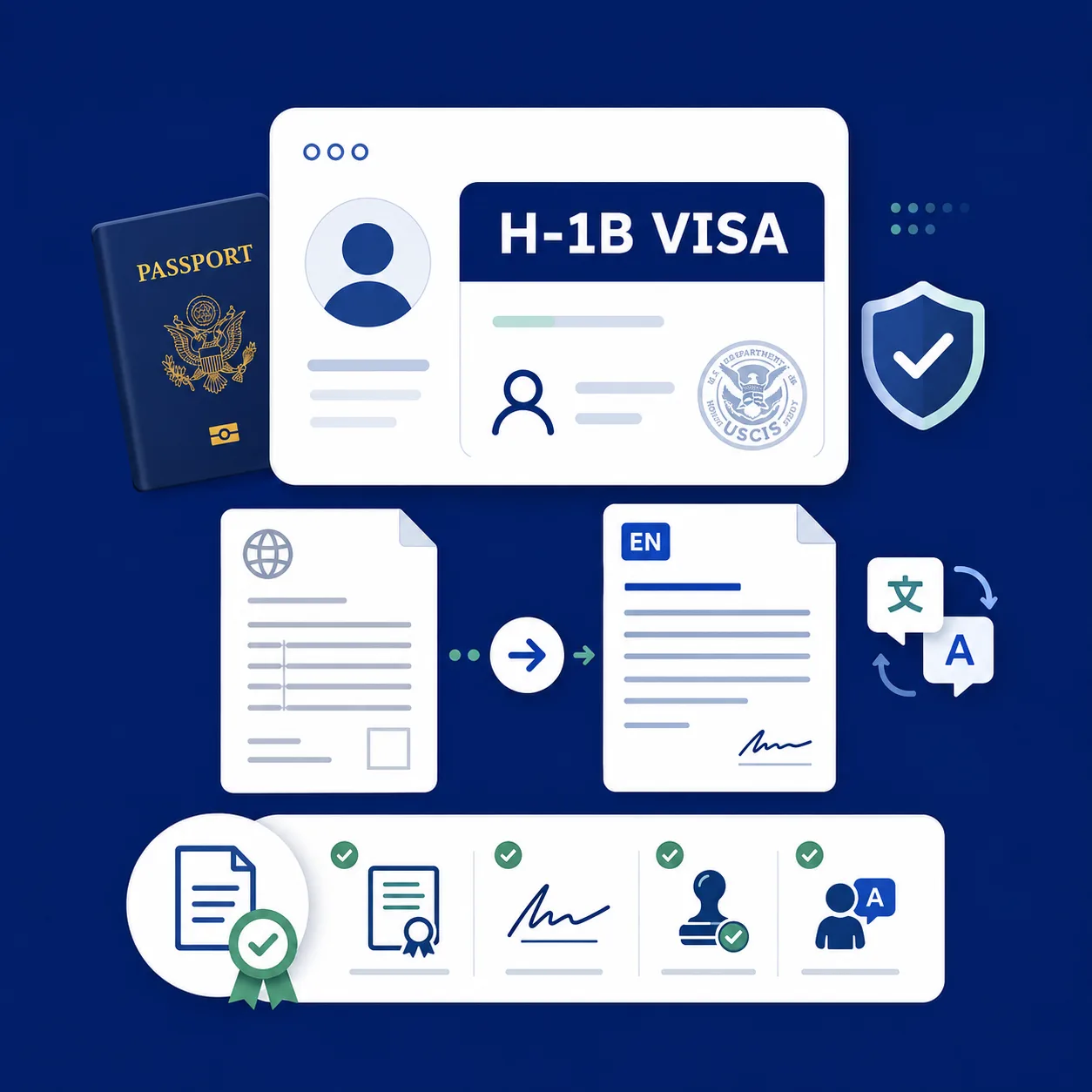
- Certified translation is essential in the H-1B visa process when educational, employment, civil, or identification documents are not fully in English.
- USCIS requires every foreign-language document to be translated completely and accurately, with a signed certification statement from the translator.
- A certified translation is different from a notarized translation; USCIS generally requires certification, while notarization may be needed for certain consulates or credential evaluation agencies.
- H-1B applicants often need certified translations for diplomas, transcripts, employment letters, contracts, pay records, birth certificates, marriage certificates, and dependent documents.
- Educational documents may require both certified translation and academic credential evaluation to show the U.S. equivalency of a foreign degree.
- Every seal, stamp, watermark, fine print, and visible text must be translated or clearly represented to avoid USCIS concerns.
- Common translation-related RFE risks include missing certification statements, incomplete translations, poor formatting, unclear scans, and translations prepared by biased or non-professional parties.
- Applicants should prepare translations early, confirm name spellings against the passport, provide context for technical terminology, and keep both digital and physical copies of certified translations.
Navigating the U.S. immigration system can often feel like trying to solve a complex puzzle where half the pieces are printed in a different language—literally. If you have been selected in the annual lottery or are actively preparing your petition, you already know that the stakes are incredibly high. The H-1B program allows U.S. employers to hire highly skilled foreign professionals for specialized roles, but proving your eligibility requires a mountain of precise, flawlessly prepared paperwork.
For many applicants, a significant portion of this vital paperwork originates from their home country and is not in English. Bridging the gap between your foreign credentials and strict U.S. government standards is critical. This comprehensive H1-B Visa Guide and Certified Translation during the visa process will walk you through exactly what you need to know. From understanding USCIS guidelines to securing the right professionals for your paperwork, this guide is designed to help you avoid delays, denials, and unnecessary stress.
Understanding the H-1B Visa and the Role of Documentation
The H-1B visa is reserved for individuals in a "specialty occupation." This means the job requires both theoretical and practical application of a body of highly specialized knowledge, typically requiring at least a bachelor’s degree or its equivalent.
Because the burden of proof falls entirely on you and your petitioning employer, the documents you submit are the only way U.S. Citizenship and Immigration Services (USCIS) can verify your qualifications. If you are seeking h1b visa help or general immigration document help, the very first piece of advice any seasoned immigration attorney will give you is this: Your paperwork must be perfect, and any foreign language documents must be translated accurately.
The Core H1B Visa Application Document Checklist
Before we dive into the nuances of translation, it is essential to know what documents you are actually required to submit. While your immigration lawyer or employer will provide a tailored list, a standard H1B visa application document checklist typically includes:
Proof of Education: University degrees, diplomas, and full academic transcripts.
Proof of Experience: Letters of recommendation from previous employers, employment contracts, and pay stubs.
Identification and Travel Documents: Your current passport, previous U.S. visas, and identification cards.
Dependent Information: If bringing a spouse or children, you will need civil documents to prove your relationship.
When preparing your specialty occupation document checklist, take a close look at the origin of these papers. If a single word on any of these crucial documents—including seals, stamps, or watermarks—is in a language other than English, it must undergo professional visa document translation.
USCIS Requirements for Document Translation
One of the most frequently asked questions by applicants is: "Do I need a certified translation for USCIS?"
The short answer is an absolute yes. According to the Code of Federal Regulations (8 CFR 103.2(b)(3)), any document containing a foreign language submitted to USCIS must be accompanied by a full English translation. Moreover, the translator must certify that the translation is complete and accurate, and that they are competent to translate from the foreign language into English.
Understanding USCIS requirements for document translation is vital to ensuring your petition is accepted without delays. The government does not accept rough summaries, partial translations, or auto-generated texts from digital translation tools. Every single element of the document must be visually represented and translated in the English version.
What is a Certified Translation?
A certified translation is not simply a high-quality translation; it is a specific legal format. When you obtain a certified translation for h1-b visa processing, the translated document comes bound with a signed statement from the translator or the translation agency.
This statement is known as an accuracy certificate for immigration documents. It formally attests to the following facts:
The translation is a true, accurate, and complete rendering of the original document.
The translator is fully fluent and competent in both English and the original foreign language.
The date of the translation, along with the translator's name, signature, and contact information.
To meet USCIS translation certification requirements, this letter of accuracy must be attached to the translated document. Without it, the translation is legally meaningless to an immigration officer.
Certified Translation vs Notarized Translation for Visas
Applicants often get confused by the terminology and wonder about a certified translation vs notarized translation for visas.
Certified Translation: As explained above, this involves a signed statement affirming the accuracy and completeness of the translation. USCIS strictly requires certified translations.
Notarized Translation: This involves the translator signing the certification of accuracy in front of a Notary Public. The notary then stamps the document, verifying the identity of the person signing it, not the accuracy of the translation itself.
While USCIS generally only requires the translation to be certified, some specific U.S. consulates abroad or certain academic evaluation agencies may require notarized translations. It is highly recommended to use a professional service that provides both, ensuring your documents are accepted by any evaluating body.
Who Can Translate Documents for USCIS?
Another common question is who can translate documents for USCIS. Technically, the USCIS guidelines state that anyone who is competent in both languages can perform the translation.
However, in practice, translating your own documents or having a family member do it is highly discouraged. Immigration officers look for objectivity and professional formatting. Self-translations are viewed with heavy scrutiny due to the inherent conflict of interest. To protect your investment in the H-1B process, it is always best to use a professional agency specializing in h1-b visa translation.
Deep Dive: Documents That Require Professional Translation
Let’s break down exactly which documents usually require translation and why they are so critical to the success of your petition.
Educational Credentials
Proving that you have the equivalent of a U.S. bachelor's degree in your specialized field is the cornerstone of the H-1B visa. If you graduated from a university outside the United States, you will need to utilize foreign diploma translation services for visa application purposes.
This process actually involves two distinct steps:
Translation: First, your foreign-language diploma, degree certificate, and transcripts (including course descriptions, if requested) must be translated into English via a certified translation.
Evaluation: Second, you must submit the original foreign documents alongside the certified English translations to an independent credential evaluator. This process, known as an academic credential evaluation for H1B, assesses your foreign education and determines its exact U.S. equivalent. Credential evaluators will not process your files if the translations do not meet professional standards.
Professional Experience Records
Sometimes, a degree alone isn't enough, or your degree might be in a slightly different field than your job. In these cases, you must prove your expertise through your work history. Translating non-English employment records is critical here.
You may need to provide letters of experience from past managers, previous employment contracts, promotion letters, or tax documents. Because these letters establish your specialized skills, the nuanced industry terminology must be translated accurately to align perfectly with the U.S. job duties outlined in your Labor Condition Application (LCA).
Identification and Travel Papers
While a passport is inherently an international document, older passports, specific stamps, or internal identification cards (like a national ID or foreign driver's license used for background checks) might only feature the local language. Passport translation is sometimes necessary if you have entry/exit stamps in Arabic, Cyrillic, or Asian characters that USCIS needs to review to establish your physical presence or legal status over time.
Civil Documents for Dependents (H-4 Visas)
If you are married or have children, they will likely accompany you to the United States on an H-4 dependent visa. Their eligibility is directly tied to proving their legal relationship to you.
Translating foreign birth certificate for H1B dependents is mandatory to prove the parent-child relationship. The translation must include all seals, registration numbers, and the names of both parents exactly as they appear on the original.
Translating marriage certificate for H1B dependents is required for your spouse. It is important to note that religious marriage documents (such as a Hindu marriage certificate or an Islamic Nikah Nama) must often be accompanied by the official government registration of that marriage, and both must be translated.
Avoiding the Dreaded RFE (Request for Evidence)
An RFE (Request for Evidence) is a notice from USCIS stating that your application does not contain enough evidence to make a decision. Receiving an RFE extends the processing time of your visa significantly and increases the risk of an eventual denial.
A large number of RFEs are triggered by completely preventable documentation errors. Understanding the common RFE reasons for document translation can save you months of anxiety:
Missing Certification Statement: Submitting a translated document without the signed accuracy certificate for immigration documents is an automatic RFE.
Incomplete Translations: If a translator decides to skip translating the fine print, the background text, or the official government seals on a university transcript, USCIS will reject it. Every visible word must be translated.
Unprofessional Formatting: If the translation is jumbled, hand-written, or impossible to compare side-by-side with the original document, the reviewing officer will likely request a new version.
Suspicion of Bias: As mentioned earlier, submitting a translation done by yourself, your spouse, or a close friend can prompt USCIS to issue an RFE requesting an independent, professional translation.
By relying on seasoned professionals who understand the intricate details of h1-b visa translation, you effectively eliminate these risks from your application.
Planning Your Timeline: How Long Does It Take?
The H-1B timeline is notoriously strict. The initial registration occurs in March, selections are announced shortly after, and if selected, you only have a 90-day window (typically April 1 to June 30) to file the complete petition.
You must factor the certified translation processing time for visas into your overall schedule. Waiting until the last week of June to realize your transcripts are in Spanish, Mandarin, or Hindi can derail your entire application.
Standard processing times for certified translations generally range from 24 to 72 hours, depending on the length and complexity of the document. However, highly technical documents—such as complex academic transcripts or detailed employment letters—might take slightly longer to ensure the terminology perfectly reflects your specialty occupation. When coordinating with your employer and legal counsel, secure your translations as soon as you have your core documents in hand. Early preparation is the best strategy.
Actionable Tips for a Smooth Translation Process
To summarize the best practices for handling your H-1B documentation, keep these actionable tips in mind:
Scan Clearly: Before sending documents to a translation service, ensure you have high-resolution, full-color scans. Blurry documents lead to guesswork, and guesswork leads to inaccurate translations and potential RFEs.
Provide Context: If your employment letters contain highly specific technical jargon related to your specialty occupation, provide a glossary or explain the context to your translator.
Check Name Spellings: Ensure that the English spelling of your name on translated documents matches your passport exactly. If a foreign birth certificate translates your name slightly differently, it can cause identity discrepancies.
Keep Digital and Physical Copies: Professional translation services will provide a digital PDF of the certified translation (which is perfect for the standard digital filing with USCIS) and can mail you physical, wet-ink signed copies for your own records or for your consulate interview.
Conclusion
Securing an H-1B visa is a monumental career milestone, representing months of hard work, planning, and anticipation. Do not let a simple language barrier stand between you and your professional aspirations in the United States.
By familiarizing yourself with the H1-B Visa Guide and Certified Translation during the visa process, you are taking a proactive step toward a successful petition. Whether you are dealing with complex academic records, gathering letters to prove your expertise, or ensuring your family can join you via H-4 visas, the quality of your documentation matters immensely.
Invest in professional, USCIS-compliant translation services, meticulously review your document checklists, and work closely with your immigration counsel. By meeting and exceeding USCIS requirements for document translation, you clear the path for a smooth, efficient, and ultimately successful H-1B visa journey.