Key Takeaways
- For an I-824 follow-to-join request, the documents that need certified English translation are mainly the marriage certificate, the birth certificates of children, and any divorce or death record.
- USCIS requires a full English translation of every foreign-language document, certified by the translator as complete and accurate and as competent to translate from that language into English.
- USCIS keeps no list of approved translators or translation companies, so a certified translation means one that carries the certification USCIS asks for, not an endorsement.
- The date on the translated marriage certificate has to match the source exactly, because a spouse can follow to join only when the marriage existed at the principal's admission or adjustment.
- Complete translation covers headings, field labels, stamps, seals, signatures, handwritten entries, marginal notes, and the back of the page, and unreadable parts are marked as illegible.
- The Department of State's Reciprocity Schedule shows which version of a civil document a country issues and accepts, so applicants should check it before ordering a translation.
- When a primary record is unavailable, the applicant shows it is unavailable and submits secondary evidence, and each foreign-language piece of that evidence also needs its own certified translation.
- The NVC and the consulate require certified translations of civil documents not in English, with a signed translator statement, but the official-language exception does not apply once the case is with USCIS.
- Police certificates and medical or vaccination records usually come up only at the consular stage and are translated when the NVC or the consulate asks for them.
- A certified translation made for the I-824 can be used again at the consulate when the source document has not changed, which avoids differences in name spelling and dates.
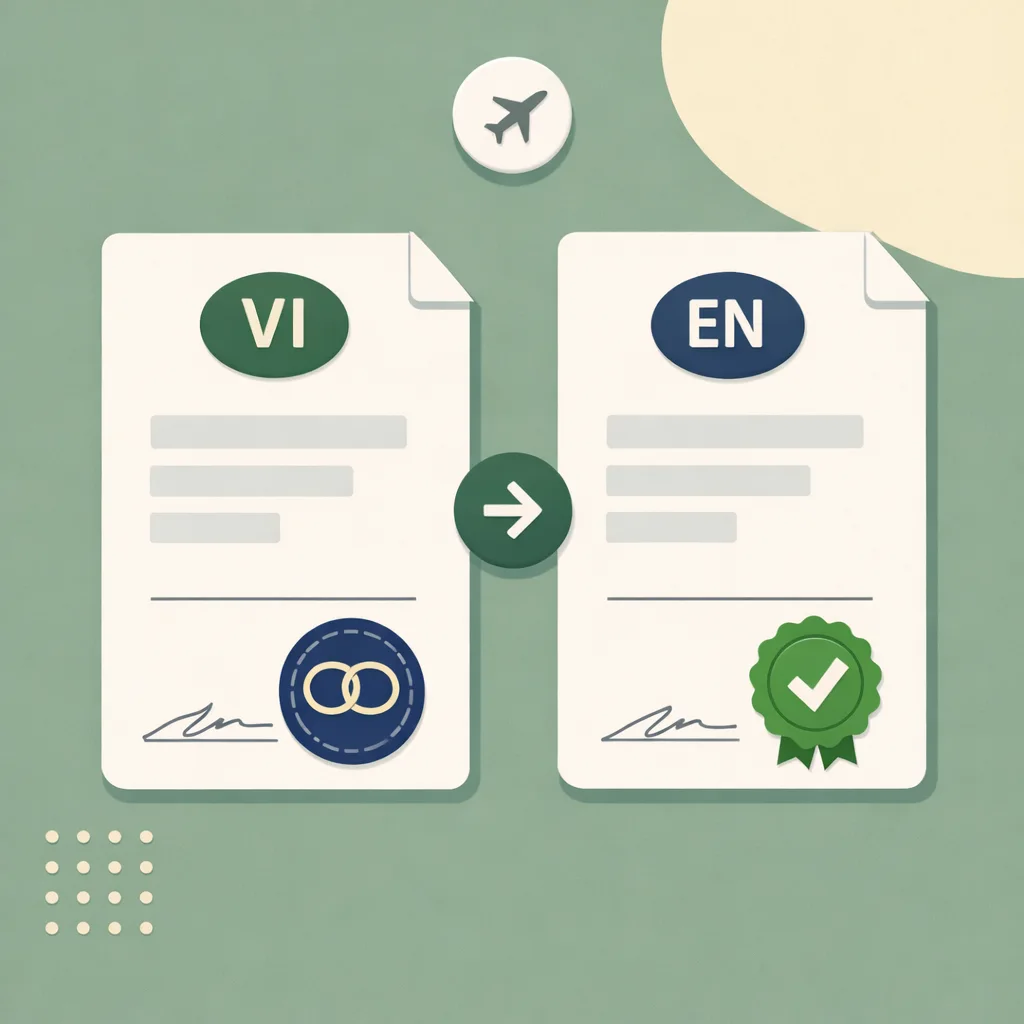
For a Form I-824 follow-to-join request, the documents that need a certified English translation are the ones that prove the family relationship: the marriage certificate for a spouse and the birth certificate for each child. Documents that only come up later, such as police certificates and medical records, are translated when the National Visa Center (NVC) or the consulate asks for them. All of it goes through one certified document translation for USCIS process, so the same translated pages can be used at both stages.
Form I-824, Application for Action on an Approved Application or Petition, is the form used to ask USCIS to notify a consulate that a spouse or child abroad can follow the principal applicant who already adjusted status in the United States. The relatives abroad then continue with the NVC and the consulate. The USCIS page for Form I-824 lists the filing instructions, and the attorney or accredited representative decides what goes into each package.
Form I-824 follow-to-join: which documents are translated
USCIS requires that any document in a foreign language be filed with a full English translation, and that the translator certify the translation as complete and accurate and state that the translator is competent to translate from that language into English. For an I-824, the foreign-language documents are usually the records that connect the derivative to the principal applicant. They are the marriage certificate, the birth certificates of the children, and, where a prior marriage ended, the divorce or death record.
USCIS does not keep a list of approved translators or translation companies. A certified translation for USCIS is a translation that carries the certification USCIS asks for: the translator's typed name, signature, date, and contact information, a statement of competence in both languages, a statement that the translation is complete and accurate, and a line that identifies the document translated. A separate certification for each document is the safer practice.
Marriage certificate translation and the date of the marriage
The marriage certificate is the document an officer reads for the date. A spouse can follow to join only when the marriage existed at the time the principal was admitted or adjusted, so the day, month, and year on the translated certificate have to match the source exactly. A Vietnamese marriage certificate, for example, may carry the date in several places, including the registration entry and the issue date, and each one is translated as written. A Vietnamese marriage certificate translation also has to spell both spouses' names the way they appear in the passports, since the case file is compared name by name.
The translation covers everything on the page: headings, field labels, stamps, seals, signatures described as "[signature]", handwritten entries, marginal notes, and the back of the page if it carries anything. Parts that cannot be read are marked "[illegible]" rather than guessed. Dates stay in the order the translator reads them in the source and are written out in a form a US officer cannot misread.
Birth certificates for children who follow to join
Each child who will follow needs a birth certificate that names the principal applicant as a parent. The Department of State's Visa Reciprocity and Civil Documents by Country schedule says which version a country issues and which one is acceptable, for example a long-form record instead of an abridged extract. Applicants should look at the schedule before ordering a translation, because translating the wrong version spends the fee on a document the consulate will not accept.
For Vietnam, the full giấy khai sinh is the birth certificate, and a trích lục is an extract of it. A certified birth certificate translation is made from whichever version the schedule accepts, and when a family holds both, the translation company should translate each one separately and label them as two documents.
Divorce records, passports and other relationship documents
When either spouse was married before, the file needs proof that the earlier marriage ended. A divorce certificate translation follows the same completeness rule as every other record: the court's name, the case number, the seals, and any handwritten annotation are all part of the translation. If the earlier marriage ended by death, the death certificate is handled the same way.
Passports are translated when the identity pages or visa stamps are in a language other than English, and the translator describes the stamps rather than leaving them out. If a primary record is unavailable, the applicant shows that it is unavailable, for instance with a written statement from the issuing authority, and then submits secondary evidence such as school or church records. Each foreign-language piece of secondary evidence needs its own certified translation.
What the NVC and the consulate add afterward
Once the case is with the NVC, civil documents that are not in English, or not in the official language of the country where the applicant applies, must have certified translations. Each translation carries a statement signed by the translator that it is accurate and that the translator is competent to translate. Applicants upload scans to the CEAC portal and bring originals or certified copies to the interview. The official-language exception belongs to the NVC and consulates only. The comparison in the article on NVC translation requirements compared with USCIS rules covers the differences in detail.
At this stage the file grows. A police certificate translation is needed when the consulate asks for a police certificate in a foreign language, and any medical or vaccination record in another language needs an English version before the physician can read it. The consulate sets its own list of requirements, so the family should follow the instructions the NVC and the consulate send for the specific case.
One certified translation for both stages
The marriage and birth records that went to USCIS with the I-824 are the same records the consulate asks for later. A translation that was complete and certified for the first stage can be used at the second, as long as the source document and the content have not changed. Ordering a new translation for each stage invites small differences in name spelling and dates, and an officer who sees two versions of one record will compare them.
Machine translation alone carries no human certification and mishandles names, dates, abbreviations, and legal terms, so it does not meet the requirement at either stage. When a translation is missing, incomplete, or uncertified, USCIS may issue a Request for Evidence or a Notice of Intent to Deny, and it may also deny a filing without first issuing an RFE where the initial evidence is insufficient.
Before ordering, the family should gather every page of each record, including the reverse side, and check each name and date against the passports. Texliff prepares each certified translation from the full source pages, and the marriage certificate translation page describes how that document is handled.