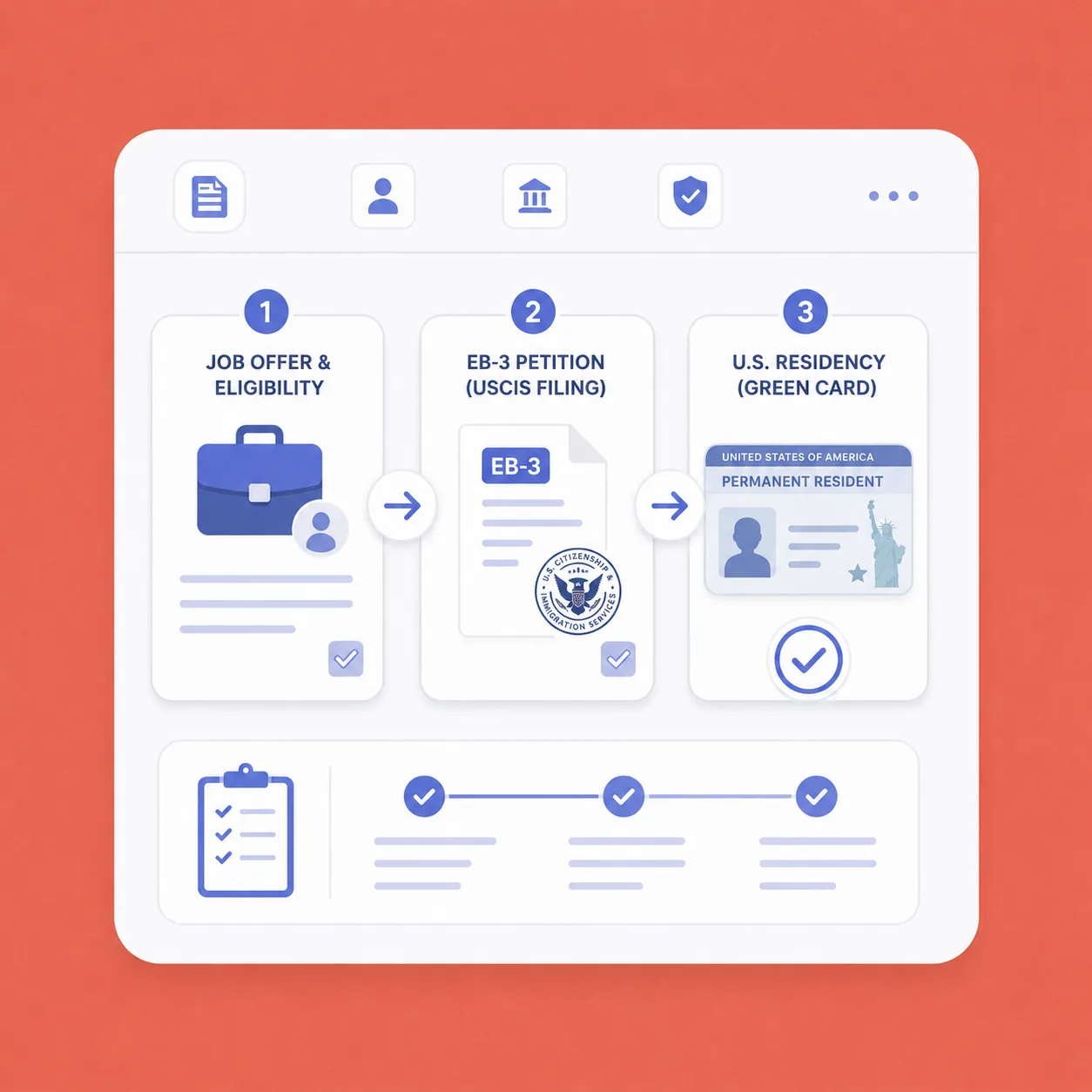
Key Takeaways
- The EB3 visa is an employment-based green card pathway for professionals, skilled workers, and certain unskilled workers with permanent job offers from U.S. employers.
- EB3 sponsorship is employer-driven, meaning the U.S. employer must handle key steps such as the PERM labor certification and Form I-140 filing.
- The EB3 category is broader than EB2 because it can apply to applicants with a bachelor’s degree, at least two years of experience or training, or qualifying unskilled labor roles.
- Most EB3 cases begin with PERM labor certification, where the employer must show that no qualified, willing, and available U.S. workers are available for the position.
- The PERM process includes a prevailing wage determination, mandatory recruitment, job postings, and filing ETA Form 9089 with the Department of Labor.
- After PERM approval, the employer files Form I-140 to prove the applicant’s qualifications and the employer’s ability to pay the required wage.
- The applicant’s priority date usually comes from the PERM filing date and determines their place in the employment-based green card line.
- The Visa Bulletin must be checked regularly because the applicant can move forward only when their priority date becomes current.
- The final green card step depends on location: applicants inside the United States may file Form I-485, while applicants abroad go through consular processing.
- Foreign-language documents such as diplomas, birth certificates, marriage certificates, police clearances, and employment records must include certified English translations.
- Poor translations, missing certificates of accuracy, untranslated stamps or seals, and self-translated documents can lead to RFEs or delays.
- The EB3 process can take several years, especially for applicants from backlogged countries, so maintaining valid nonimmigrant status during the wait is often important.
If you are exploring how to get a green card through employment in the United States, you have likely encountered a sea of complex immigration jargon. For many foreign nationals—whether they are currently working in the US on a temporary visa or applying from their home country—the EB3 visa represents a highly sought-after, reliable pathway to permanent residency.
Unlike family-based immigration, which requires a relative to file an I-130 petition on your behalf, employment-based immigration relies on the sponsorship of a US employer. The EB-3 (Employment-Based Third Preference) visa is specifically designed for skilled workers, professionals, and unskilled workers. However, the journey from receiving a job offer to holding a physical green card in your hand is multi-layered.
This comprehensive guide will break down the EB3 visa process into clear, manageable steps, providing you with actionable insights to navigate your immigration journey with confidence.
What is the EB3 Visa? Understanding the Categories
Before diving into the steps, it is essential to understand employment-based third preference eligibility. The EB-3 visa is divided into three distinct subcategories, each with its own specific criteria:
Professionals: This category requires the applicant to hold a US bachelor’s degree or a foreign equivalent that is normally required for the profession.
Skilled Workers: The minimum education requirements for skilled workers are less rigid regarding a bachelor's degree; however, applicants must demonstrate at least two years of job experience or specialized training.
Unskilled Workers (Other Workers): The unskilled worker sponsorship requirements apply to individuals taking on non-seasonal, permanent jobs that require less than two years of training or experience. Examples include specific roles in food service, agriculture, or manufacturing.
EB2 vs. EB3: What is the Difference?
A common question among applicants involves the difference between second and third preference visas. The EB-2 visa is reserved for individuals with advanced degrees (Master’s or higher) or exceptional ability in the arts, sciences, or business. The EB-3 visa is broader and generally more accessible since it only requires a bachelor's degree, two years of experience, or even unskilled labor qualifications. However, because it is more accessible, the EB-3 category historically experiences longer wait times.
Step 1: The PERM Labor Certification Process
The PERM labor certification process is the foundational step of the EB-3 journey. Before an employer can sponsor a foreign worker, they must prove to the US Department of Labor (DOL) that there are no qualified, willing, and available US workers for the position.
Prevailing Wage Determination
The PERM process begins with a prevailing wage determination for sponsors. The employer submits a request to the DOL to find out the minimum wage they must legally pay the foreign worker based on the job's location and requirements. This prevents employers from undercutting US workers' wages by hiring cheaper foreign labor.
The Recruitment Phase
Once the prevailing wage is issued, the employer must conduct a rigorous recruitment process for labor certification. This typically involves:
Placing two Sunday newspaper advertisements.
Posting the job order with the State Workforce Agency for 30 days.
Displaying an internal notice of filing at the job site.
Conducting three additional recruitment steps for professional positions (e.g., job fairs, employer's website, radio ads).
If no qualified US workers apply, the employer can formally file the ETA Form 9089 (the PERM application) with the DOL.
Actionable Tip: The PERM process is strictly employer-driven. As an employee, you cannot pay for the costs associated with PERM. Ensure your employer works with an experienced immigration attorney to avoid costly audit delays.
Step 2: Filing Form I-140
Once the DOL approves the PERM labor certification, the process moves to US Citizenship and Immigration Services (USCIS). Your employer will file the Form I-140 Immigrant Petition for Alien Workers.
This form serves two primary purposes:
Verification of Qualifications: It proves that you, the applicant, meet the specific job requirements outlined in the PERM certification (such as your degree or prior work experience).
Ability to Pay: The employer must provide financial documentation (like tax returns or audited financial statements) to prove they can afford to pay you the prevailing wage.
Employers have the option to pay an additional fee for Premium Processing on the I-140, which guarantees a response from USCIS within 15 calendar days.
Step 3: Navigating Priority Dates and The Visa Bulletin
Filing the I-140 does not immediately grant you a green card. Because Congress limits the number of employment-based green cards issued each year, a queue forms. Your place in this queue is determined by your "Priority Date," which is the date your employer initially filed the PERM application.
The Visa Bulletin Explained
To know when you can actually apply for the green card, you must monitor the Department of State visa bulletin final action dates, which is published monthly. You must compare your Priority Date to the current priority dates for employment immigrant categories listed in the bulletin.
Understanding the Backlog
Your wait time depends heavily on your country of birth. Due to per-country limits, there is often a significant backlog for category three green cards for individuals born in countries with high immigration volumes, such as India and China. If your priority date is "current" (meaning it is earlier than the date listed in the bulletin), you can move to the final step.
Step 4: The Final Green Card Application
When your priority date becomes current, you reach the final stage. The path you take depends on your physical location, highlighting the choice of adjustment of status versus consular processing.
Adjustment of Status (Form I-485)
If you are already inside the United States on a valid non-immigrant visa, you will file Form I-485 to adjust your status to a permanent resident. This is incredibly common for foreign professionals mapping out their path from H-1B to permanent residency.
Benefits: You can remain in the US while the application is pending, and you can apply for an Employment Authorization Document (EAD) and Advance Parole (travel document) simultaneously.
Consular Processing
If you are living outside the US, you will go through Consular Processing. Your case will be transferred to the National Visa Center (NVC), and you will eventually attend an in-person interview at the US Embassy or Consulate in your home country. Once approved, you enter the US as a permanent resident.
Crucial Administrative Steps: Document Translation
A major, yet often overlooked, hurdle in the EB3 visa process is document preparation. USCIS and the Department of State are exceptionally strict about the formatting and language of civil and educational documents.
If any of your required documents—such as a foreign university degree, birth certificate, marriage certificate, or police clearance—are not in English, you must get a professional service to translate documents before submission. USCIS requires certified translations, meaning the translator must certify in writing that the translation is accurate and that they are competent to translate.
Why Quality Translations Matter
When you are translating documents for immigration purposes, cutting corners can lead to a dreaded Request for Evidence (RFE) or outright denial. You should never translate your own documents or rely on bilingual family members. Instead, utilizing a professional translation service is essential.
For instance, dealing with specific dialects or character sets requires linguistic expertise. If your documents are from China or Taiwan, ensuring localized accuracy in Mandarin for Mandarin-speaking officers who might review regional nuances is critical. Fortunately, using a reputable online translation service makes this easier than ever. These platforms allow you to securely upload your foreign documents and receive USCIS-certified translations quickly, ensuring that every stamp, seal, and signature is accurately interpreted and formatted to government standards.
Actionable Tip: Always request a "Certificate of Translation Accuracy" when hiring an agency to translate your civil and educational documents for your I-140 or I-485 filings.
Timeline and Expectations
Understanding the employer-sponsored permanent residency timeline requires patience. While every case is unique, here is a general breakdown:
Prevailing Wage Determination: 5 to 7 months.
PERM Recruitment & Filing: 3 to 4 months for recruitment, plus 8 to 12 months for DOL processing (longer if audited).
Form I-140 Processing: 15 days (with Premium Processing) to 6+ months (standard processing).
Visa Bulletin Wait Time: Varies drastically from current (0 days) to several years based on country of birth.
Adjustment of Status / Consular Processing: 8 to 14 months.
In a best-case scenario (with no visa backlog), the entire process takes about 2 to 3 years. For heavily backlogged countries, it can take significantly longer, underscoring the importance of maintaining underlying non-immigrant status (like an H-1B or O-1) while waiting.
Conclusion
Securing an EB3 visa is a life-changing milestone that offers permanent stability in the United States. While the process—from the initial PERM labor certification to interpreting the Visa Bulletin and filing the final application—is undeniably complex, breaking it down into these four distinct steps makes it much more manageable.
By ensuring your employer understands the prevailing wage and recruitment rules, diligently tracking your priority dates, and partnering with a professional translation service to ensure your foreign documents meet strict USCIS standards, you can avoid unnecessary delays. With careful preparation and the right legal guidance, your path to a US green card is entirely within reach.