Key Takeaways
- Form I-130 is the first step in the family-based green card process and is used to prove a qualifying relationship between a U.S. citizen or lawful permanent resident and a foreign relative.
- The petitioner is the U.S. citizen or green card holder filing the petition, while the beneficiary is the foreign family member seeking permanent residence.
- U.S. citizens can sponsor more family categories than lawful permanent residents, including parents, married children, and siblings when eligibility rules are met.
- Immediate relatives of U.S. citizens do not have to wait for a visa number, while family preference categories are subject to annual limits and Visa Bulletin backlogs.
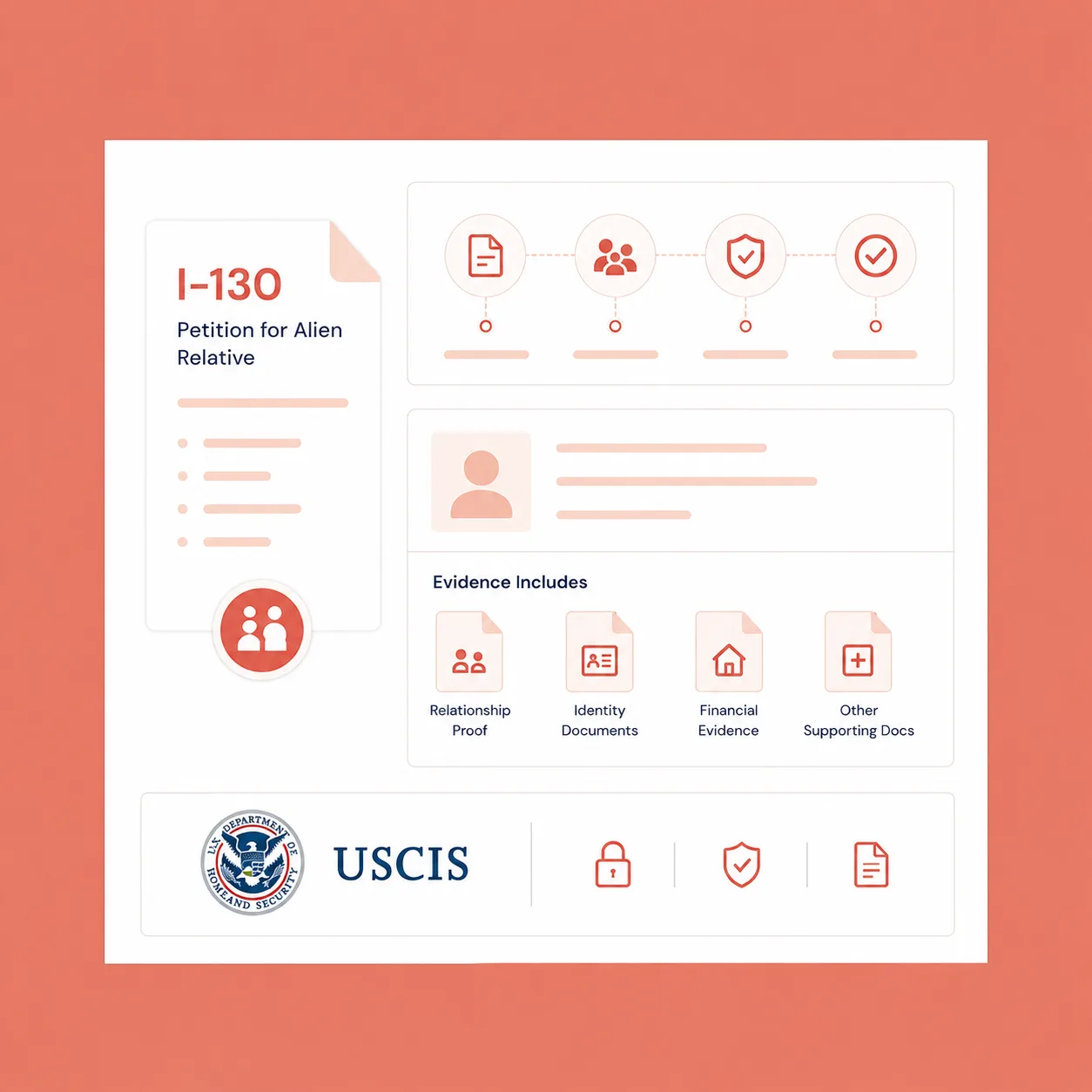
- A strong I-130 filing must include proof of the petitioner’s status, proof of the family relationship, legal name change documents when applicable, and certified translations for any foreign-language records.
- Spousal petitions require more than a marriage certificate; applicants must provide evidence of a bona fide marriage, such as joint finances, shared residence, insurance records, photos, communication records, and affidavits.
- Any non-English document submitted with Form I-130 must include a certified English translation confirming that the translation is complete and accurate.
- Filing can be completed online or by mail, but applicants must use the latest USCIS form edition, pay the correct fee, and submit the petition to the correct location.
- Processing times vary depending on the relationship category, USCIS service center, case completeness, and whether the beneficiary is an immediate relative or in a family preference category.
- After I-130 approval, the next step depends on where the beneficiary is located: adjustment of status for eligible applicants inside the United States or consular processing for applicants abroad.
- For consular processing, the case moves to the National Visa Center, where the applicant submits fees, Form DS-260, civil documents, and financial sponsorship evidence.
- Common I-130 problems include insufficient relationship evidence, missing certified translations, incorrect eligibility assumptions, outdated forms, wrong fees, failure to respond to RFEs, and fraud or misrepresentation.
Navigating the U.S. immigration system can feel like learning a completely new language, especially when your ultimate goal is reuniting with your loved ones. If you are looking to bring a family member to live in the United States permanently, your journey will almost certainly begin with USCIS Form I-130, officially known as the Petition for Alien Relative.
This foundational immigration form is the indispensable starting point for the family-based green card process. Whether you are bringing your spouse, your children, or your parents across borders, this form establishes the qualifying family relationship between you and your relative.
However, dealing with government paperwork is rarely simple. From gathering the right evidence to understanding processing times and navigating government portals, the process requires patience, precision, and a solid strategy. This comprehensive step-by-step guide will break down everything you need to know about family sponsorship, ensuring your application is as strong as possible from the day you submit it.
Understanding the Basics: Terminology and Concepts
Before you start filling out any paperwork, it is vital to understand the language used by United States Citizenship and Immigration Services (USCIS). A frequent point of confusion for many families at the start of their journey is the difference between petitioner and beneficiary.
The Petitioner: This is the U.S. citizen or Lawful Permanent Resident (green card holder) who currently lives in the U.S. and is filing the petition for relative. The petitioner is the sponsor.
The Beneficiary: This is the foreign national family member who currently lacks permanent U.S. residency and wishes to obtain a green card.
The purpose of USCIS Form I-130 is strictly to prove that a valid, legally recognized relationship exists between the petitioner and the beneficiary. Approving this form does not grant a green card by itself; it merely confirms that the beneficiary is legally eligible to apply for one based on their relationship with the petitioner.
Who Can File? Eligibility for Family-Based Immigration
When it comes to family sponsorship, the rules are strict regarding who can sponsor whom. Understanding exactly who can sponsor a relative for permanent residency will save you from spending time and money on an invalid application.
Eligibility for family-based immigration is primarily dictated by the petitioner's legal status in the United States.
U.S. Citizens Can Sponsor:
Their spouse
Unmarried children under the age of 21
Unmarried sons and daughters aged 21 or older
Married sons and daughters of any age
Parents (if the U.S. citizen is at least 21 years old)
Brothers and sisters (if the U.S. citizen is at least 21 years old)
Lawful Permanent Residents (Green Card Holders) Can Sponsor:
Their spouse
Unmarried children under the age of 21
Unmarried sons and daughters aged 21 or older
Note that Lawful Permanent Residents cannot sponsor married children, parents, or siblings. If a permanent resident naturalizes and becomes a U.S. citizen while an I-130 petition is pending, the beneficiary's preference category will automatically upgrade, which can significantly speed up the process.
Immediate Relative vs. Family Preference Categories
The U.S. immigration system organizes family members into different tiers. Knowing whether your relative falls into the "Immediate Relative" category or a "Family Preference" category is critical, as this distinction dictates your family-based green card processing timeline.
Immediate Relatives
The immediate relative category includes the spouses, unmarried children (under 21), and parents of U.S. citizens.
The major advantage for immediate relatives is that there is no annual cap on the number of immigrant visas (green cards) issued to this group. Therefore, immediate relatives do not have to wait in line for a visa number to become available. Once USCIS approves the I-130, the beneficiary can immediately move forward with the next step of the green card process.
Family Preference Categories
For family members who do not qualify as immediate relatives, Congress has established the family preference categories. Because there is a strict annual limit on the number of visas granted in these categories, demand heavily outpaces supply, creating a waiting list.
The preference categories are structured as follows:
First Preference (F1): Unmarried sons and daughters (21 or older) of U.S. citizens.
Second Preference (F2A): Spouses and unmarried children (under 21) of Lawful Permanent Residents.
Second Preference (F2B): Unmarried sons and daughters (21 or older) of Lawful Permanent Residents.
Third Preference (F3): Married sons and daughters of U.S. citizens.
Fourth Preference (F4): Brothers and sisters of U.S. citizens.
Priority Dates and Visa Bulletin Explained
If your relative is in a family preference category, you will receive a "Priority Date" when USCIS accepts your Form I-130. Think of the priority date as your relative's "ticket number" in the waiting line.
To know when it is your relative's turn to apply for their green card, you must monitor the monthly Visa Bulletin published by the Department of State. To have priority dates and visa bulletin explained simply: the bulletin lists "cutoff dates" for each category. When the cutoff date published in the Visa Bulletin advances past your relative's priority date, their visa number becomes "current," and they can finally apply for their actual green card. Depending on the category and the beneficiary's country of origin, this wait can range from a few years to over two decades.
Form I-130 Requirements: Gathering Your Evidence
Submitting the I-130 form itself is only half the battle; the government requires substantial proof to back up your claims. Meeting all i-130 requirements is vital to avoid delays, Requests for Evidence (RFEs), or outright denials.
When assembling supporting documents for family petitions, you must include primary evidence that establishes the petitioner’s U.S. status and the family relationship.
Core Documents Required for All Petitions
Regardless of the relationship, every I-130 filing must include specific documents:
Proof of Petitioner’s Status: A copy of the petitioner’s U.S. birth certificate, naturalization certificate, unexpired U.S. passport, or Permanent Resident Card (Green Card).
Proof of Name Changes: If either the petitioner or the beneficiary has changed their name (e.g., due to marriage or court order), you must provide the legal name change documents.
Documents Proving the Relationship
The exact evidence required depends on who you are sponsoring:
For Parents: A copy of the petitioner's birth certificate showing the names of both the petitioner and the parent.
For Children: The child’s birth certificate showing the names of the child and the parent(s).
For Siblings: The birth certificates of both the petitioner and the beneficiary, showing at least one common parent.
Handling Foreign Language Documents
Because immigration is inherently global, it is common for birth certificates, marriage certificates, and legal records to be in languages other than English. USCIS mandates that any foreign language document must be accompanied by a certified translation.
A certified translation is not simply a rough translation done by a bilingual friend. The translator must provide a formal declaration stating that they are competent to translate the language into English and that the document translation is accurate and complete to the best of their knowledge. Failing to provide properly translated documents is a leading cause of processing delays.
The Ultimate Challenge: Proving a Bona Fide Marriage for Immigration
If you are filing a petition for a spouse, simply providing a marriage certificate is not enough. USCIS is highly vigilant about marriage fraud. Therefore, the burden of proof is on you to demonstrate that you entered the marriage in good faith, out of genuine affection, and not solely to bypass immigration laws.
Proving a bona fide marriage for immigration is often the most labor-intensive part of the entire I-130 process. You need to assemble a comprehensive portfolio of evidence showing that you and your spouse share a life together.
Strong evidence includes, but is not limited to:
Joint Finances: Joint bank account statements, shared credit card accounts, or joint tax returns. Financial commingling is considered one of the strongest indicators of a genuine marriage.
Shared Property and Cohabitation: A joint lease or mortgage, utility bills in both names, or property deeds showing joint ownership.
Insurance Policies: Health, life, or auto insurance policies showing one spouse as the beneficiary or dependent of the other.
Photographic Evidence: A selection of photographs showing the couple together over time, at various locations, and preferably with family members and friends. (Include dates, locations, and names of people in the photos).
Communication Records: Call logs, text messages, emails, or letters exchanged between the couple, especially if they spent time living apart.
Affidavits: Sworn letters from friends, family members, or religious leaders who can attest to the genuineness of the relationship. These should include the author's contact information and a detailed explanation of how they know the couple.
Actionable Tip: Do not just submit a massive, disorganized stack of papers. Create a cover letter and a table of contents. Organize your evidence using labeled tabs. A neatly compiled packet makes it significantly easier for the USCIS officer to review your case, which can ultimately speed up adjudication.
Step-by-Step Guide to the USCIS Filing Process
Once your evidence is compiled, it is time to execute the uscis filing. Follow these steps meticulously to ensure a smooth submission.
Step 1: Complete Form I-130 (and I-130A if applicable)
You can choose to file online or by mail. If filing by mail, download the most recent version of the form directly from the USCIS website. Never use outdated forms, as USCIS will reject them.
If you are petitioning for a spouse, you must also complete Form I-130A (Supplemental Information for Spouse Beneficiary). This form collects additional background information about the foreign spouse, such as their employment history and addresses for the last five years.
Step 2: Pay the Filing Fees
Before submitting your application, you must verify the current USCIS filing fees for sponsors, as the government periodically updates these costs. Currently, the fee for filing Form I-130 online is slightly cheaper than filing a paper application by mail.
If filing online, you will pay via the Pay.gov portal using a credit card, debit card, or bank withdrawal. If filing by mail, you can pay via money order, personal check, cashier’s check, or by credit card using Form G-1450. Always check the official USCIS fee calculator on their website on the day you file to ensure you are submitting the exact required amount.
Step 3: Submit the Application
If you are filing by mail, you must send your packet to the correct USCIS lockbox facility. The address depends on where the petitioner lives and whether you are filing Form I-130 by itself or concurrently with other forms.
If you file online through a USCIS account, you will simply follow the portal prompts, upload digital copies of your evidence (including every necessary document translation), and submit electronically. Online filing offers the advantage of instant receipt confirmation.
I-130 Processing Time: What to Expect
Once the paperwork is out of your hands, the waiting game begins. Many families anxiously wonder, how long does uscis review form i 130 once it is received?
The i-130 processing time is notoriously unpredictable. It depends on several factors, including:
The immigration category: Petitions for immediate relatives (spouses, parents, minor children of U.S. citizens) are usually processed faster than family preference categories.
The specific USCIS service center: Your case will be routed to a specific service center (e.g., Texas, Nebraska, California, Potomac). Some centers experience higher backlogs than others, causing longer wait times.
The completeness of your application: If USCIS has to issue a Request for Evidence (RFE) because you forgot a signature or failed to provide a certified translation, your processing time will be significantly delayed.
On average, for an immediate relative of a U.S. citizen, the I-130 processing time can range anywhere from 10 to 16 months. For family preference categories, it can take several years just for the I-130 to be approved, separate from the wait for the visa number.
Tracking Your Case
About two to four weeks after filing, you will receive Form I-797C, Notice of Action. This is your official receipt, and it contains a highly important 13-character alphanumeric code.
Knowing how to track case status with receipt number will help preserve your sanity during the long wait. You can enter this receipt number into the "Case Status Online" tool on the USCIS website to see where your petition stands. You can also create a free USCIS online account to receive automatic status updates via email or text message.
Can You Speed Up the Process?
If you are facing a severe emergency, you might wonder if there is a way to jump the line. There is, but the uscis expedite criteria for form i 130 are incredibly strict. USCIS will only consider expediting a case in exceptional circumstances, such as:
Severe financial loss to a company or person.
Urgent humanitarian reasons (e.g., the beneficiary requires urgent medical treatment available only in the U.S., or the petitioner is suffering from a terminal illness).
Compelling U.S. government interests.
Clear USCIS error that has caused an unreasonable delay.
To request an expedite, you must contact the USCIS Contact Center, provide your receipt number, and be prepared to submit overwhelming documentary evidence proving your emergency.
Navigating Mistakes: Troubleshooting Your Petition
We are all human, and mistakes happen. However, in the realm of immigration, mistakes can lead to major setbacks.
Correcting Errors on Submitted Immigration Forms
When it comes to correcting errors on submitted immigration forms, the protocol depends on when you catch the mistake.
If you realize the mistake immediately after filing: You can upload an unsolicited correction letter and the corrected document to your USCIS online portal if you filed online. If you filed by mail, you can call the USCIS Contact Center to notify them.
If the mistake is minor (typographical): The officer may simply correct it during processing or bring it up during an eventual interview.
If USCIS catches a missing document or error: They will issue a Request for Evidence (RFE) or a Notice of Intent to Deny (NOID). You will be given a specific timeframe (usually 30 to 90 days) to submit the missing evidence. Always respond to an RFE promptly and completely.
Why Do Petitions Get Denied?
Understanding the common reasons for immigration petition denial can help you safeguard your own case. Petitions are frequently denied for the following reasons:
Lack of sufficient evidence: Especially in spousal cases where the couple fails to prove a bona fide marriage.
Ineligibility: For example, a permanent resident trying to sponsor a married son.
Failure to respond to an RFE: If you miss the deadline to reply to a Request for Evidence, USCIS will automatically deny the petition.
Fraud or Misrepresentation: Lying on an immigration form or submitting fraudulent documents carries severe penalties, including permanent bans from entering the U.S.
The Approval and Beyond: Next Steps
Getting that long-awaited I-797 Notice of Approval for your I-130 petition is a massive milestone. It is a moment to celebrate—but the journey is not over. The approval of the I-130 simply means USCIS recognizes your family relationship. The next phase is actually securing the green card.
The path you take next depends entirely on where the beneficiary is physically located. This brings us to the crucial difference between adjustment of status vs consular processing.
Adjustment of Status (For Beneficiaries Already in the U.S.)
If the beneficiary is already physically present in the United States on a valid, unexpired visa (such as a student visa, work visa, or tourist visa) and they are an immediate relative, they can undergo "Adjustment of Status."
This involves filing Form I-485 (Application to Register Permanent Residence or Adjust Status). Often, immediate relatives choose to file the I-130 and the I-485 at the exact same time—a process known as concurrent filing. This allows the beneficiary to remain in the U.S. while waiting for their green card and even apply for a work permit and travel authorization in the meantime.
Consular Processing (For Beneficiaries Outside the U.S.)
If the beneficiary lives in their home country, they must go through Consular Processing.
Once the I-130 is approved by USCIS, the case is transferred to the Department of State. Here is where the National Visa Center next steps after approval come into play. The NVC will create a case file and assign an invoice ID number.
You will then be required to log into the Consular Electronic Application Center (CEAC) portal. In this portal, you must:
Pay the immigrant visa application processing fee.
Submit Form DS-260 (Immigrant Visa Electronic Application).
Upload civil documents for the beneficiary (police certificates, passport copies, etc.).
Proving Financial Support
During this final phase, whether you are doing Adjustment of Status or Consular Processing, the petitioner must submit Form I-864, Affidavit of Support.
This form provides the government with evidence of financial support for sponsored immigrants. The U.S. government wants a guarantee that the incoming immigrant will not become a "public charge" (dependent on government welfare). The sponsor must prove that their household income meets or exceeds 125% of the U.S. Federal Poverty Guidelines. If the petitioner’s income is too low, they may need to find a joint sponsor who is willing to take on this legal financial obligation.
Once the NVC accepts all documents and the Affidavit of Support, they will schedule the beneficiary for an in-person interview at the nearest U.S. embassy or consulate in their home country. If the consular officer is satisfied after the interview, the immigrant visa is placed into the beneficiary’s passport, allowing them to travel to the United States and officially become a Lawful Permanent Resident.
Conclusion
Filing USCIS Form I-130 is the vital first step in reuniting your family on American soil. While the process may seem incredibly daunting at first glance—filled with complex requirements, strict deadlines, and a massive amount of paperwork—understanding the fundamental rules sets you up for success.
By familiarizing yourself with the difference between a petitioner and a beneficiary, accurately tracking your priority date, meticulously gathering your evidence (and ensuring you have every required certified translation), and carefully following the uscis filing instructions, you can minimize delays and avoid common pitfalls. The road to permanent residency requires patience and perseverance, but bringing the people you love home makes every step of the journey profoundly worthwhile.