Key Takeaways
- Form I-485 is used by eligible applicants who are already in the United States to apply for a green card through adjustment of status.
- Adjustment of status allows applicants to complete the permanent residence process inside the United States, while consular processing is handled through a U.S. embassy or consulate abroad.
- Applicants must generally show physical presence in the United States, lawful entry, an eligible immigrant petition, and visa availability when required.
- Priority dates and the monthly Visa Bulletin determine when many family-based and employment-based applicants can file Form I-485.
- Concurrent filing may allow eligible applicants to submit the immigrant petition and Form I-485 together when a visa is immediately available.
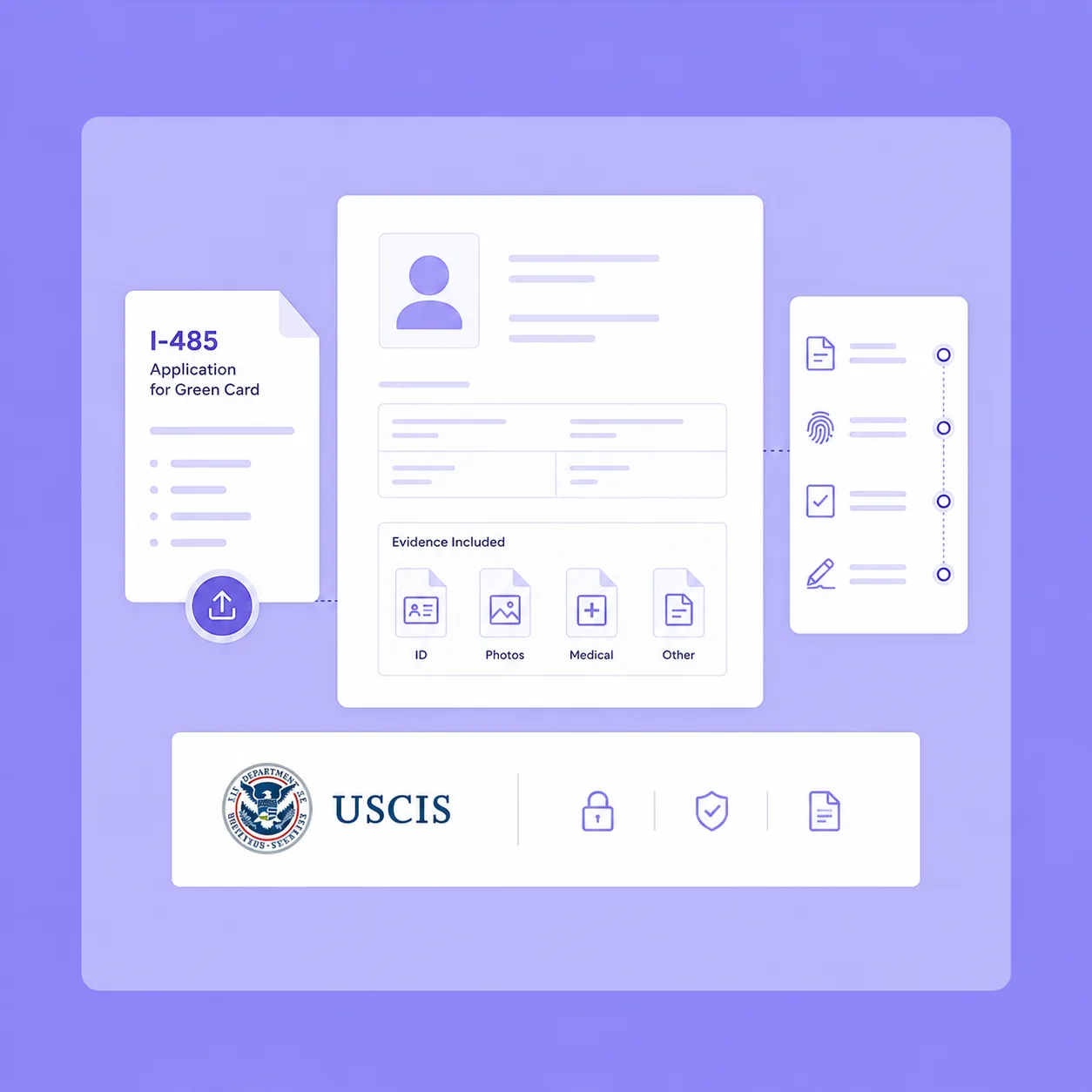
- A complete I-485 packet may include identity documents, proof of lawful entry, immigration status records, birth certificate, marriage or divorce records, court records when applicable, financial sponsorship documents, medical exam records, and certified translations.
- Any non-English document submitted to USCIS must include a full certified English translation, including seals, stamps, signatures, registrar codes, and other visible details.
- The I-693 medical exam must be completed by a USCIS-approved Civil Surgeon and submitted in a sealed envelope.
- Many family-based applicants must submit Form I-864 to show that the sponsor meets the required income level and can support the applicant financially.
- Applicants may apply for work authorization and travel permission while Form I-485 is pending, but leaving the United States without Advance Parole can cause the application to be abandoned in many cases.
- The green card interview is used to verify the information in the application, review eligibility, and assess supporting evidence, especially in marriage-based cases.
- Applicants who need language support at the interview should bring a fluent, neutral interpreter who is not the petitioner or a witness in the case.
- Common denial risks include missed RFE deadlines, ineligibility, criminal history, medical or financial issues, fraud, misrepresentation, incorrect fees, outdated forms, and incomplete documentation.
- Careful preparation, correct USCIS forms, accurate filing fees, certified translations, organized evidence, and close attention to USCIS notices can help reduce delays and strengthen the application.
Navigating the U.S. immigration system can feel like learning a completely new language. Whether you are seeking permanent residency through family sponsorship, an employment opportunity, or humanitarian relief, the journey is filled with paperwork, deadlines, and strict legal requirements. For individuals who are already physically present in the United States, the ultimate step in this immigration journey is filing the USCIS Form I-485 Application for Green Card.
Filing this application is a monumental milestone. It signifies that you are moving from a temporary nonimmigrant status—such as a student, tourist, or temporary worker—to becoming a Lawful Permanent Resident (LPR) of the United States. However, successfully obtaining your green card requires meticulous attention to detail, a thorough understanding of immigration law, and patience.
In this comprehensive guide, we will break down every aspect of the green card application. From understanding eligibility and gathering documentation to preparing for your final interview, this article will serve as your ultimate roadmap for a successful filing.
What is Form I-485?
Officially known as the "Application to Register Permanent Residence or Adjust Status," form I-485 is the primary document used by immigrants inside the United States to apply for a green card. When you submit this document, you are formally asking United States Citizenship and Immigration Services (USCIS) to grant you the right to live and work in the U.S. permanently.
This process is legally referred to as adjustment of status. It is a unique privilege designed to keep families together and allow skilled workers to remain in the U.S. without having to endure the time and expense of traveling back to their home countries to finalize their immigration process.
Understanding the Difference Between Consular Processing and Adjustment of Status
A common area of confusion for many applicants is understanding the difference between consular processing and adjustment of status.
Adjustment of Status (AOS): This path (utilizing the uscis i-485) is strictly for individuals who are physically present in the United States, usually on a valid visa. You process your entire application without leaving the country.
Consular Processing: This path is for individuals who are currently living outside the United States, or for those who are in the U.S. but do not meet the strict adjustment of status eligibility requirements. In this scenario, the applicant applies for an immigrant visa through a U.S. embassy or consulate in their home country. Once the visa is approved, they use it to enter the U.S., becoming a permanent resident upon entry.
If you are eligible for AOS, it is generally the preferred route because it allows you to remain in the U.S., continue working (once you receive authorization), and avoid the potential travel risks associated with leaving the country while an application is pending.
Determining Your Eligibility
Before you spend time and money putting together an i-485 application, you must determine if you are actually allowed to file. The i-485 eligibility rules are strict and unforgiving.
Basic Adjustment of Status Eligibility Requirements
To qualify for an adjustment of status, you generally must meet the following criteria:
Physical Presence: You must be physically present in the United States when the application is filed.
Lawful Entry: With very few exceptions (such as those protected under INA Section 245(i) or certain asylum seekers), you must provide evidence of lawful entry for adjustment of status. This means you were inspected and admitted, or paroled, into the United States by a U.S. Customs and Border Protection (CBP) officer. You will typically prove this by submitting a copy of your Form I-94 arrival/departure record, a passport admission stamp, or a border crossing card.
Continuous Lawful Status: In most categories, such as employment-based petitions, you must have continuously maintained a lawful immigration status since entering the U.S. (Note: Immediate relatives of U.S. citizens—spouses, unmarried children under 21, and parents—are generally forgiven for overstaying their visas or working without authorization, provided their original entry was lawful).
An Approved or Concurrently Filed Immigrant Petition: You must have an underlying basis for your application. This is usually an approved family-based petition (Form I-130), employment-based petition (Form I-140), or humanitarian claim.
The Importance of Priority Date and Visa Bulletin Movement
Just because you have an approved immigrant petition does not mean you can immediately file your uscis form i-485. You can only file if an immigrant visa is currently available to you.
The U.S. government limits the number of green cards issued each year in certain family and employment categories. If demand exceeds supply, a backlog forms. Your place in this line is dictated by your Priority Date (usually the date your sponsor filed the underlying petition on your behalf).
To know when you can file, you must monitor the U.S. Department of State’s monthly Visa Bulletin. Tracking priority date and visa bulletin movement is crucial. The bulletin features two charts: "Dates for Filing" and "Final Action Dates." Each month, USCIS announces on its website which chart applicants must use to determine if they can submit their adjustment of status paperwork. If your priority date is earlier than the date listed in the relevant chart for your category and country of birth, a visa is available, and you may file.
(Pro Tip: Immediate relatives of U.S. citizens do not have to worry about the Visa Bulletin, as visas in this category are always immediately available.)
Setting Up Your Application: The Concurrent Filing Option
In certain situations, you do not have to wait for your underlying immigrant petition to be approved before applying for your green card. This is known as the concurrent filing of I-130 and I-485 (for family cases) or I-140 and I-485 (for employment cases).
Concurrent filing offers a massive advantage: it saves time. By submitting both the petition to establish your relationship (family or employer) and your green card application in the same envelope, USCIS can process your background checks, biometrics, and work permits while simultaneously reviewing the underlying petition.
Who can file concurrently?
Immediate relatives of U.S. citizens.
Family-preference and employment-based applicants if the Visa Bulletin shows that a visa is current and immediately available for their category at the time of filing.
If a visa is not current, you must file the underlying petition first, wait for your priority date to become current, and then file the i-485 application separately.
Comprehensive Document Checklist and Preparation
A successful filing relies heavily on the supporting documents you include. USCIS officers adjudicate thousands of applications; providing a well-organized, thoroughly documented packet makes their job easier and decreases the chances of delays.
Always begin by reading the latest uscis form i 485 instructions directly from the USCIS website. Forms are updated frequently, and using an outdated version will result in an automatic rejection.
The Essential I-485 Requirements
While every case is unique, a standard adjustment of status package generally requires the following documents:
Two Passport-Style Photographs: Must be taken within 30 days of filing.
Government-Issued Photo Identification: A copy of a valid passport or driver's license.
Birth Certificate: A copy of your foreign birth certificate.
Proof of Lawful Entry: A copy of your I-94 record, passport visa page, and admission stamp.
Proof of Continuous Lawful Status: Copies of I-20s (for students), DS-2019s (for exchange visitors), or previous I-797 approval notices (for H1-B, O-1, etc.).
Marriage Certificate: If you are applying based on a marriage, or if you are applying as a dependent spouse.
Divorce Decrees: If you or your sponsor were previously married, you must prove those marriages were legally terminated.
Police Clearances and Court Records: Required if you have ever been arrested, charged, or convicted of a crime, regardless of the outcome.
Overcoming Language Barriers: Translations
USCIS requires that any document not originally written in English be accompanied by a full and accurate translation. You cannot simply summarize a document.
A certified translation is mandatory. This does not mean you need to hire an expensive, notarized translation agency, but the person performing the document translation must be competent to translate from the foreign language into English.
Birth Certificate Translation: This is one of the most heavily scrutinized documents. Ensure that the birth certificate translation includes all seals, stamps, and signatures present on the original document. If the original contains a national ID number or specific registrar code, it must be reflected in the translation.
Marriage Certificate Translation: Similarly, a marriage certificate translation must be precise. Errors in dates, names, or the location of the marriage can trigger a Request for Evidence (RFE), delaying your i-485 processing by several months.
What makes a translation "certified" for USCIS? The translator must type and sign a certification statement at the bottom of the translation. A standard accepted format is: "I, [Translator's Name], certify that I am fluent in the English and [Foreign Language] languages, and that the above/attached document is an accurate translation of the document attached entitled [Name of Document]."
Medical Requirements
To protect public health, the U.S. government requires applicants to prove they do not have any communicable diseases of public health significance and that they have received necessary vaccinations. This is done via the I-693 report of medical examination and vaccination record.
You cannot go to your regular family doctor for this. The exam must be performed by a USCIS-approved "Civil Surgeon." The doctor will review your vaccination history, perform blood and urine tests (depending on your age), and check for conditions like tuberculosis and syphilis.
Once the exam is complete, the doctor will give you the I-693 form in a sealed envelope. Do not open this envelope. If the seal is broken, USCIS will reject the medical exam. You can submit the I-693 alongside your initial USCIS Form I-485 Application for Green Card, or you can bring it with you to your green card interview to ensure it does not expire during processing.
Financial Sponsorship
The U.S. government wants to ensure that new immigrants will not rely on government welfare programs. Therefore, most family-based and some employment-based applicants must submit financial documentation.
Understanding the I-864 affidavit of support requirements is critical. Your petitioner (sponsor) must complete Form I-864 and prove that they earn an income of at least 125% of the Federal Poverty Guidelines for their household size. They must provide recent tax transcripts, W-2s, and proof of current employment.
If your primary sponsor does not make enough money, you may use a "Joint Sponsor"—a U.S. citizen or permanent resident who is willing to accept legal financial responsibility for you.
Failing to meet these financial requirements directly triggers the public charge ground of inadmissibility. Under the public charge rule, an immigration officer must evaluate the totality of your circumstances—including your age, health, family status, assets, resources, financial status, education, and skills—to determine if you are likely to become dependent on the U.S. government for subsistence. A strong, well-documented I-864 is your best defense against a public charge denial.
Calculating Costs and Mailing the Application
A major step in preparing your application is securing the filing fee for adjustment of status packages. USCIS fees are subject to change, and on April 1, 2024, USCIS implemented a significant fee schedule update.
Historically, paying the I-485 fee automatically covered the costs for your work permit and travel document. Under current rules, if you wish to apply for work and travel authorization alongside your adjustment of status, you must pay separate, albeit sometimes reduced, fees for those respective forms (Form I-765 and Form I-131).
Always double-check the USCIS fee calculator on their official website before writing a check or purchasing a money order. Submitting the wrong filing fee is the number one reason applications are immediately rejected and mailed back to the applicant.
When mailing your package, use a trackable courier service like USPS Certified Mail, FedEx, or UPS. Assemble your documents logically, using binder clips or two-hole punch fasteners at the top. Include a detailed cover letter acting as a table of contents to help the intake officer navigate your file.
The Waiting Game: I-485 Processing
Once your package arrives at the USCIS lockbox, the i-485 processing begins. Here is a step-by-step breakdown of what happens next.
1. The Receipt Notices
Within two to four weeks of filing, you should receive Form I-797C, Notice of Action, in the mail. This is your official receipt. It contains your unique receipt number. You can use this alphanumeric code (which usually starts with MSC, LIN, SRC, or EAC) to figure out how to check application status online via the USCIS case tracking portal.
2. The Biometrics Appointment
A few weeks after receiving your receipt notice, you will receive a notice scheduling your biometrics appointment for permanent residency. You must attend this appointment at a local Application Support Center (ASC).
During this brief, 15-minute appointment, a technician will take your fingerprints, a digital photograph, and your signature. USCIS uses this data to run a comprehensive background and security check through the FBI database. It is a mandatory step, and failing to attend can result in the abandonment of your application.
3. Receiving Interim Benefits (Work and Travel)
Because green card processing can take months or even years, applicants are allowed to apply for temporary benefits while they wait. If you filed Form I-765 and Form I-131 with your I-485, you will eventually receive these benefits.
Historically, USCIS issued an employment authorization document and advance parole combo card—a single card that served as both a work permit and a travel document. While combo cards are still issued in some cases, USCIS now frequently issues these approvals separately. You may receive a standalone Employment Authorization Document (EAD) card in the mail, followed later by a paper Advance Parole document.
Warning: Do not travel outside the United States until you have the physical Advance Parole document in your hands, or your underlying visa allows for dual intent (like an H-1B or L-1). Leaving the country without Advance Parole will result in the automatic abandonment and denial of your pending adjustment of status application.
4. Tracking Processing Times
A common question applicants ask is: "How long will this take?" The frustrating but honest answer is that it varies wildly.
I-485 processing times by field office depend on several factors, primarily the caseload of the USCIS office closest to your zip code. An office in a heavily populated area like Miami, Florida, or San Jose, California, may have a processing time of 12 to 18 months, whereas a smaller office in Omaha, Nebraska, might process applications in 6 to 8 months. You can check the estimated processing times for your specific field office using the processing times tool on the USCIS website.
The Final Hurdle: The Green Card Interview
For many, the most nerve-wracking part of the process is the final step. So, what happens at the green card interview?
Depending on your case type, USCIS may waive the interview (which is becoming increasingly common for employment-based petitions and parents of U.S. citizens). However, if your application is based on marriage to a U.S. citizen, an interview is almost guaranteed.
The purpose of the interview is to verify the information on your uscis form i-485 and ensure you are eligible for the benefit.
Preparing for a Marriage-Based Interview
If you are adjusting status based on marriage, both you and your spouse must attend. The interviewing officer will separate you both from the lobby or interview you together to assess the "bona fides" of your marriage. They want to ensure the marriage is real and was not entered into solely to obtain an immigration benefit.
You should bring originals of all the copies you submitted in your application packet. Furthermore, bring updated evidence of your shared life, such as:
Recent joint bank account statements.
New utility bills with both names.
A recent residential lease or mortgage in both names.
Updated photos of you and your spouse taking vacations or spending time with family.
The officer will ask questions about how you met, your daily routines, your families, and your future plans. As long as your marriage is genuine, there is no need to panic—just answer honestly. If you do not know an answer, it is always better to say "I don't know" or "I don't remember" rather than guessing or lying.
Handling Language Barriers at the Interview
If you are not comfortable speaking or understanding English fluently, you have the right to bring an interpreter. However, the rules regarding interpretation for USCIS interview settings are strict.
Your interpreter must be fluent in both English and your native language. They must be at least 18 years old. Most importantly, your interpreter cannot be the petitioner (your sponsor) or a witness in your case. For example, if your U.S. citizen spouse is sponsoring you, they cannot translate for you during the interview. You must bring a neutral, qualified third party. The interpreter will be required to swear an oath to translate accurately and neutrally without coaching you on how to answer.
Failure to bring a competent interpreter if you need one can result in your interview being canceled and rescheduled, severely delaying your final approval.
Navigating Bumps in the Road: Understanding Denials
Despite your best efforts, things can sometimes go wrong. Knowing the common reasons for green card application denial can help you avoid these pitfalls before you even file.
Missing Deadlines for RFEs: If USCIS needs more information (such as an updated I-693 medical exam or clearer translations), they will issue a Request for Evidence (RFE). RFEs come with strict deadlines. If you miss the deadline by even one day, your application will likely be denied.
Ineligibility Discovered During Processing: Sometimes, an applicant believes they are eligible, but an officer determines otherwise. For example, if you overstayed a tourist visa and married a Permanent Resident (instead of a U.S. Citizen), you are not legally permitted to adjust status inside the U.S.
Criminal History: Failing to disclose arrests, or having convictions for Crimes Involving Moral Turpitude (CIMT) or drug offenses, will render you inadmissible. Never lie about your criminal history; a background check will uncover it.
Health and Financial Issues: As discussed, failing the medical exam or failing to provide sufficient evidence to overcome the public charge ground of inadmissibility will result in a denial.
Fraud or Misrepresentation: If an officer believes you lied on your application or committed marriage fraud, your application will be denied, and you may be placed in deportation proceedings and permanently barred from ever receiving U.S. immigration benefits.
If your application is denied, you typically cannot "appeal" the decision in the traditional sense, but you may be able to file a Motion to Reopen or Reconsider (Form I-290B) if you believe the officer made a factual or legal error. Consulting with an experienced immigration attorney at this stage is highly recommended.
Conclusion: Crossing the Finish Line
Filing a USCIS Form I-485 Application for Green Card is arguably one of the most important administrative tasks you will ever undertake. It is the bridge between a temporary existence and laying permanent roots in the United States.
The journey requires meticulous preparation. From securing a certified document translation of your foreign birth certificate to ensuring your sponsor meets the strict I-864 affidavit of support requirements, every detail matters. By understanding the adjustment of status eligibility requirements, monitoring priority date and visa bulletin movement, and carefully reading the uscis form i 485 instructions, you are setting yourself up for success.
Remember that patience is a virtue in the realm of immigration. I-485 processing takes time. Keep track of your paperwork, check your mail regularly for notices regarding your biometrics appointment or green card interview, and utilize the online tracking tools to stay informed about your case status.
With proper preparation, attention to detail, and a thorough understanding of the process, your green card application will move smoothly through the system. Soon enough, the waiting will end, and you will finally hold your Lawful Permanent Resident card in your hands—ready to start the next exciting chapter of your life in the United States.