Key Takeaways
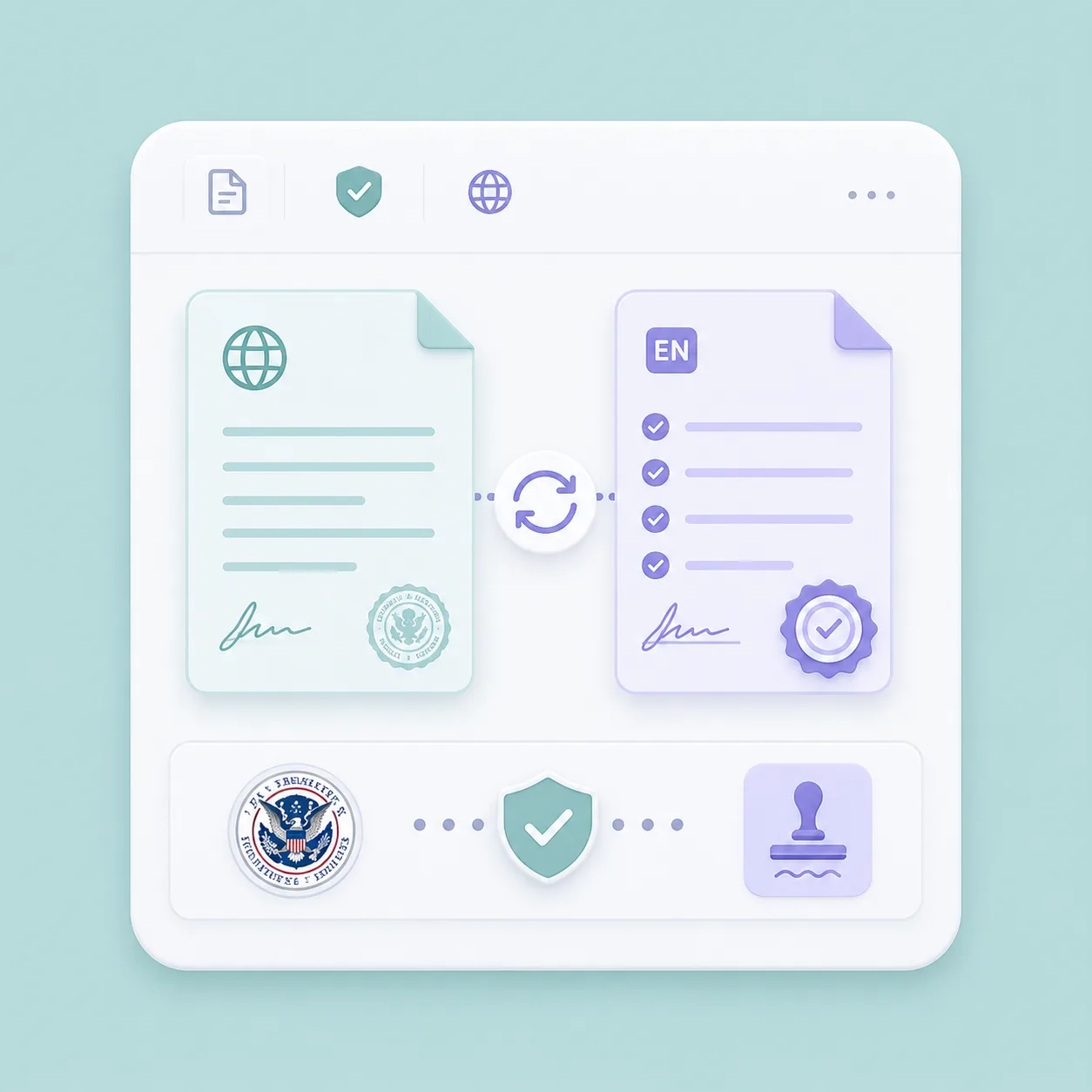
- USCIS requires certified English translations for any submitted document that is not originally in English.
- The USCIS reciprocity schedule helps applicants understand which civil documents are available, acceptable, or required for each country.
- Country-specific document rules matter because document formats, issuing authorities, and availability can vary widely from one country to another.
- Certified translation is required to make sure USCIS officers can accurately review foreign-language records during the immigration process.
- A certified translation must be complete, accurate, and accompanied by a translator’s certification statement.
- Common documents that may require certified translation include birth certificates, marriage certificates, divorce decrees, death certificates, court records, adoption papers, educational credentials, and financial records.
- The translation should include every detail from the original document, including stamps, seals, signatures, notes, and formatting where relevant.
- USCIS does not endorse specific translation providers, but translations must follow USCIS requirements for accuracy, completeness, and certification.
- Applicants should check the reciprocity schedule before submitting documents because country-specific requirements can change.
- Submitting incomplete translations, uncertified translations, missing originals, or documents that do not match reciprocity requirements can lead to delays, RFEs, or denials.
- Professional translation services can help ensure that foreign-language documents are translated accurately and formatted for USCIS review.
- Keeping copies of the original documents, certified translations, and certification statements is important in case USCIS requests clarification later.
Navigating the USCIS document requirements can be daunting. Understanding the need for certified translations is crucial. This guide will help you grasp the essentials.
USCIS requires certified translations for all non-English documents. This ensures accuracy and consistency in immigration processes. Certified translations are vital for a successful application.
The reciprocity schedule plays a key role. It outlines document requirements by country. Knowing this can prevent delays and denials.
For country-by-country civil document guidance, applicants commonly reference the U.S. Department of State's Visa Reciprocity and Civil Documents by Country page.
Certified translations must meet specific USCIS guidelines. These include a certification statement from the translator. The statement affirms the translation's accuracy and completeness.
Choosing the right translation service is important. Official translation services can ensure compliance with USCIS standards. This helps avoid application setbacks.
Immigration document translation is not just about language. It involves understanding legal and cultural nuances. This ensures the document's intent is preserved.
USCIS does not endorse specific translation services. However, they require adherence to their guidelines. This maintains fairness and consistency in the process.
Applicants should stay informed about USCIS updates. Document requirements can change, affecting submission success. Regularly checking the reciprocity schedule is advisable.
This guide will explore these topics in detail. It aims to equip you with the knowledge needed for USCIS document compliance.
Understanding USCIS Document Requirements and Reciprocity
USCIS document requirements are designed to maintain uniformity in immigration processes. The terms might seem complex at first. However, gaining a clear understanding is essential.
Each type of immigration document has specific criteria. USCIS specifies these through their comprehensive guidelines. These requirements ensure that all submissions are complete and consistent.
Reciprocity of civil documents refers to mutual recognition of standards. Each country may have different document formats and availability. USCIS adjusts its criteria to accommodate these variations.
The reciprocity schedule is a critical tool for applicants. It details the document standards USCIS accepts from each country. Proper use of this tool can greatly enhance application accuracy.
Key aspects of USCIS document requirements include:
Certified translations for non-English documents.
Adhering to specific document submission formats.
Compliance with country-specific document availability and standards.
Applicants must ensure that their submissions follow these standards. Submitting incomplete or incorrect documents can lead to delays or even denials. This underscores the importance of thoroughness.
The reciprocity schedule is updated periodically. It reflects changes in international document availability and standards. Staying current with these updates is critical for compliance.
Understanding USCIS document requirements and the reciprocity schedule may seem challenging. Yet, with careful attention and preparation, applicants can navigate this process successfully. Consulting legal professionals or translation services can provide valuable guidance. This helps ensure that all document submissions meet USCIS standards.
What Is Certified Translation and Why Does USCIS Require It?
Certified translation ensures that any document in a foreign language is translated accurately. It involves translating documents while maintaining their original meaning. This process is vital for clear communication.
USCIS requires certified translations for all non-English documents. These could include birth certificates, marriage licenses, or academic records. Accurate translations prevent misunderstandings that could impact application decisions.
A certified translation includes a statement from the translator. This statement affirms the translator's competence and the accuracy of the translation. Such a declaration builds trust in the translation's credibility.
USCIS doesn't endorse specific translation companies. However, translations must adhere to their strict criteria. Following these guidelines helps in meeting USCIS standards for document submissions.
Here are reasons why USCIS insists on certified translations:
Ensures linguistic accuracy in complex documents.
Guarantees that translations are consistent with the original text.
Provides a legal declaration of accuracy from the translator.
Certified translations require more than just language knowledge. Translators need to understand legal terminology relevant to the documents. This ensures the entire context is conveyed correctly.
Moreover, the certification process adds a layer of accountability. Translators must include their name, signature, and date of certification. This aspect is crucial for verifying the authenticity of the translation.
In sum, certified translations bridge the language gap. They play a crucial role in the immigration process by ensuring all information is presented accurately to USCIS. As such, they help avoid unnecessary application hurdles. Using professional translation services can assist in fulfilling USCIS requirements efficiently.
The USCIS Reciprocity Schedule: What It Is and How to Use It
The USCIS Reciprocity Schedule is a crucial tool for applicants. It provides detailed information on document standards by country. Understanding this schedule is essential for anyone submitting documents to USCIS.
As a practical reference point for country-specific civil document availability and format notes, applicants often consult the U.S. Department of State reciprocity resource: https://travel.state.gov/content/travel/en/us-visas/Visa-Reciprocity-and-Civil-Documents-by-Country.html
This schedule outlines the type of documents required, their availability, and special considerations. It covers various documents, including civil and vital records. Being aware of these details helps ensure proper submissions.
Applicants should consult the schedule to verify document requirements. Each country has unique standards and guidelines. Knowing these specifics can prevent delays or rejections in the application process.
Using the reciprocity schedule involves understanding its key components:
Document Types: Specifies civil and legal document needs by country.
Document Availability: Indicates how accessible required documents are.
Special Notes: Highlights specific requirements or issues for particular countries.
The schedule also helps identify if certain documents need an apostille. This can sometimes be crucial for international documents. Checking this information in advance is vital for timely submissions.
Staying informed of changes in the reciprocity schedule is important. The schedule is updated periodically to reflect new guidelines. Regular checks ensure that you have the latest information for your application.
In conclusion, the USCIS Reciprocity Schedule is more than just a list. It is a guiding document that helps streamline the application process. By correctly using it, applicants can align their document submissions with USCIS expectations. This reduces potential hurdles and increases the chance of a successful application. Understanding and utilizing the schedule is a proactive step in navigating the complexities of immigration documentation.
Types of Documents That Require Certified Translation for USCIS
When applying to USCIS, certain documents require certified translation. This applies to any document not in English. Certified translations ensure that all information is clearly understood by USCIS officials.
Several types of documents commonly require certified translation. These include vital records such as birth certificates and marriage licenses. Other common documents include divorce decrees and death certificates. Legal documents like adoption papers and court documents also fall under this category.
Civil and Vital Documents:
Birth Certificates
Marriage Certificates
Divorce Decrees
Death Certificates
Legal and Financial Documents:
Court Records
Adoption Papers
Educational Credentials
Financial Statements
For immigration purposes, each document must be translated accurately. These translations need to include every detail from the original. This ensures USCIS can evaluate the information fully.
It's crucial for translations to include a certification statement. This statement must affirm the accuracy of the translation. It should also identify the translator's qualifications and include their contact information.
Certified translations help prevent misunderstandings. Errors or omissions can lead to delays or application denials. For these reasons, translations must be complete and error-free.
USCIS requires that the translation be submitted alongside the original document. This allows USCIS to verify the translation's accuracy. Ensuring all translations meet these requirements is key to a smooth application process.
Engaging professional translation services can be beneficial. They provide assurance that translations comply with USCIS standards. This step can prevent issues later in the application process.
Understanding which documents require certified translations is essential. By ensuring compliance with these requirements, applicants can avoid common pitfalls. This helps facilitate a more efficient and successful application outcome with USCIS.
USCIS Translation Guidelines: Key Rules and Best Practices
USCIS has specific guidelines for document translations. These ensure fairness in the immigration process. It's important for applicants to adhere to these guidelines closely.
The primary requirement is the accuracy of translations. Every detail from the original document must be included. Missing or altered information can lead to application issues.
The translations must feature a certification statement. This statement confirms the accuracy and completeness of the translation. Additionally, it verifies the translator's competence.
Key Guidelines Include:
Complete and accurate translations
Inclusion of a certification statement
Translator's qualifications documented
Submission with the original document
Translators must be impartial. They should not have a personal relationship with the applicant. This rule helps ensure the integrity of the translation.
Understanding the format is also crucial. USCIS expects translations to mirror the original document in layout. This aids USCIS officers in reviewing the documents efficiently.
Applicants should provide legible translations. Formatting should be clear, and the text should be easy to read. This helps avoid any delays due to clarity issues.
Avoid using automated tools for translations. These often fail to capture the nuances of the original text. Instead, rely on skilled human translators for better outcomes.
Verifying the translator's credentials can prevent problems. Ensuring they have the necessary expertise is critical. This adds credibility to the submitted documents.
In summary, following USCIS translation guidelines is essential. By adhering to these rules, applicants can avoid unnecessary delays. It makes the entire process smoother and more predictable.
How to Choose Official Translation Services for USCIS Submissions
Selecting the right translation service for USCIS submissions is crucial. Not all services meet the USCIS standards. Therefore, a careful selection process is essential.
Start by verifying the service provider's experience. Experience in USCIS translations is invaluable. It indicates familiarity with specific requirements and processes.
Consider the qualifications of the translators. Qualified translators should have verifiable credentials. Their expertise in language pairs adds reliability to the translations.
Reputation is another vital factor. Look for services with positive reviews and recommendations. User feedback can offer insights into the service quality and customer satisfaction.
Checklist for Choosing Translation Services:
Experience with USCIS document translations
Qualified and credentialed translators
Positive reputation and reviews
Understanding of USCIS guidelines
Fast and accurate service delivery
Next, ensure that the service understands USCIS guidelines. Compliance with these rules is necessary for acceptance. Ask if they provide certification statements that meet USCIS standards.
Inquire about the service's turnaround time. USCIS processes are time-sensitive. Efficient services help in meeting application deadlines without rushing.
Lastly, consider the cost, but don't let it be the sole factor. High quality often justifies a reasonable price. Balance budget constraints with the need for accurate, compliant translations.
In conclusion, choosing a translation service is a critical step. The right service ensures that your documents are both accurate and timely. This reduces the risk of application delays or rejections.
Step-by-Step: Preparing and Submitting Certified Translations to USCIS
Preparing certified translations for USCIS requires careful attention to detail. Here is a step-by-step guide to help navigate the process.
Step 1: Gather Required Documents
First, identify all documents USCIS requires. This includes birth certificates, marriage licenses, and any other pertinent documents. Ensure these documents are complete and readable.
Step 2: Select a Qualified Translation Service
Choose a service that specializes in USCIS certified translations. Look for services with experienced translators and solid reputations. This choice is crucial for ensuring compliance and accuracy.
Step 3: Provide Necessary Details to the Translator
Supply the translator with all documents. Include any specific instructions if required. Ensure the translator understands the necessity of certification for USCIS.
Step 4: Obtain and Review the Translations
Once translations are complete, review them carefully. Check for accuracy and completeness of each document. Verify that the translation matches the original in detail.
Step 5: Ensure Certification Statements Are Included
The translator must include a certification statement. This should affirm their qualifications and the translation's accuracy. Ensure that this is attached to every translated document.
Step 6: Prepare the Full Submission Package
Assemble your submission. Include the original documents, translations, and certification statements. Organize them clearly to facilitate the review by USCIS.
Step 7: Submit to USCIS
Finally, send the complete package to USCIS. Use their specific submission guidelines. Keep copies of everything for your records in case of queries or additional requests.
Each step is crucial for a successful document submission. Paying attention to each detail reduces the risk of delays or rejections. By following this guide, your application stands a better chance of being processed efficiently.
Common Mistakes and How to Avoid USCIS Translation Rejections
Submitting certified translations to USCIS requires precision. Mistakes can lead to rejections or delays. Avoiding common errors is essential for a smooth application process.
One common mistake is using uncertified translators. USCIS requires certified translations for all documents in a foreign language. Ensure the translator provides a certification statement as per USCIS guidelines.
Failure to submit original documents with translations is another error. USCIS requires translations to accompany original non-English documents. Always include both when submitting your application.
Sometimes, translations are incomplete or inaccurate. This can happen if the translation service fails to understand immigration terms. Verify translations for completeness and correctness to prevent issues.
A frequent error involves improper formatting. USCIS prefers translations that mimic the original document's format. This helps USCIS reviewers match translated text to the original.
Using translations that lack a proper certification is risky. The certification must include the translator's qualifications, affirmation of accuracy, and a signature. Double-check these details before submission.
Common mistakes to avoid include:
Using uncertified translators.
Submitting translations without original documents.
Allowing inaccuracies or incomplete translations.
Ignoring document formatting.
Excluding certification statements.
Ignoring country-specific document requirements can also cause problems. Check the USCIS reciprocity schedule for each country's specific guidelines. This can prevent submission errors related to country-specific documents.
Lastly, not retaining copies of submitted documents is a missed safety net. Applicants should always retain copies of everything sent to USCIS. This includes translations, original documents, and certification statements. Keeping records ensures you have backup information in case of any disputes or USCIS inquiries.
By avoiding these common pitfalls, applicants can enhance the chances of acceptance. Careful attention to detail and adherence to USCIS guidelines make a significant difference in the application process.
Frequently Asked Questions About USCIS Certified Translation Reciprocity
Many applicants have questions about USCIS certified translation reciprocity. Here, we address some common concerns related to this process.
What is USCIS translation reciprocity?
Translation reciprocity refers to mutual recognition of translation standards across countries. USCIS abides by these standards to ensure uniformity.
Why is certification necessary for document translations?
Certification ensures that translations meet accuracy and completeness standards. A proper certification instills confidence in USCIS reviewers regarding the translation's quality.
Does USCIS endorse specific translation services?
USCIS does not endorse any particular service. However, they require compliance with their certified translation guidelines.
Can a friend translate my documents for USCIS?
While possible, it's not recommended. USCIS prefers qualified translators who are unrelated to the applicant to avoid bias.
Where can I find USCIS document guidelines?
The USCIS website hosts various resources including guidelines and the reciprocity schedule. Reviewing these will clarify document requirements.
Are there any common reasons for translation rejections?
The most frequent reasons include:
Lack of certification statement.
Incomplete translations.
Absence of an original document.
Improper translator qualifications.
These FAQs aim to clarify the process and requirements of USCIS translations. Understanding the nuances can significantly assist in your application journey.
Conclusion: Ensuring Compliance and Success with USCIS Document Requirements
Navigating USCIS document requirements can be complex, but understanding the rules enhances your success chances. Adhering to USCIS guidelines helps you avoid unnecessary delays or potential denials in your immigration process.
Ensuring that each document is accompanied by a certified translation if needed is a crucial step. This not only reflects attention to detail but also your commitment to providing comprehensive and compliant submissions.
For a successful submission, consider these essential steps:
Review the USCIS translation guidelines thoroughly.
Double-check the accuracy and completeness of translations.
Retain copies of all documents and translations for your records.
Stay updated with any changes to USCIS requirements or reciprocity schedule.
These proactive steps can greatly improve your outcomes. Consulting with legal professionals or professional translators offers added assurance that your application meets all USCIS standards and requirements. By taking these actions, you are investing in the success of your immigration journey, ensuring that your submissions align with the stringent requirements set forth by USCIS.