Key Takeaways
- Arabic civil records filed with USCIS need a full certified English translation in which dates are converted in brackets and every name follows one reference spelling across the packet.
- Egypt, Jordan, Iraq, Syria, Lebanon, Morocco, Saudi Arabia, the Gulf states, Sudan, and Yemen issue different civil records, so the version an applicant holds determines what gets translated.
- The Reciprocity Schedule on travel.state.gov lists which Arabic-country documents exist and which version is acceptable, and applicants should check it before ordering a translation of a short extract.
- Handwritten entries in older Arabic registry records are translated line by line like printed text, and unreadable parts are marked as illegible instead of being guessed.
- Hijri dates are translated as written with the Gregorian equivalent added in brackets, so the officer can compare the English with the original and see that a conversion took place.
- Converted Hijri dates are checked against the other dates in the same record, because month boundaries in the Hijri calendar can shift the Gregorian result by a day.
- Arabic name chains of given name, father, grandfather, and family name can reach English in several accepted spellings, so the spelling printed in the applicant's passport becomes the reference for every document.
- Some Gulf records printed in Arabic and English side by side still need the Arabic text translated in full, because the issuer's English half carries no translator's certification.
- Where a religious or family court records a marriage or divorce, the court paper and the registry extract each carry their own stamps, signatures, and numbers that the translation must report.
- A translation company prepares an Arabic packet as one set, fixing spellings, place names, and date format once and then giving each document its own certification.
An Arabic civil record sent to USCIS needs a full English translation in which every date is converted in brackets, every name follows one reference spelling, and every stamp and handwritten line is accounted for. Arabic records raise questions that records in many other languages do not, and a careful certified document translation for USCIS settles them before the packet is filed. Country of issue, calendar, and name spelling decide most of the work.
Arabic civil status records differ by country and by version
Egypt, Jordan, Iraq, Syria, Lebanon, Morocco, Saudi Arabia, the Gulf states, Sudan, and Yemen each issue their own civil status documents, and the same event can be recorded on more than one paper. A civil registry may issue a full extract of the entry, a short certificate, a family card that lists a household, or an individual status statement. Each has a different layout and a different level of detail.
The Department of State publishes a Visa Reciprocity and Civil Documents by Country schedule that lists which documents exist in a country, who issues them, and which version is acceptable. Applicants should read the Reciprocity Schedule entry for their country before ordering a translation, because translating a short extract when the long form is required wastes the work. Where a computerized record and an older handwritten record both exist, the translation follows whichever version the applicant actually holds, and the handwritten entries are translated line by line like printed text.
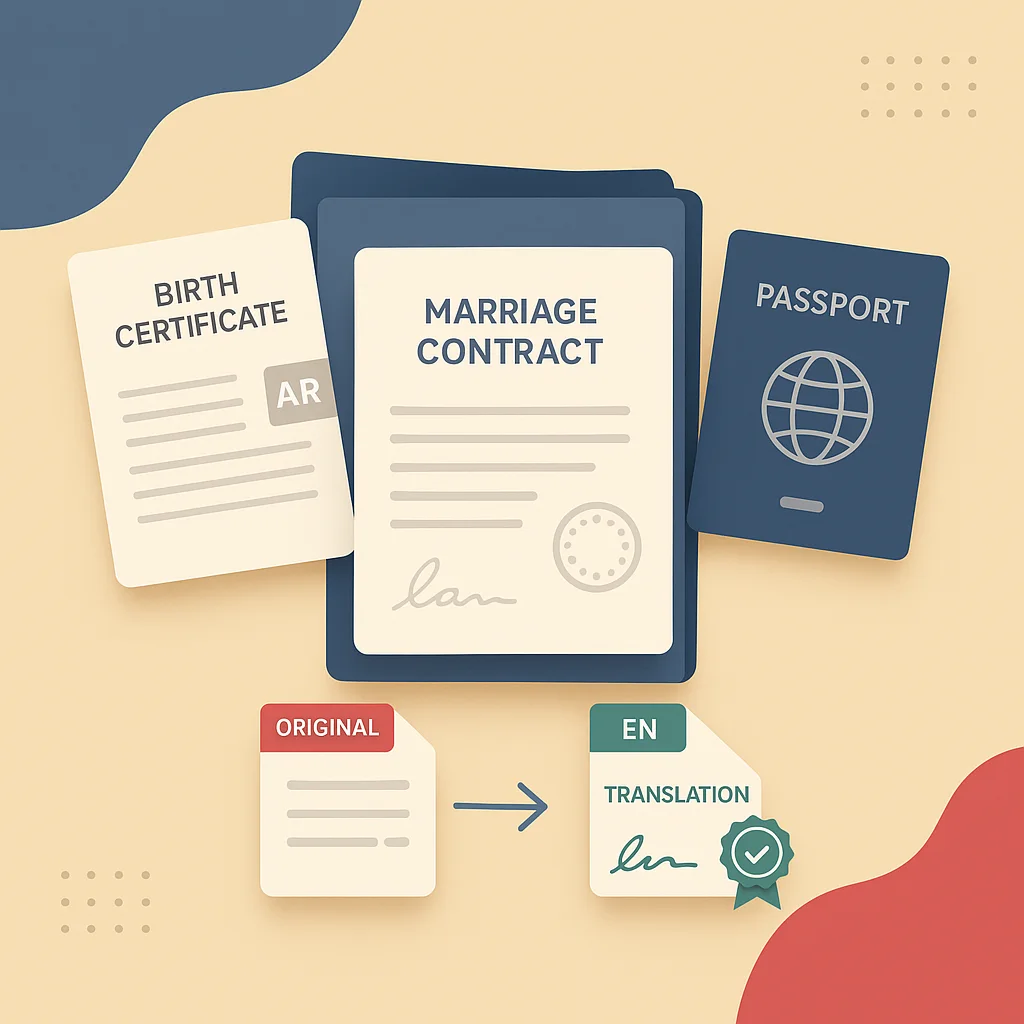
Arabic birth certificate translation shows the usual pattern. The child's name, the parents' names, the place and date of birth, and the registry number all appear in set positions, and the translation keeps those positions so that an officer can match each English line to the Arabic source.
Hijri dates in Arabic documents need a bracketed Gregorian date
Many Arabic records carry dates in the Hijri calendar, and Saudi records use it most often. Some documents print both calendars, some print only Hijri, and a few mix them on the same page, for example a Hijri issue date beside a Gregorian date of birth. A reader at USCIS works with Gregorian dates, so the translation gives the date as written and the converted date in brackets, for example 12 Ramadan 1440 [May 17, 2019].
The original date is never replaced. Replacing it would leave nothing for the officer to compare with the source, and it would hide the fact that a conversion happened at all. Conversion tables can differ by a day because the Hijri month depends on the sighting of the moon, so the translator checks the converted date against the other dates in the same record and flags any date that does not fit.
A second point is the numerals. Documents may use Western digits or Eastern Arabic digits, and registry numbers can contain both. Each digit is read from the page and typed into the translation exactly as it appears, since one wrong digit in a registry number breaks the match with the original.
Four-part Arabic names and the passport spelling
Arabic names usually run in a chain of a given name, the father's name, the grandfather's name, and a family name. Records from different countries may show two, three, or four parts, and a woman's family name often differs from her husband's. Arabic script also leaves most short vowels unwritten, so one name can reach English in several accepted spellings. Mohammed, Muhammad, and Mohamed are the familiar case.
USCIS compares names across the passport, the birth record, the marriage record, and the forms. The safest rule is to take the spelling printed in the Latin letters of the passport translation or the passport itself and use it in every other document in the set. When a record contains a different Latin spelling, the translation can note it in brackets so the difference is visible and explained. A name chain that appears in a different order on two documents is rendered in the order the document uses, with the same reference spelling for each part.
Bilingual records, religious court documents, and stamps
Some Gulf records are printed in Arabic and English side by side. The English half was written by the issuer and carries no translator's certification, so the Arabic text is still translated in full and the printed English is reported as it appears. When the two halves disagree, the translation says so instead of choosing one.
In some Arabic-speaking countries, marriage and divorce are recorded by a religious or family court as well as by a civil registry. An Arabic marriage certificate translation may therefore cover a court-issued contract, a registry extract, or both, and each has its own stamps, clerk signatures, and registration numbers. A divorce decree translation follows the same approach, with the court's wording and dates carried over line by line.
Stamps and seals in Arabic calligraphy are part of the page. The translator reads the text inside a round seal, describes its shape, and marks it as a seal. Signatures are shown as "[signature]", and parts that cannot be read are marked "[illegible]" instead of guessed.
How a translation company prepares an Arabic packet
For an I-130, an I-485, an asylum file, or an N-400, the Arabic documents are rarely filed alone. A marriage record, two birth records, a passport, and perhaps a divorce decree from an earlier marriage all name the same people. The translation company therefore works from the whole set. It sets one reference spelling for each person, one rendering for each place name, and one date format, then applies them to every document.
The work runs in this order:
- The translator reads every page, including backs, margins, and stamps, and lists the names, places, and dates that appear in more than one document.
- One English spelling is fixed for each name and each place, matched to the passport.
- Hijri dates are converted in brackets and checked against the other dates in the set.
- Each document is translated in full, in a layout that follows the original.
- Each translation receives its own certification with the translator's name, signature, date, contact details, and statements of competence and accuracy.
USCIS regulations require a complete English translation with that certification for any foreign-language document, and USCIS may issue a Request for Evidence when a translation is missing or incomplete. Machine translation alone does not meet the requirement, and it handles Arabic names and dates poorly. The attorney or accredited representative on a case decides which documents go into the filing.
Before ordering, applicants should collect full-page scans of every Arabic record, starting with the Arabic birth certificate translation source, check the Reciprocity Schedule for the right version, and note how the passport spells each name. Our Arabic translation services apply the passport spelling across every document in the set.