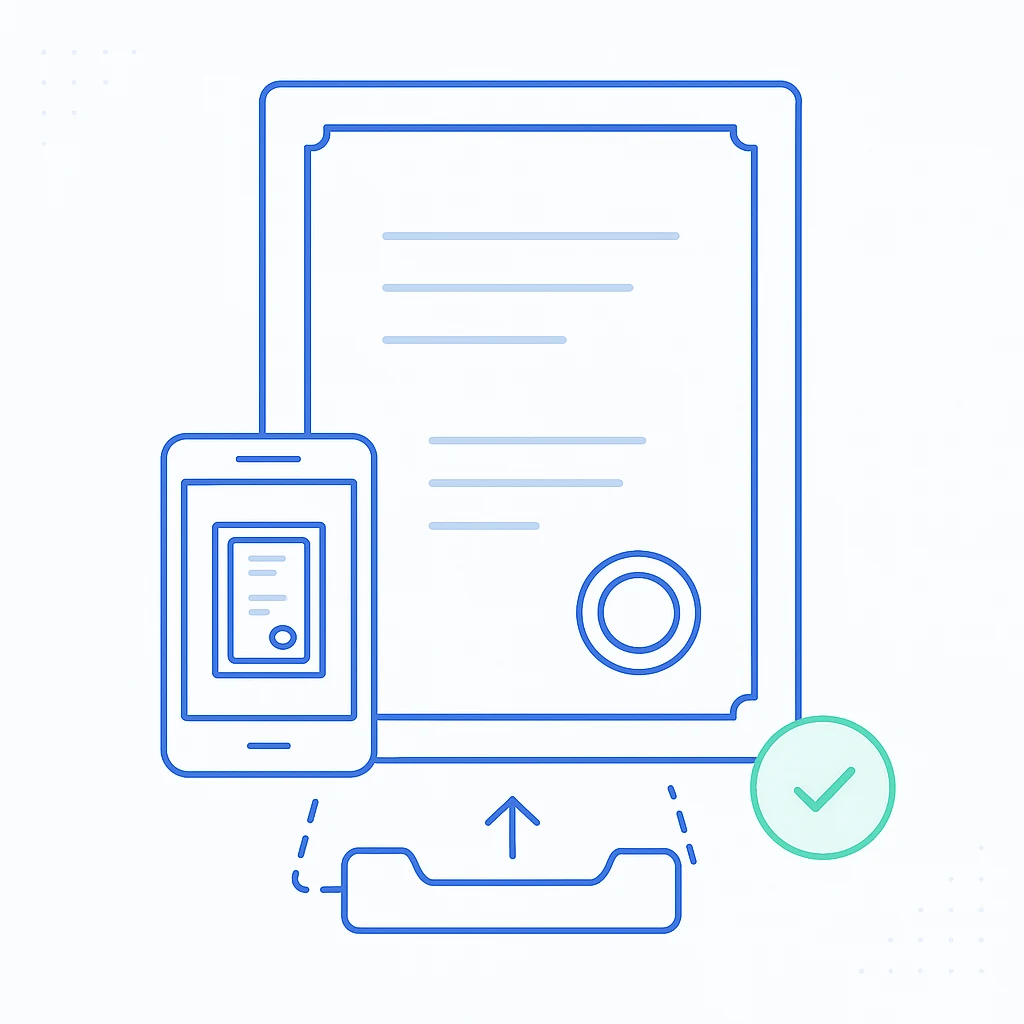
Upload
Upload the Arabic document
Any format, from any device, several documents at once if you need.
Photo, scan or PDF
Arabicالعربية1.2M+ U.S. speakersView our translators
Arabic translation is heavily weighted toward immigration — refugee and asylum files, vital records from Middle East / North Africa countries, and credentials for medical and engineering professionals seeking U.S. licensure.

USCIS-accepted
Certified translation

ATA member
American Translators Association

Starting at $24.95
Priced by word count

HIPAA-aligned
Medical records and consent forms
Upload
Any format, from any device, several documents at once if you need.
Photo, scan or PDF

Price
Priced by word count, so a short document costs less than a dense one. Rush options available.
Starting at $24.95 · Certificate included

Certified PDF
Layout, stamps and seals rebuilt to match the original. Certificate, translation and source copy as one PDF, in your inbox and dashboard.
USCIS-accepted
The price shows before you pay. Every file is covered by an NDA; medical records are handled in line with HIPAA.
Where Arabic translations go
The offices and institutions that receive Arabic translations most, and the documents each one asks for.

Syrian, Iraqi, Yemeni, Sudanese and Palestinian asylum packets
A complete translation with a signed certification; notarization is not required.
Typical documents

Consular processing, waiver packages and DS-260 evidence
State boards and agencies accept certified translations on letterhead with the certificate of accuracy.
Typical documents

Foreign-use certified translation for US-issued documents
Check with the consulate whether the source needs an apostille; the translation carries our certificate.
Typical documents
ECFMG / FCVS for physicians with Iraqi, Egyptian or Syrian degrees
State boards and agencies accept certified translations on letterhead with the certificate of accuracy.
Typical documents
How it works

Upload your document and get your instant quote
The word count and the exact price show right away, certificate included.

Place your order
Pay online. The project opens in your dashboard with its delivery date.

Translation and proofreading
A native Arabic translator in the document’s field translates, and a second linguist proofreads names, dates and numbers.

Certified translation in your inbox
Certificate, translation and source copy arrive as one PDF in your inbox and stay in your dashboard.
What you receive
Every file and session is covered by an NDA and sent over an encrypted connection. Clinical matters are handled in line with HIPAA.
Document translation
Every document type below has its own Arabic page — who issues it, how names, dates, and scripts are handled, and what the certified translation includes. Priced by word count, both directions.
 Academic Transcripts
 Adoption Documents
 Affidavit
 Asylum Documents
 Background Check
 Bank Statement
 Birth Certificate
 Brochure
 Business License
 Change of Name
 Course Guide
 Criminal Record
 Death Certificate
 Deposition
 Diploma
 Divorce Certificate
 Driver’s License
 Email
Email Employee Manual
 Financial Statement
Browse the full document directory — all 37 types, all 78 languages.
If you also need an interpreter
Booked from the same account: court-certified and medically credentialed Arabic interpreters, on-site, by video (VRI) or by phone (OPI).
Arabic interpreters who have sat through asylum, adjustment and naturalization interviews at USCIS field offices across the country.
Court-certified Arabic interpreters for hearings, arraignments, depositions and arbitration, on-site or by video.
Medically credentialed Arabic interpreters for appointments, IMEs and inpatient care, on-site or by HIPAA-aligned video.
Arabic interpreters for IEP (special education) meetings, workers' compensation cases, HR investigations and staff trainings.


 Arabic interpreters in every state, for courts, hospitals, USCIS interviews, schools and workplaces, with the venues and varieties each state involves.See Arabic interpretation
Coverage
Pick your state for Arabic certified translation there: the offices, the filings and the documents they ask for. Every state page orders from the same roster.
Other translation languages
Arabic certified translation by state
Arabic FAQ
The ones we hear most often, answered by our dispatch and project-management teams.
Can't find it here?
Yes. Every Arabic translation we deliver ships with a signed Certificate of Translation Accuracy that meets USCIS requirements. It is accepted by USCIS, the State Department, U.S. embassies abroad, U.S. district and state courts, and state vital-records offices.
We distinguish MSA, Iraqi, Gulf, Egyptian, Levantine (Syrian / Lebanese / Palestinian / Jordanian), Sudanese and North African (Maghrebi) dialects. Modern Standard Arabic is used for written material but is rarely natural in spontaneous interpretation.
Arabic translation is heavily weighted toward immigration — refugee and asylum files, vital records from Middle East / North Africa countries, and credentials for medical and engineering professionals seeking U.S. licensure.
Yes. Each Arabic translation ships on our letterhead with a signed Certificate of Translation Accuracy meeting the USCIS requirements for foreign-language documents.
Arabic is right-to-left. We deliver bidirectional DTP with correct numeral forms (Arabic-Indic vs. Western) and handle embedded Latin text cleanly.
Related translation services
USCIS-accepted certified translations with a signed certificate of accuracy.
ExploreContracts, filings and evidence translated for court and counsel.
ExploreManuals, specs and engineering docs with strict terminology control.
ExploreRecords, trials and device docs handled by HIPAA-aligned linguists.
ExploreReady when you are
Upload the document, see the word count and the exact price, and receive the translation, the certificate and a copy of the source as one PDF.
Linguist network
Browse selected Arabic translators available through the Texliff network.
27 professional profiles
Translator
Translator
Translator
Translator
Translator
Translator
Translator
Translator
Translator
Translator
Translator
Translator
Translator
Translator
Translator
Translator
Translator
Translator
Translator
Translator
Translator
Translator
Translator
Translator
Translator
Translator
Translator


