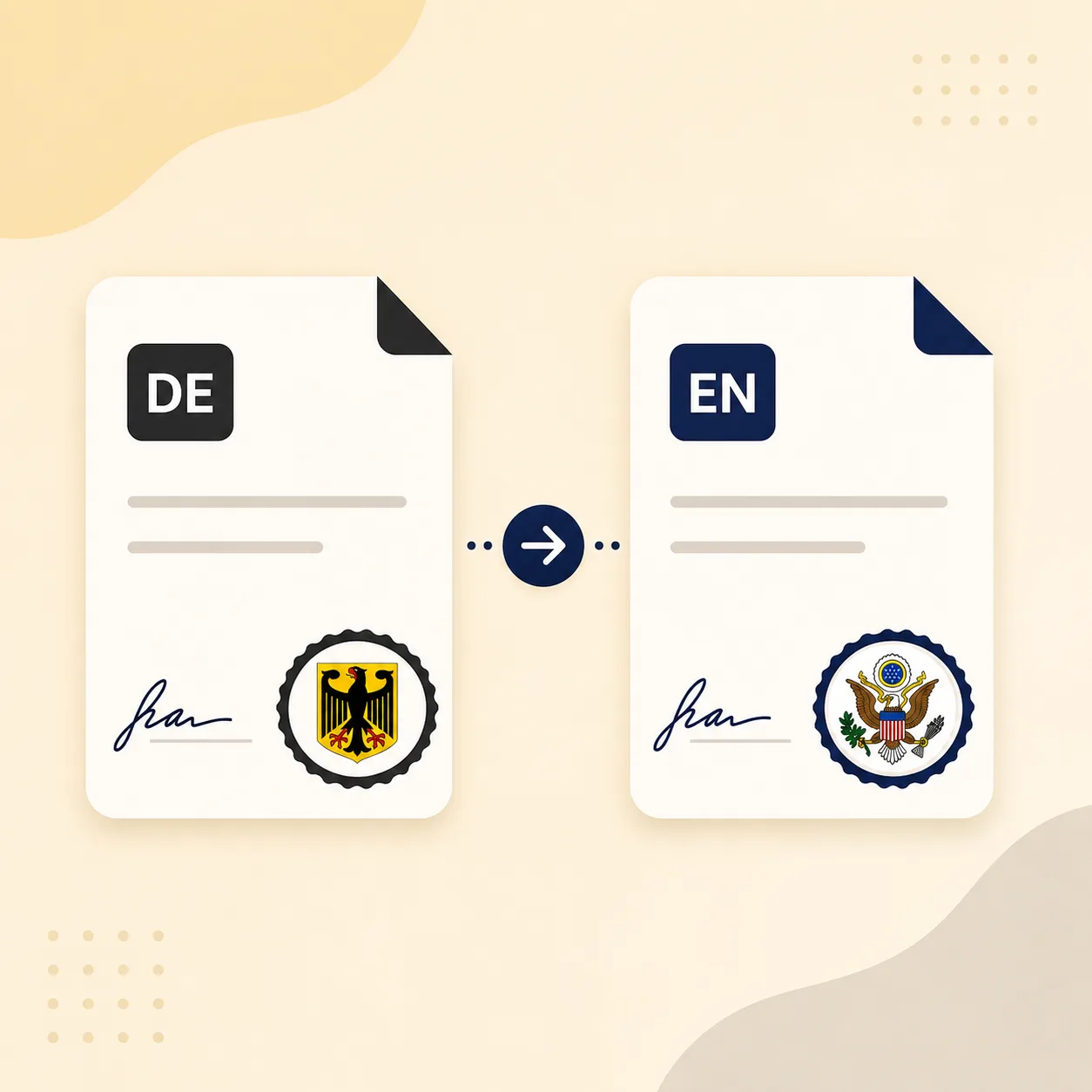
Key Takeaways
- Certified German to English translation is often required for immigration, university admissions, employment, business, legal, medical, and DMV-related submissions.
- A certified translation must include a complete English translation and a signed certification statement confirming accuracy, completeness, and translator competence.
- For USCIS, any German-language document must be accompanied by a full English translation that meets USCIS certification requirements.
- USCIS does not approve or endorse specific translation agencies, so acceptance depends on compliance, completeness, formatting, and certification.
- Common German documents requiring certified English translation include birth certificates, marriage certificates, divorce decrees, name change records, academic transcripts, diplomas, employment references, contracts, driver’s licenses, and medical records.
- German birth certificates should be translated in full, including Standesamt details, register numbers, marginal notes, stamps, seals, annotations, and handwritten entries.
- Names containing umlauts or ß must be handled consistently across the full application packet, especially when compared with passports and other records.
- A proper translation should preserve the document structure so officials can easily compare the German source with the English version.
- Common issues include omitted stamps, inconsistent name spelling, untranslated marginal notes, skipped back pages, and summaries instead of full translations.
- Professional translation agencies reduce risk through document intake, translator assignment, formatting, quality control, certification, and secure delivery.
- Applicants should provide clear scans or photos, include front and back pages, state the purpose of the translation, provide deadline details, and mention preferred name spellings when relevant.
- For official submissions, self-translation or informal translation can create avoidable problems, while certified translation services provide the accuracy and documentation institutions expect.
Whether you are applying for a visa, enrolling in an American university, or finalizing a cross-border business deal, navigating the bureaucracy of a new country is a complex process. One of the most critical steps in this journey is ensuring your official documents are properly localized. If you are moving from Germany, Austria, or Switzerland to the United States or another English-speaking country, obtaining a Certified German into English Translation is not just a formality—it is often a strict institutional requirement.
From immigration authorities to university admissions offices, institutions require certainty that your foreign language documents have been translated accurately and impartially. In this guide, we will cover what a certified translation is, what USCIS expects, which documents commonly need certification, and how to choose certified translation services that deliver work that is accepted the first time.
Certified German to English Translation for Official Use
Certified German to English Translation is typically required when the receiving institution needs a formal statement of accuracy. A standard German to English Translation may be suitable for internal use, but official submissions usually require a certification page that makes the translation usable as an official record.
For that reason, many clients work with an official translation agency that can provide a consistent, repeatable process for certified document translation across multiple documents in the same application packet.
What is a Certified Translation?
A certified document translation is more than converting text from German into English. It is a translation delivered with a formal certificate of accuracy stating that the English version is a true, accurate, and complete translation of the original document.
When you request a certified document translation german to english, the certification is typically signed by the translation provider and includes the translator’s or company’s statement of competency in both languages, along with identifying details and a signature/date. This is what makes the translation acceptable for official use.
Immigration and USCIS Requirements
If you are submitting documents to the United States Citizenship and Immigration Services (USCIS), a USCIS-accepted certified translation is essential to avoid delays, rejections, or Requests for Evidence (RFEs).
Understanding USCIS Guidelines
USCIS requires that any document containing a foreign language be accompanied by a full English translation. The translation must be complete and accurate, and it must be accompanied by a certification from the translator (or translation provider) stating they are competent to translate from German into English.
While people often search for a USCIS-approved translation, it is important to note that USCIS does not officially endorse or approve specific agencies or translators. Instead, USCIS evaluates whether your submission includes a properly formatted, certified translation that meets their stated requirements. That is why USCIS-accepted certified translation is about compliance, completeness, and presentation—not a particular vendor list.
What a USCIS-accepted Certified Translation Should Include
For USCIS, the most common compliance issues are avoidable when certified translation services follow a consistent checklist. A strong certified translation german to english package typically includes:
A complete translation: All visible text is translated, including headers, stamps, marginal notes, and annotations.
Clear handling of unclear marks: Illegible elements are flagged consistently (for example, with bracketed notes), rather than being omitted.
Accurate names and identifiers: Spellings, diacritics, dates, and register numbers match the source document and remain consistent across all submitted records.
Document-aware formatting: The English version is laid out so that officials can cross-reference fields and entries easily.
Certification statement: A signed certification confirming completeness, accuracy, and competency for German to English Translation.
German Birth Certificate Translation for USCIS (Agency Process)
A German birth certificate (Geburtsurkunde) is one of the most frequently requested records in immigration filings. In practice, applicants typically rely on certified translation services to produce a USCIS-ready translation package. A professional process usually looks like this:
You provide a clear copy: Submit a high-resolution scan or photo of the document (front and back, if applicable), including stamps, seals, and handwritten notes.
We translate all content faithfully: Every element on the document is translated—including letterhead, registry office details (Standesamt), marginal notes, stamps, and annotations. If something is not legible, it is clearly marked as such in brackets.
We preserve document structure: The English layout is formatted to closely reflect the original, so officials can easily cross-reference fields and entries.
We attach certification: The delivery includes the required certification statement confirming completeness, accuracy, and competency for German to English Translation.
We perform a quality check: Names, dates, places, register numbers, and consistency across pages are reviewed to reduce the risk of avoidable issues during filing.
This approach keeps the responsibility for producing a compliant certified translation with the provider—not with the applicant.
Certified Document Translation German to English: Where Errors Commonly Happen
Certified document translation german to english is often rejected or questioned for reasons that are not strictly “translation quality” issues, but completeness and traceability issues. Common friction points include:
Omitted stamps or seals: Civil documents often contain multiple stamps, round seals, or administrative notes that must be reflected in the translation.
Inconsistent romanization: Names with umlauts (ä, ö, ü) or ß can be rendered multiple ways; consistency across every document in the packet matters.
Handwritten marginal notes: Birth certificate translation and marriage certificate translation frequently involve handwritten addenda that affect legal status or name history.
Multiple-issue certificates: Some German records include later corrections or added references; these must be included, not summarized.
Professional translation services built around official submissions focus on capturing every element that a reviewer could rely on, not just the “main text.”
Common Documents Requiring Certified Translation
Different document types come with different formatting conventions and terminology. The following are among the most common requests for certified translation german to english:
Civil Registry Documents (Birth, Marriage, Divorce)
Alongside a birth certificate translation, agencies frequently request certified translations of marriage certificates (Heiratsurkunde), divorce decrees (Scheidungsurteil), name change records, and other civil status documents.
German civil documents often contain formal phrasing, abbreviations, and marginal notes that must be handled carefully. A certified document translation should capture all official entries and annotations without omissions. This is particularly important when the translated record is used as a supporting document for USCIS.
Academic Transcripts and Diplomas
For admissions, credential evaluation, and licensing, a certified German to English Translation of transcripts and diplomas is typically required. The translation should render subjects, grades, and institutional information accurately, without making unofficial conversions that could conflict with a university’s evaluation process.
Employment References (Arbeitszeugnis)
German employment references can be nuanced and highly structured. A professional translation provider will reproduce the content faithfully and consistently, preserving meaning and tone while keeping the English readable for US-based reviewers.
Business and Legal Documents
Beyond immigration and education, certified translation services may be needed for contracts, corporate documents, court filings, or compliance materials. These documents often require terminology consistency across multiple exhibits and attachments, which is best managed through an agency workflow rather than ad hoc translation.
Driver’s Licenses
For DMV-related needs, relocations, or administrative submissions, a certified document translation may be requested. Requirements can vary by state and by purpose, so it helps to work with a provider experienced in official document translation for US institutions.
Medical Records
Medical translation requires precision and strict attention to terminology. If you are translating German medical records for treatment, insurance, or legal purposes, ensure the provider has appropriate domain experience and quality controls.
Professional Translation Services: How Agencies Deliver Certified Translations Reliably
For certified translation german to english, reliability comes from process. Certified translation services and official translation agency workflows typically include:
Intake and document review: The provider confirms what must be translated (including stamps, back pages, and attachments) and identifies any legibility risks early.
Translator assignment for German to English Translation: Projects are matched to linguists familiar with the document type (civil registry formats, academic records, or legal documents).
Formatting for official review: The translation is structured so that fields, entries, and notes are easy to verify against the German source.
Quality control: Names, dates, and identifiers are checked for consistency across the full set of documents, especially when multiple records will be submitted together to USCIS.
Certification and delivery: The final package includes the translated document and the certification statement suitable for USCIS-accepted certified translation.
How to Choose Certified Translation Services (Without Guesswork)
When your documents must be accepted by USCIS or another institution, the safest approach is to choose certified translation services with established workflows for compliance-driven documents. Consider the following:
Compliance-focused certification: Confirm they provide a proper certificate of accuracy suitable for USCIS-accepted certified translation and other official submissions.
Document-format experience: Ask whether they routinely handle certified document translation german to english for civil records, including stamps, seals, and handwritten notes.
Quality assurance: Look for a review process designed to catch inconsistencies in names, dates, and key identifiers.
Clear deliverables: Ensure they specify what you will receive (translated document + certification) and how it will be delivered.
Institutional familiarity: An official translation agency that regularly supports USCIS, universities, and employers will anticipate common reviewer expectations.
You may still see german english translator used as a search term or keyword. For official submissions, however, the key is not whether an individual advertises the term, but whether the provider can deliver certified translation services with consistent certification language, formatting, and quality controls.
What We Need From You to Start (Efficient, Compliance-Ready Intake)
To keep the process fast and minimize back-and-forth, certified translation services usually request:
Legible scans/photos: Include the entire page, corners, and any back-side text or stamps.
Purpose of the translation: USCIS, school admissions, employment, or another institution (so the package matches the expected format).
Deadline and submission format: For example, whether you need digital delivery for online filing or a print-ready PDF.
Name spelling preferences (when applicable): If your passport uses a specific spelling, it can help align document sets—while still remaining faithful to the original German document.
Confidentiality and Document Handling
Official records often contain sensitive personal data. Professional translation services typically use secure file handling practices and limit access to project staff involved in translation, review, and delivery. If your documents include identification numbers or protected health information, it is reasonable to ask your provider about retention and deletion practices after completion.
The Value of Professional Translation Services
For USCIS and other official uses, self-translation and informal translations are a common cause of avoidable problems. Certified translation services are designed to deliver complete, accurate, properly formatted translations along with the certification statement institutions expect.
Whether you need certified translation german to english for civil records, academic documents, or legal and medical materials, working with an experienced official translation agency helps reduce risk, streamline submission, and keep your process moving forward.
Final Thoughts
Cross-border life events—immigration, education, business, and family matters—often depend on documents that must be presented in English with a certification of accuracy. A legitimate Certified German into English Translation ensures your paperwork is clear, complete, and ready for official review.
If your goal is USCIS-accepted certified translation or another compliance-critical use, prioritize a provider that translates every element on the page, delivers consistent formatting, and supports the submission with a properly prepared certification statement.