Key Takeaways
- Certified Spanish diploma translation is often required for U.S. university admissions, immigration filings, credential evaluations, professional licensing, and employment purposes.
- A standard translation is usually not enough for official submissions because institutions need a signed Certificate of Accuracy from a qualified translator.
- Applicants should not translate their own diplomas because self-translation creates a conflict of interest and may be rejected by universities or government agencies.
- A valid certified translation should include a complete English translation, a copy of the Spanish original, a formal accuracy statement, the translator’s signature, and verifiable contact information.
- Academic documents must be translated carefully because degree titles, grades, course names, seals, stamps, and institutional language can affect how the credential is reviewed.
- For USCIS, a certified translation is generally required for non-English academic documents, while universities or licensing boards may also request notarization, credential evaluation, or an Apostille.
- Credential evaluation providers such as WES or other NACES members often require accurate official translations before they can assess the U.S. equivalency of a foreign diploma.
- The translated diploma should mirror the original layout as closely as possible so reviewers can compare both documents easily.
- High-quality scans are important because blurry images, missing corners, unreadable seals, or cropped signatures can delay the translation process.
- A professional translation workflow usually includes quote review, requirements check, translation, formatting, quality review, and final certified delivery.
- Common rejection risks include missing certification, unverifiable translator credentials, machine-only translation, untranslated seals or footnotes, inconsistent names, and incorrect dates.
- Before submission, applicants should confirm that the translation includes all required certification elements and that names, dates, locations, stamps, seals, and footnotes match the original document.
You poured years of hard work into earning your Spanish diploma, and now you are ready for the next major step in the United States. Whether applying to a state university or filing for a visa, submitting your academic credentials involves more than just swapping words. According to admissions officers, missing proper documentation frequently causes rejected applications and stressful bureaucratic delays.
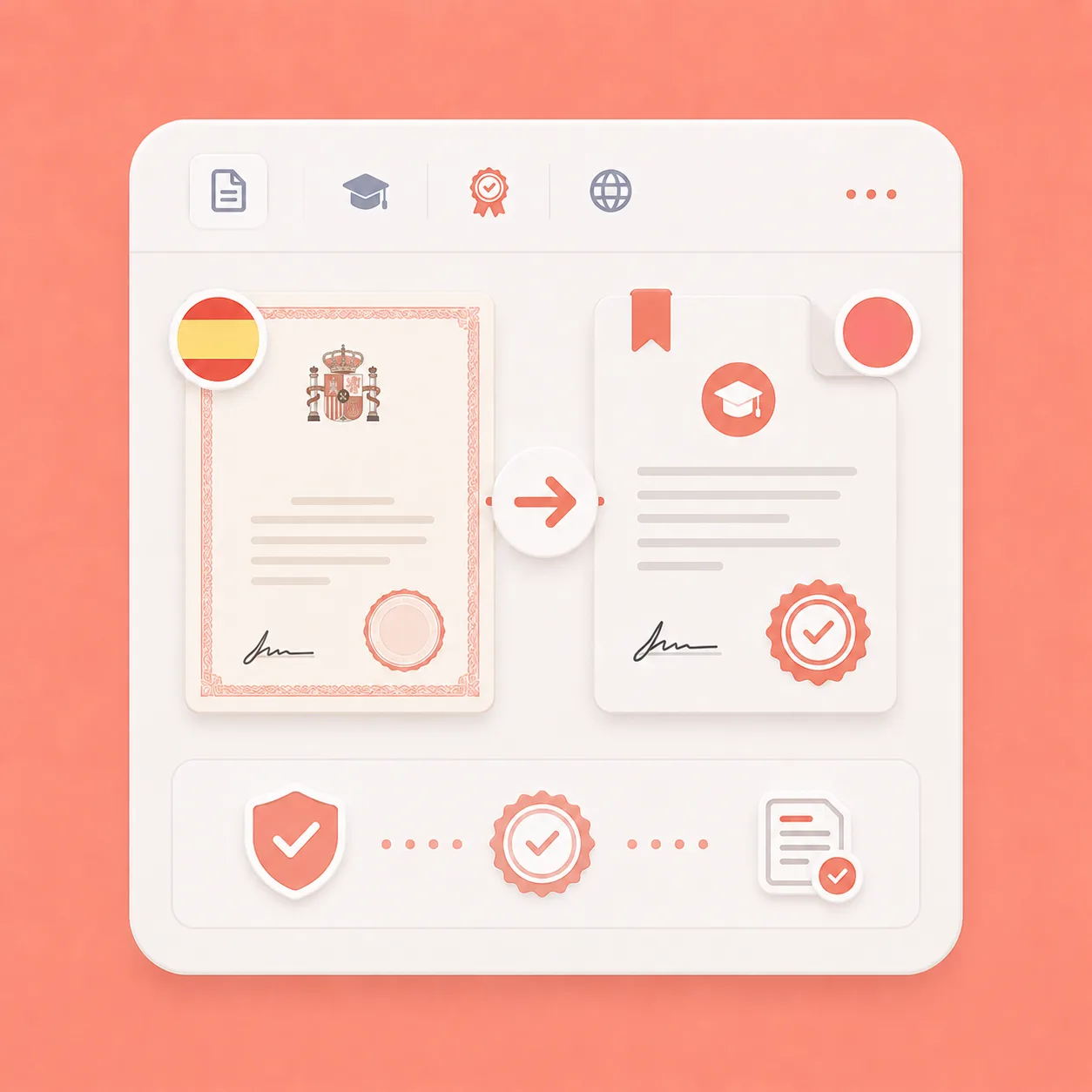
Bridging the gap between your original achievement and an English-speaking institution requires a Certified Spanish Diploma Translation. Think of this process like getting a signature notarized, adding a vital layer of institutional trust to your paperwork. In practice, the professional provides a "Certificate of Accuracy," a formally signed statement swearing that the official spanish translation perfectly mirrors your original text.
Bilingual ability alone cannot satisfy strict application requirements. Government agencies like USCIS demand certified language translation to ensure academic documents are evaluated objectively, proving your hard-earned degree is legitimate. Securing this professional verification guarantees your background is respected by decision-makers, giving you total peace of mind as your paperwork clears the desk on the very first try.
Why a Standard Translation Isn't Enough: The Power of the Certificate of Accuracy
Speaking perfect English makes it tempting to translate your own diploma to save money. However, admissions offices view this as a clear conflict of interest. Reviewers cannot objectively trust that self-translated grades or degree titles haven't been exaggerated to benefit your application. To an official, a standard word swap done by the applicant lacks legal weight.
Without a neutral third party, your application risks immediate delay. Institutions demand a professional diploma translation adhering to strict guidelines from bodies like the American Translators Association (ATA). Universities routinely reject DIY attempts for three specific reasons:
Missing an official, signed Certificate of Accuracy.
Inability to verify the translator's professional credentials.
Suspicion of bias regarding the listed academic achievements.
Reliable certified translation services solve this problem instantly. Working with an ATA certified Spanish to English translator provides an official guarantee that the English version is a complete, unbiased mirror of your original document. This vital layer of trust transforms your credentials into a valid legal record, perfectly preparing you for meeting the USCIS and university bar.
Meeting the USCIS and University Bar: What Official Bodies Actually Require
Every institution plays by its own strict rulebook. Since you already know your target agency, your goal is perfectly matching their standards to prevent frustrating delays. Navigating the USCIS requirements for foreign academic documents, for instance, demands a straightforward certified translation, whereas universities often require a deeper academic review to process your application.
Admissions offices frequently request a credential evaluation from organizations like World Education Services (WES) or other NACES members. These evaluation bodies analyze your coursework to determine your degree's U.S. equivalent, but they cannot proceed without an official transcript translation for WES evaluation that precisely matches the original Spanish layout and terminology.
Depending on your deadline and destination, you might also face an additional hurdle: the notarized affidavit. While submitting an accepted academic translation for immigration purposes generally only requires the translator’s signed certification, certain professional licensing boards demand a notary public witness that signature to definitively prove the translator's identity and add legal weight.
Avoid costly rejection letters by ensuring your submission instantly satisfies the reviewer. A compliant USCIS package routinely requires:
A complete English translation.
A clear copy of the Spanish original.
The formal statement of accuracy.
The translator's verifiable signature and contact information.
What’s Inside the Envelope? The 4 Must-Have Elements of a Valid Translation
Opening your final document translation brings relief, but you must verify its contents before submitting your application. A legitimate translation doesn't just convert words; it uses "visual mirroring." This means the English version replicates the exact layout, tables, and seals of your original Spanish diploma, allowing reviewers to compare both documents side-by-side effortlessly.
Beyond the layout, the most critical page is the Translator’s Attestation. This formal statement transforms ordinary text into a legally binding certified translation. To be universally accepted, this certificate must display four non-negotiable components:
A sworn statement confirming the translation is complete and accurate.
The translator's professional qualifications.
The date of completion and an original signature.
Complete contact information for the translation provider.
Missing even one detail—especially the contact info for verification—can trigger an instant rejection. When required by specific boards, this attestation is upgraded into a notarized affidavit of translation accuracy to definitively prove the signer's identity. Checking these markers ensures your paperwork survives official scrutiny, preparing your application for the next crucial steps.
From Mexican 'Título' to U.S. College Admission: A Step-by-Step Translation Roadmap
Navigating the steps to get a Spanish degree recognized in the United States starts at your desk, not the post office. Translators rarely need physical originals; instead, high-quality electronic copies are the industry standard. Since you already know documents must be perfectly clear to be processed, ensure your scan captures every seal, signature, and corner. Blurry smartphone photos routinely trigger unnecessary processing delays before the actual work even begins.
With a pristine scan ready, the rest of the path is straightforward. Most agencies provide a fast turnaround for official document translation, completing this five-step workflow in just 24 to 48 hours:
Quote Request: Submit your file to receive pricing and timelines.
Requirement Check: Verify if your university needs an Apostille (a separate government certificate that authenticates the original document's signatures).
Translation Phase: Experts accurately convert the text while mirroring the original layout.
Quality Review: The agency verifies strict formatting and linguistic accuracy.
Final Delivery: You receive a Digital Certification—a secure, electronically signed PDF universally accepted by admissions offices.
Figuring out how to translate a Mexican degree for US college admission isn't meant to be a stressful waiting game. With your certified files securely delivered, your application is practically complete. Moving forward confidently simply requires absolute trust in your chosen agency.
Avoiding Rejection: How to Spot a Legitimate ATA-Certified Professional
Handing your academic future over to just anyone is risky. Many applicants confuse a Notary Public with a qualified linguist, but their roles are entirely different. A notary simply verifies identities and signatures; they cannot attest to linguistic accuracy. Furthermore, relying on cheap, machine-only tools often triggers immediate institutional rejection. To secure an accepted professional diploma translation, you need a human expert who understands strict bureaucratic requirements.
Knowing exactly how to vet providers shields you from costly delays. If you are wondering where to find a sworn Spanish translator or legitimate U.S. expert, the American Translators Association (ATA) online directory is your best verification tool. Before committing to certified translation services, always ask these crucial questions:
Are you an active ATA member with a verifiable directory number?
Will the final delivery include a signed "Certificate of Accuracy"?
Do human professionals actively translate and review the text?
Securing verified talent guarantees that admissions offices and government agencies will respect your hard-earned credentials. Once you trust the provider, you can accurately plan your application budget.
The Real Cost of Diploma Translation: Understanding Pricing and 24-Hour Turnarounds
Budgeting for official paperwork feels overwhelming when application fees are piling up. However, the true cost of professional Spanish certificate translation is straightforward compared to the massive expense of a rejected application. While free digital tools save money upfront, institutions routinely reject these uncertified printouts, forcing you to reapply entirely. Reputable providers protect your investment by using a transparent flat-fee pricing model, meaning you pay one predictable rate per page rather than being surprised by hidden charges.
When requesting quotes from academic translation services, several elements dictate your final bill. The main factors that influence the final price of a diploma translation include:
Document Length: A single-page degree costs significantly less than a multi-page university transcript.
Turnaround Time: Standard delivery usually takes a few days, but adding 24-hour rush processing increases the price if you face a strict deadline.
Clear timelines and upfront pricing provide essential peace of mind during stressful application processes.
Your Submission Checklist: Final Steps to Ensure Your Documents Are Approved
Transforming your hard-earned credentials into a recognized asset is a major milestone. You now have the knowledge to navigate complex document requirements for academic credential evaluation and ensure the validity of translated degrees for employment. Before submitting your application, perform this final audit:
Confirm your chosen provider guarantees institutional or USCIS acceptance.
Verify your certified Spanish diploma translation includes a signed Certificate of Accuracy.
Check that the translator’s professional credentials and contact information are clearly visible.
Review all names, dates, and locations for exact spelling matches.
Ensure all original stamps, seals, and footnotes were properly translated or noted.
Save both physical and digital copies of the complete, finalized package.
Satisfying these bureaucratic steps honors the years of study you’ve already completed. With your paperwork perfectly aligned, you can submit your application with complete confidence and step into your future.