Key Takeaways
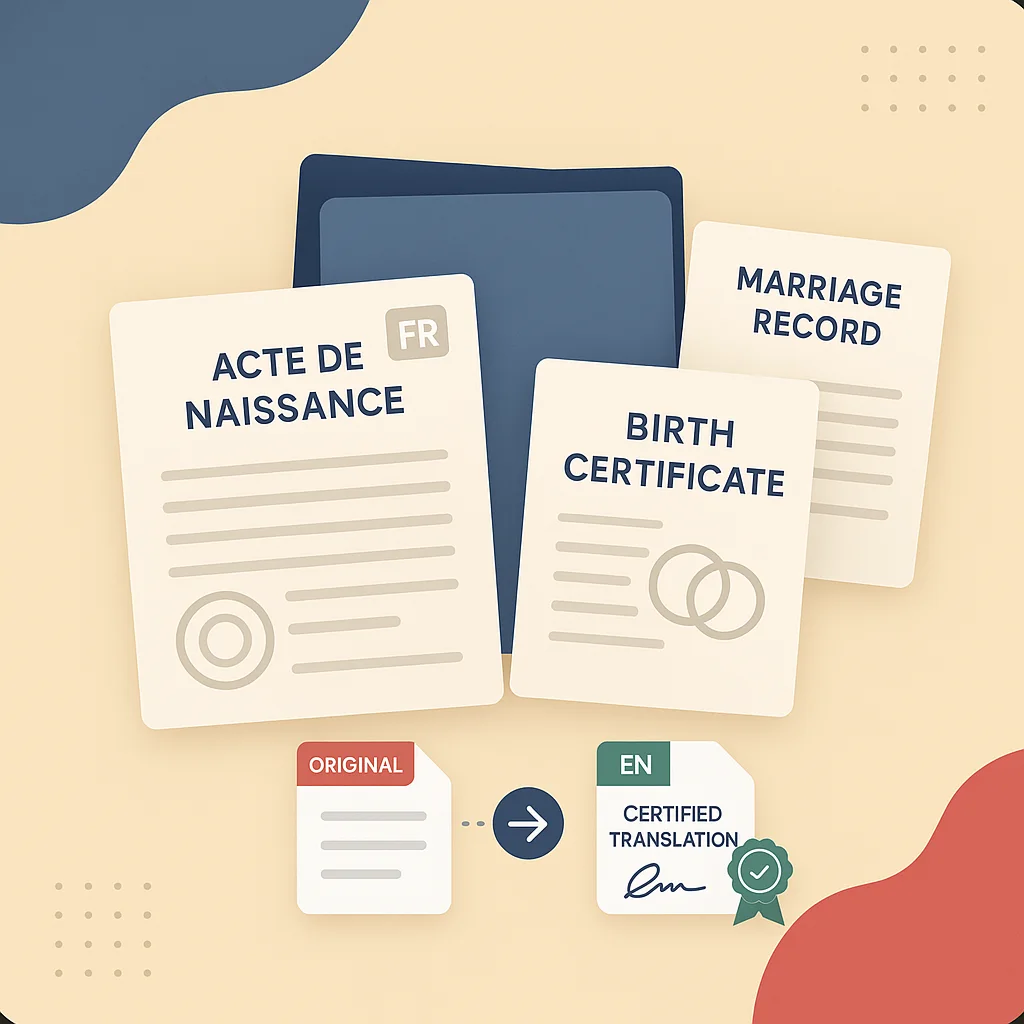
- A Haitian birth certificate for USCIS is usually an acte de naissance in French, and USCIS requires a complete English translation of it with a signed certification.
- USCIS keeps no list of approved translation companies, so a USCIS-certified translation only means one that carries the certification USCIS asks for.
- Applicants should read the Haiti entry in the Reciprocity Schedule before ordering, because translating the wrong version of a civil record wastes the fee and can lead to a Request for Evidence.
- Every copy of a record that goes into the filing, such as a long copy and an archives extract, needs its own certified translation, with names and dates matching across them.
- Older actes follow a fixed legal pattern in formal French, and a faithful translation keeps that order and wording instead of turning the formulas into shorter modern phrasing.
- Complete translation covers handwritten entries, marginal notes, signatures, fiscal stamps, and seals, with unreadable words marked as illegible and empty fields marked as blank.
- Names are reproduced exactly as written on each document, so French and Creole spellings are never corrected, and any explanation of the difference goes into a separate statement.
- Marriage records, death records, national identification cards, court judgments, and late declarations of birth are translated under the same completeness rule as the birth record.
- When no primary record exists, the applicant shows that it is unavailable and submits secondary evidence such as baptismal records, school records, or two affidavits, each with a certified translation.
A Haitian birth certificate for USCIS is usually an acte de naissance written in French, and USCIS requires a full English translation of it with a signed certification. Before ordering that translation, the applicant should confirm which version of the record the filing calls for, because the acte issued at registration and the later extract from the national archives are not always treated alike.
Haitian applicants send records like these with the I-130, the I-485, TPS applications, asylum claims, and the N-400. The translation requirement is the same for each filing. USCIS regulations require a complete English translation, together with the translator's certification that the translation is complete and accurate and that the translator is competent to translate from French or Haitian Creole into English. USCIS does not keep a list of approved translation companies, so "USCIS-certified translation" only describes a translation that carries that certification. When a translation company signs it, the certification is independent of the case, whereas a statement signed by the applicant or a close relative comes from someone with a stake in the outcome and may be given less weight. Texliff provides this as certified document translation for USCIS.
Acte de naissance and archives extract: which Haitian version to translate
The acte de naissance is drawn up by the officier de l'état civil of the commune where the birth was registered, and the register entry is often handwritten. The extract from the national archives is a later copy of that entry. The Department of State's Reciprocity Schedule lists, country by country, which civil documents exist, who issues them, and which version is acceptable. The Haiti entry should be read before anything is sent for translation, because a translation of the wrong version costs the applicant the fee and the time.
Both USCIS adjudicators and consular officers rely on the schedule. If a filing contains only a locally issued acte and the schedule names a different version as the acceptable one, the officer may ask for the missing version through a Request for Evidence. A single record can also exist in more than one form, for example a long copy with every register detail and a shorter extract. Each copy that goes into the filing needs its own certified translation, and the names and dates must agree across all of them.
How handwritten French register entries and legal formulas are translated
Older actes follow a fixed legal pattern. They open with the date and hour of the declaration, name the officier de l'état civil, identify the person who came to declare the birth, and list the witnesses present. The language is formal French with set phrases, and the handwriting can be hard to read. A faithful translation keeps that order and does not shorten the formulas into modern wording.
USCIS expects everything on the page to be translated: the printed form text, handwritten entries, marginal notes added after registration, signatures described as "[signature]", and every stamp and seal. Haitian documents often carry fiscal stamps (timbres fiscaux), and the translation describes each stamp and transcribes its text. A word that cannot be read is marked "[illegible]" and is never guessed. A blank field is marked as blank, and the back of the page is translated when anything appears on it.
Each translated element should sit where the original element sits, so that an officer can match the two pages line by line. A French birth certificate translation follows the source layout for this reason.
Name spellings in French records and Creole usage
Many Haitian families speak Haitian Creole at home, while civil registers are kept in French. A person's name may therefore appear in its French form on the record and in a Creole spelling on a passport, a school record, or the application form. The translation corrects neither spelling. It reproduces the name exactly as written on each document, and if the applicant wants the difference explained, that explanation goes into a separate statement prepared for the filing, not into the translation.
Dates and place names follow the same approach. The commune is transcribed as it appears on the record, and the day, month, and year are rendered so that they can be read only one way. For background on the language itself, Texliff has a guide to certified Haitian Creole to English translation and a page on Haitian Creole translation services.
Other Haitian civil records that appear beside the birth record
Several other records are commonly filed with the acte de naissance, and each is translated under the same completeness rule.
- The acte de mariage, which a spouse-based filing uses to show the marriage and which a French marriage certificate translation renders in full.
- The acte de décès, which a petition or derivative claim needs when it depends on a person who has died, handled as a death certificate translation.
- The carte d'identification nationale, translated front and back, including the number and any printed codes.
- A jugement from a Haitian court that corrects a name or a date on a civil record.
- A late-registered birth, where the déclaration tardive is translated together with the judgment or the documents that support it.
A late declaration shows that the birth was not registered when it happened, so the translation must carry the registration date and every supporting reference exactly as they appear on the record.
Secondary evidence when a Haitian birth was never registered
When a primary record does not exist or cannot be obtained, the applicant first shows that it is unavailable. The proof can be a written statement from the issuing authority or a Reciprocity Schedule entry saying the record is generally unavailable. The applicant then submits secondary evidence, such as church or baptismal records, school records, medical records, or affidavits from people with personal knowledge of the birth, commonly two. Whether that evidence is enough is for the attorney or accredited representative handling the case to decide.
Every piece of secondary evidence written in French or Creole needs its own certified translation. An affidavit translation keeps the first-person wording of the person who gave the statement, including the date, the place, and the signature block. A baptismal record is translated the same way, with the church's stamp and the priest's signature described as carefully as the body text.
What to gather before ordering a Haitian record translation
Gather a full scan of every page, front and back, in the best quality available, and compare the Haiti entry in the Reciprocity Schedule with the copies in hand. Keep one file for each document so that each one receives its own certification. Documents issued in Creole, or documents that mix French and Creole, should be named as such when they are sent. Once the set is ready, we prepare each certified birth certificate translation together with the other records in the same filing, with names spelled the same way as on the source documents.