Key Takeaways
- A damaged or faded document can be translated for USCIS, but the translator marks every unreadable part as [illegible] and never fills gaps from context or from guesses.
- The marker goes on the smallest unreadable part, so one smeared word is marked at that word and longer losses are described by size and position.
- Names, dates, and registration numbers carry the most risk, so a partly readable value is shown as read and the missing portion is marked, not reconstructed.
- The certification can state that the translation was made from a copy of limited legibility, which tells the officer that the gaps come from the source and not the translator.
- Some legibility problems come from a poor scan, so a new image should be made before translation starts, and the marker should describe only a true loss on the paper.
- A good scan lies flat, covers the full page and all four edges, includes both sides, uses color, and is not cropped or shrunk.
- When paper is torn, faded, or water damaged, a new certified extract from the issuing registry or school is usually a stronger fix than translating the damaged copy.
- The Department of State Reciprocity Schedule shows which civil documents a country issues and which version is acceptable, and applicants should check it before ordering a translation.
- If no readable primary record exists, the applicant shows it is unavailable and submits secondary evidence, and each foreign-language piece of that evidence needs its own certified translation.
- For records with missing pages, the translation covers only the pages provided and states the gap, while the attorney decides whether to request the missing pages.
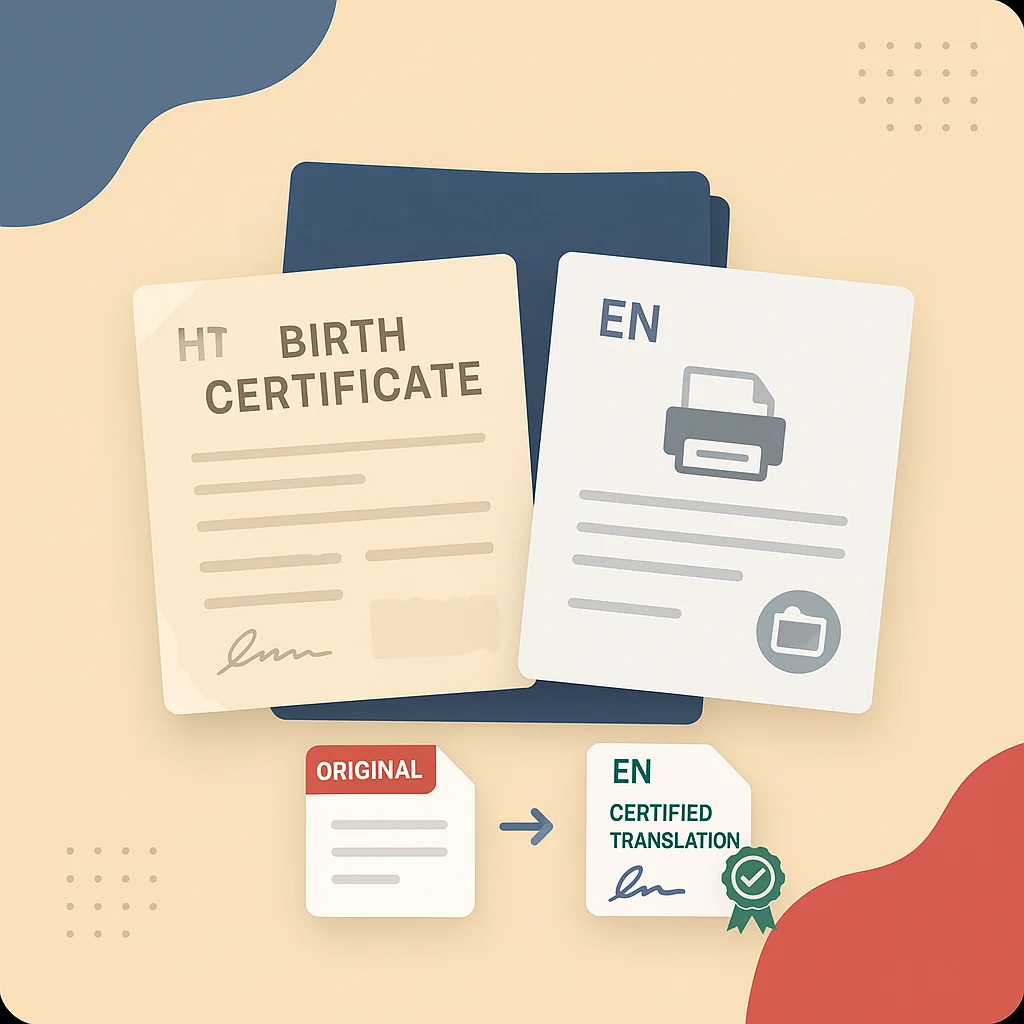
A faded, damaged, or incomplete source document can still be translated for USCIS, but the translation can only be as complete as the page is readable. Anything the translator cannot read is marked "[illegible]" and left alone, and the certification can say that the translation was made from a copy of limited legibility. When the original record is the problem, the better fix is usually a new copy from the office that issued it.
Illegible document translation for USCIS: what the translator may do
USCIS regulations require a full English translation of every foreign-language document, certified as complete and accurate. For a clean page, that means every line, stamp, and signature appears in English. For a damaged page, it means the translator reports what is actually on the page, including the parts that cannot be read. A translator who fills a gap with a reasonable guess has changed the evidence, and the officer cannot tell which words came from the document and which came from the translator.
The same rule applies to names, dates, and numbers, where a wrong guess does the most harm. If the last digit of a registration number is smeared, the translation shows the digits that can be read and marks the missing one. If a month in a date is unreadable but the year is clear, the translator leaves the month marked and does not work it out from other entries on the page.
How "[illegible]" is used inside a certified translation
The marker goes on the smallest part that cannot be read. One unreadable word gets a marker at that word, and the rest of the line is translated normally. Longer losses are described by size and position, for example "[illegible, approximately two lines]" or "[corner torn off, text missing]". A translator may add a short bracketed note about the cause, such as "[faded]" or "[obscured by stamp]", when it helps the officer match the note to the source.
Other elements of the page keep the same treatment they would get on a clean copy. Seals, signatures, handwritten entries, and marginal notes are described or translated, and blank sections are marked as blank. Layout follows the original closely enough that an officer can place each translated line next to its source line. A page that arrives cropped at the edge is a separate problem, because the translator cannot know what sat outside the frame.
What the certification says about a poor source copy
The certification states that the translation is complete and accurate, and that the translator is competent in both languages. When the source is difficult to read, the certification can add a sentence stating that the translation was prepared from a copy of limited legibility and that unreadable portions are marked in the text. The sentence describes the source copy, so the officer does not assume that the original was clear.
USCIS does not keep an approved list of translators or translation companies, and "USCIS-certified" only means the translation carries the certification USCIS asks for. A certified document translation for USCIS that records its own limits openly gives the officer an accurate picture of the file, which a translation that quietly presents a damaged page as clean does not.
When a better scan or a re-issued record is the real fix
Some legibility problems come from the scan and not from the paper. A page photographed at an angle, shot in dim light, or sent through a fax machine often reads better once it is scanned again. A new image should come before the translation, because the marker should describe a true loss on the paper and not a poor photograph.
A usable scan follows these five points:
- Lay the page flat on the scanner glass and scan the entire page, including all four edges.
- Scan both sides of every page, even when the back looks empty, because stamps and notes often appear there.
- Use color, since faded ink and colored stamps separate from the paper better in color than in black and white.
- Do not crop, rotate partly, or shrink the image, and do not fold the page to fit the glass.
- For a multi-page record, scan every page in order, including blank pages and covers.
When the paper itself is faded, torn, or water damaged, the stronger answer is a new copy. A civil registry or school can often issue a fresh certified extract from its own books, and a fresh extract can be translated cleanly. The Department of State's Reciprocity Schedule lists, for each country, which civil documents exist, who issues them, and which version is acceptable. Checking it first shows which version an officer expects, such as a long-form copy instead of an abridged extract. Translating a damaged copy of the wrong version wastes the work.
Birth certificates from handwritten registers
Birth records are the most common example of the problem, because many were written by hand in a register decades ago and copied several times since. A Haitian Creole birth certificate translation often starts from an acte de naissance, an entry written by hand in French in a registry book and then copied again for each new extract. By the time the copy reaches the translator, a stamp may overlap the name, or the ink of a date may have thinned to a few strokes.
In such a case the archives extract is usually the cleaner version, since the registry re-issues it from its own book. Even when the translator reads the handwriting without trouble, as in Haitian Creole translation services, any word that stays uncertain after careful reading is still marked.
If the registry cannot produce a readable record, the applicant can show that the primary record is unavailable, through a written statement from the issuing authority or a Reciprocity Schedule entry, and then submit secondary evidence. School records, church records, and affidavits from people with personal knowledge of the birth all count as secondary evidence. Each foreign-language piece needs its own certified translation.
School and medical records with missing or damaged pages
Academic and medical files raise the same questions with a few additions. An academic transcript translation often arrives as a photocopy of a photocopy, with grades or subject names lost at the margin. The translator marks the lost entries. When the loss affects a grade or a date, the school can be asked for an official reissued transcript.
Medical records translation follows the same rule, and handwritten physician notes are a frequent source of unreadable words. Marking a drug name or dosage as "[illegible]" is always safer than guessing, since a guess in a clinical record can be read as a fact. For records that arrive with missing pages, the translation covers the pages provided and does not suggest that the file is whole.
A set of pages that is incomplete is different from a page that is hard to read. If page 2 of a four-page record is missing, the translation covers pages 1, 3, and 4 and notes the gap. The petitioner or the attorney decides whether to ask the issuer for the missing page, because the translation company cannot supply content that was never sent.
What to prepare before sending damaged documents
Gather the best available copy of each document, scanned flat and in color on both sides, and note which pages are missing or damaged. Ask the issuing office for a new certified copy where one can be obtained, and check the Reciprocity Schedule for the right version. Keep any written statement from an office that cannot reissue a record, since it supports a request to accept secondary evidence. Whether to submit a damaged original or a replacement is a decision for the attorney or accredited representative handling the filing. We mark the unreadable parts in a marriage certificate translation or any other record and state the limits of the source in the certification.