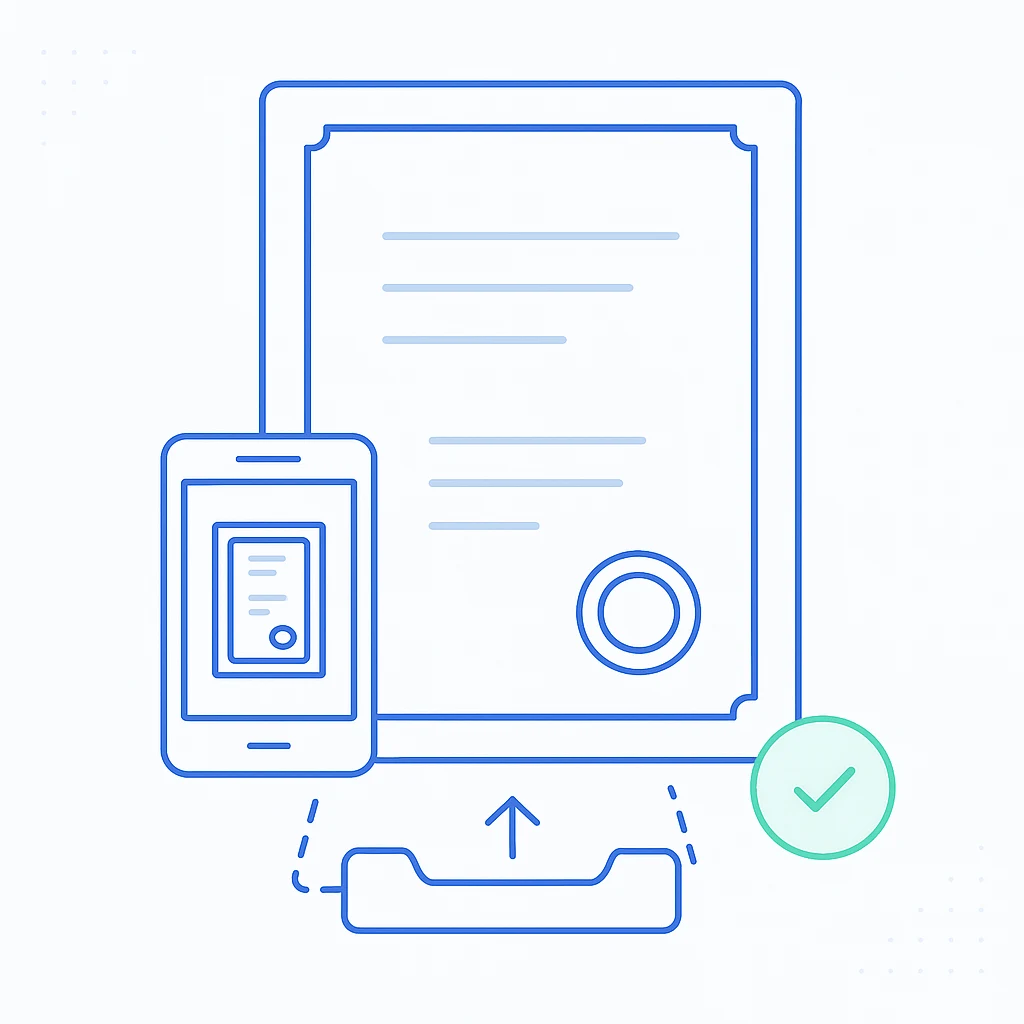
Upload
Upload your Medical Record
Any format, from any device, several documents at once if you need.
Photo, scan or PDF
Medical RecordCertified translation78 languages
Certified English translations of medical records — diagnoses, medications, lab results, and physician notes rendered by medical-specialist linguists, precisely enough for a doctor to act on.

USCIS-accepted
Certified translation

ATA member
American Translators Association

Starting at $24.95
Priced by word count

Certificate of accuracy
Signed, on our letterhead
Upload
Any format, from any device, several documents at once if you need.
Photo, scan or PDF

Price
Priced by word count, so a short document costs less than a dense one. Rush options available.
Starting at $24.95 · Certificate included

Certified PDF
Layout, stamps and seals rebuilt to match the original. Certificate, translation and source copy as one PDF, in your inbox and dashboard.
USCIS-accepted
The price shows before you pay. Every file is covered by an NDA; medical records are handled in line with HIPAA.
Order nowWhere it gets used
Medical records get translated at serious moments: a new doctor taking over treatment, an insurer weighing a claim, a court weighing an injury, an immigration file needing medical facts. Every one of those readers acts on the words — which is why approximation is the one thing this document cannot tolerate.
A US doctor continuing your treatment reads the history to decide what happens next. Translated diagnoses, procedures, and medications become clinical inputs — they have to be exact enough to prescribe against.
Claims for treatment abroad are adjudicated from the records. Clinical language rendered precisely — and consistently across the file — is what keeps a legitimate claim from stalling in review.
Personal injury and disability proceedings put medical records into evidence. Both sides’ experts will parse the wording, so it is translated to survive expert scrutiny.
Medical evidence supports waivers, asylum claims, and disability-based requests. Certified translations with clinical precision are the form adjudicators can actually weigh.
What gets translated
Medical text is its own dialect in every language — abbreviations, units, drug names, template phrases. Translating it well is a specialty, and we staff it as one.

Conditions rendered in standard clinical terminology, so a US physician reads the same medicine the original stated.

Foreign brand names paired with international generic names — the rendering a prescriber can safely act on.

Results reproduced with their original units. Units are data; converting them silently is how translated records cause clinical errors.

Handwritten notes and country-specific abbreviations expanded per source convention, with notes where a reading is uncertain.

Radiology impressions, operative notes, and discharge summaries translated with their structure intact.

Medical handwriting is notorious. What cannot be read is marked illegible in place — guessing in a medical record is malpractice by proxy.
What you receive
Every file and session is covered by an NDA and sent over an encrypted connection. Clinical matters are handled in line with HIPAA.
Before you order
A lifetime of records is rarely the ask — the new cardiologist needs the cardiac history, the claim needs the treatment episode. Scoping to the relevant records is cheaper and produces a file the reader can absorb. Word-count pricing makes the choice explicit.
Lab values only mean something against their reference ranges, and both stay exactly as printed. A physician can interpret original units; nobody can safely interpret silently converted ones.
Records move encrypted, access is limited to the assigned medical linguists, and files are deleted on request after delivery. Sensitive diagnoses get no special routing — everything is handled at the same strict tier.
How it works
Upload and order
Take a clear photo or scan of your medical records and upload it. The word count and the exact price show before you pay.
A translator is assigned
A translator who works with this document type translates it and keeps the layout, stamps and seals in place.
Proofreading and certification
A second translator checks names, dates and numbers against the original, and the Certificate of Accuracy is signed.

Delivered as one PDF
Translation, certificate and a copy of the source in one file, in your inbox and your dashboard.
Pricing is by word count, per document, starting at $24.95. Records vary wildly in density — the quote itemizes each so you can scope the file to the clinical or legal question before paying.
Price my documentThe full directory
Every language and every document type in this family links to its own dedicated page. Priced by word count, both directions, with 24-hour options.
By language — all 78
Each with its own page for this document — into and out of English.
By document type — all 37
From civil records to business content — see the full directory.
Related services: Medical Translation·Certified Translation·USCIS Certified Translation·Document Translation
FAQ
The ones we hear most often, answered by our dispatch and project-management teams.
Can't find it here?
That is the standard they are built to: medical-specialist linguists translate, a second reviews, terminology follows standard clinical usage, and drug names carry their international generics. Where the source is ambiguous or illegible, the translation says so explicitly — a physician needs to know what the record does not establish, too.
No — values and units are reproduced exactly, with reference ranges. Unit conversion in translation is a patient-safety hazard: a silently converted glucose or hemoglobin can mislead a clinician. US physicians handle international units routinely; what they cannot handle is uncertainty about whether a number was altered.
Every drug is rendered with its brand name as written plus the international nonproprietary name — the generic identity a US prescriber recognizes. Where a compound genuinely has no US counterpart, the translation says what it is rather than substituting a cousin.
Yes — every document is delivered as a complete certified translation with a signed Certificate of Accuracy, the format claims departments and adjudicators file. For claims, translating the full treatment episode rather than fragments is what usually prevents follow-up requests.
By word count, itemized per document — starting at $24.95. A discharge summary is a modest order; a full hospitalization file prices by what it actually contains, and you see it all before paying.
Encrypted transfer and storage, access restricted to the assigned linguists, no sharing of any kind, and deletion on request. Medical files are treated as sensitive by default — no flag needed.
Start a project
Upload the records that matter and see per-document pricing and delivery times before you pay. Medical-specialist linguists, strict confidentiality, and a signed Certificate of Accuracy on every document.


