Key Takeaways
- Translate the long form of a birth certificate, the full copy that shows both parents, because an extract with only the child's name, date, and place usually does not establish parentage.
- Many registries issue a short extract and a full copy of the same record, under names such as odpis skrócony and odpis zupełny, or short certificate and certified copy of the entry.
- Filings such as the I-130, I-485, and N-600 rely on a birth record to show the parent and child relationship, so a version without parents' details does not do that job.
- The Department of State's Reciprocity Schedule lists the acceptable birth record version for each country, and USCIS officers and consulates both rely on it, so read the entry before ordering a translation.
- A birth certificate that names both parents with their details and carries registry entry numbers is probably a full copy, while a title with words like extract or abridged points to the short format.
- A certified translation reproduces the source exactly, so translating a short extract produces an accurate English version of a document that still lacks parentage and may lead to a Request for Evidence.
- The correct order of work is to request the full copy from the civil registry first, stating that the version with parents' data is wanted, and to translate it second.
- The translation must cover everything on the page, including the title, field labels, stamps, seals, signatures in brackets, handwritten entries, and marginal notes, with illegible parts marked.
- A translated title and a layout that follows the original let the officer see which version the source was and match each English line to the source.
- Marriage records and other civil documents can also come as extracts or full entries, so the same version check applies before ordering any of them.
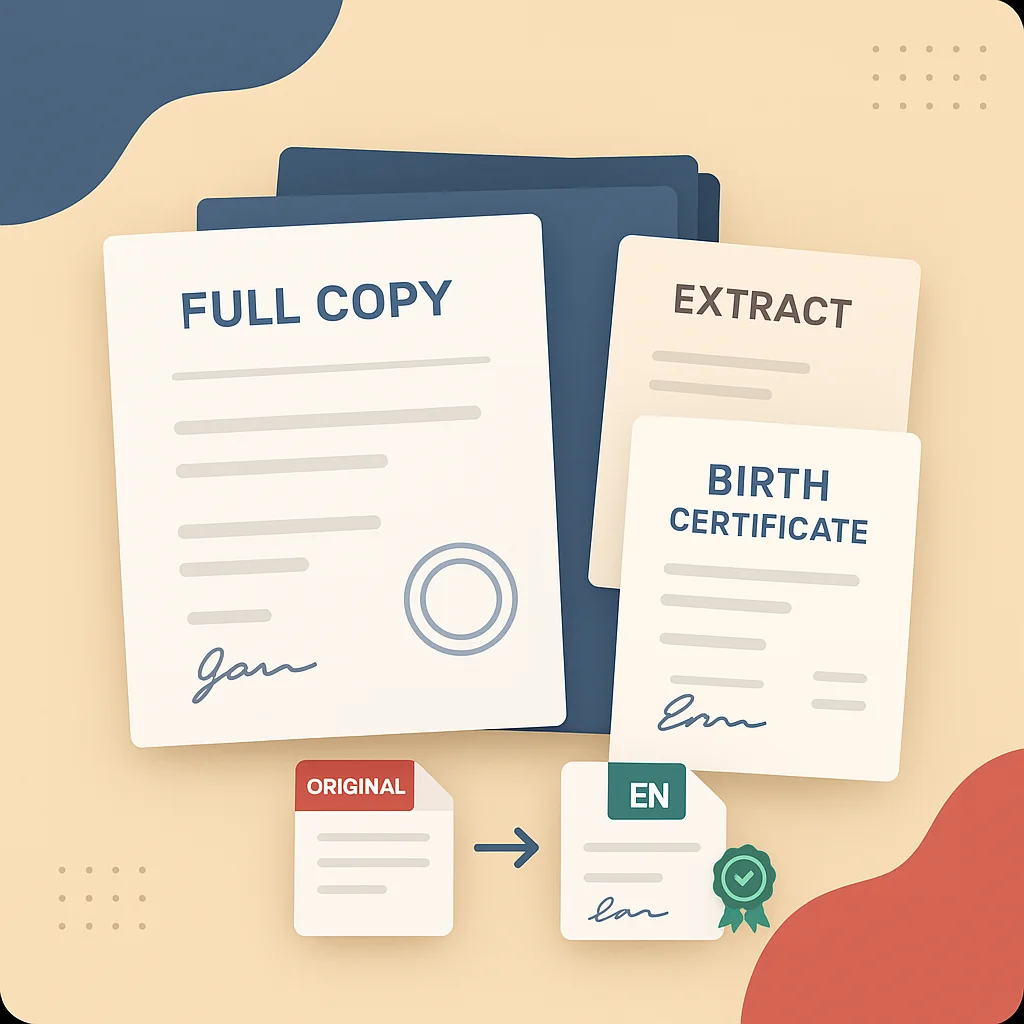
Translate the long form: the full copy of the birth record that shows the child's parents and the registration details. An abridged extract or short certificate that lists only the name, date, and place of birth usually does not establish parentage, and a certified translation of it will not fix that. USCIS, the National Visa Center, and consulates ask for the version that shows who the parents are.
Long-form and short-form birth certificates differ in content
Many civil registries issue the same birth record in more than one format. The short format, called an extract, abridged copy, or short certificate depending on the country, carries the child's name, date of birth, and place of birth, and sometimes the parents' names in a single line. The long format is a full copy of the registry entry. It lists both parents with their details, the declarant who reported the birth, the registration number and date, the registry office, and any later annotations such as a legitimation, an adoption, or a correction of a name.
Filings such as the I-130 Petition for Alien Relative, the I-485 Application to Register Permanent Residence or Adjust Status, and the N-600 Application for Certificate of Citizenship call for a birth record because the relationship between parent and child is the fact being shown. An extract that leaves out the parents cannot show it. Which documents a particular filing needs is for the applicant's attorney or accredited representative to decide.
The Reciprocity Schedule names the acceptable version by country
The Department of State publishes the Visa Reciprocity and Civil Documents by Country schedule. For each country it lists which civil documents exist, who issues them, and which version is acceptable. Both USCIS adjudicators and consular officers rely on it, so the entry for the country of birth is the first thing to read before ordering anything.
The wording of the entries follows each country's own system, and the examples below describe the general pattern rather than replace the schedule:
- Poland issues a full copy, the odpis zupełny, and an abridged copy, the odpis skrócony.
- Brazil issues the certidão de nascimento in a short format and in the inteiro teor, the full transcript of the registry entry.
- Spanish-speaking countries commonly separate a complete birth record (acta completa) from an extract (extracto), and the names of the two vary by country.
- The United Kingdom and Ireland separate a certified copy of the entry from a short certificate.
- The Philippines issues the birth certificate through the Philippine Statistics Authority (PSA), and the PSA copy is the version that is normally filed.
How to tell which version a birth certificate is
The simplest test is to look for the parents. If the document names the mother and the father with their own details, it is probably a full copy. If it shows only the child, or shows the parents' names without anything else about them, it is probably an extract. The title often says so as well: words such as "extract", "abridged", "short", "extracto", or "skrócony" point to the short format, while "complete", "full", "zupełny", "inteiro teor", or "literal" point to the long one.
A second sign is the registration data. A full copy usually carries the registry book, volume, page, or entry number, along with the date of registration and the name of the official who made the entry. Marginal notes on the original entry belong on the full copy, and an extract can leave them out. When the title and the contents disagree, the issuing registry can say which version it produced, and the Reciprocity Schedule entry shows which one the Department of State expects.
Why translating the short form wastes the fee
A certified translation reproduces its source and nothing more. If the source is an extract without parentage, the translation will be an accurate and complete English version of a document that still does not show parentage. USCIS may then issue a Request for Evidence, and the applicant has to order the correct certificate from the registry and pay for a second translation. USCIS policy also allows officers to deny a filing without first requesting more evidence when the initial evidence is insufficient, so sending the wrong version at the start carries a risk of its own.
Applicants who plan ahead order the long form from the registry first and translate it second. The order to the civil registry should state that the full copy with the parents' data is wanted, not the extract. A translation company can work only from the document it is given, so it cannot repair a source that lacks the needed information.
How the translation shows the version type
USCIS requires a full English translation, certified as complete and accurate, with a statement that the translator is competent in both languages. Complete here means everything on the page: the title, the form-field labels, stamps, seals, signatures described in brackets, handwritten entries, and marginal notes. Illegible parts are marked "[illegible]". The title of the original is translated as it appears, so an officer reading the English page can see at once whether the source was an extract or a full copy.
Layout matters for the same reason. When the translated page follows the arrangement of the original, the officer can match each English line to the line in the source. A Polish birth certificate translation of an odpis zupełny, a translation of a Brazilian inteiro teor, and a Spanish birth certificate translation of an acta completa should each show the same fields in the same places, with the annotations carried over. The Texliff post on birth certificate translation accuracy covers the certification statement in more detail.
Other civil documents have the same split
Birth certificates are the most common case, but registries also issue abridged and full versions of other records. A marriage extract, for example, can carry less than the full registry entry. The same check applies to a marriage certificate translation: read the Reciprocity Schedule entry, identify the version, and translate the one the filing needs. When the only copy at hand is an extract, a full copy has to be requested from the registry before translation starts.
Names should also be spelled the same way in every translated document of a case, which takes care with Polish diacritics. Texliff offers Polish translation services and certified document translation for USCIS for the other records a filing needs.
Before sending a birth record for translation, check the country entry in the Reciprocity Schedule, confirm that the document names both parents, and scan every page including the back. Our team prepares each certified birth certificate translation with its own certification and a layout that follows the original.