Key Takeaways
- Form I-140 is the main employment-based immigrant petition used to classify a foreign worker as eligible for a U.S. employment-based green card.
- The correct I-140 category depends on the worker’s qualifications and job type, including EB-1, EB-2, EB-2 NIW, and EB-3.
- Most EB-2 and EB-3 cases require PERM labor certification before the I-140 can be filed, while EB-1 and NIW cases may avoid this step.
- Employers must prove their ability to pay the offered wage through tax returns, annual reports, audited financial statements, payroll records, or similar evidence.
- Beneficiaries must prove that they meet the education, experience, and category requirements with diplomas, transcripts, credential evaluations, and detailed employment letters.
- Any foreign-language evidence submitted with Form I-140 must include a complete certified English translation prepared by a competent neutral third party.
- Common I-140 documents requiring certified translation include foreign diplomas, transcripts, mark sheets, employment letters, birth certificates, marriage certificates, awards, publications, and supporting evidence.
- Premium processing can speed up USCIS action on the I-140 petition, but it does not guarantee approval or shorten the green card backlog if the priority date is not current.
- The priority date determines the applicant’s place in the employment-based green card line and must be checked against the monthly Visa Bulletin.
- An approved I-140 can provide important benefits, including priority date retention and possible H-1B extensions beyond six years when the green card category is backlogged.
- Common I-140 problems include weak employer financial evidence, unclear degree equivalency, incomplete experience letters, outdated forms, missing certified translations, and poor RFE responses.
- Careful document preparation, early credential evaluation, certified translation, valid nonimmigrant status, and close attention to USCIS updates can reduce delays and strengthen the petition.
Navigating the complex landscape of the U.S. immigration system can feel like trying to solve a puzzle with ever-shifting pieces. If your ultimate goal is to build a long-term career and life in the United States, you will inevitably encounter the USCIS I-140 Form. As the primary gateway for employment-based permanent residency, understanding the intricacies of this form, its requirements, and its timeline is essential for both foreign professionals and the U.S. employers sponsoring them.
Whether you are a highly skilled tech worker, a multinational executive, an acclaimed researcher, or an employer looking to retain top global talent, this comprehensive guide will break down the process from start to finish. We will cover the specific requirements of various employment-based categories, processing timelines, common pitfalls, and the exact steps you need to take to ensure a successful outcome.
Let us dive deep into the mechanics of this critical immigration petition and explore actionable tips to make your green card application journey as smooth as possible.
What is the USCIS I-140 Form?
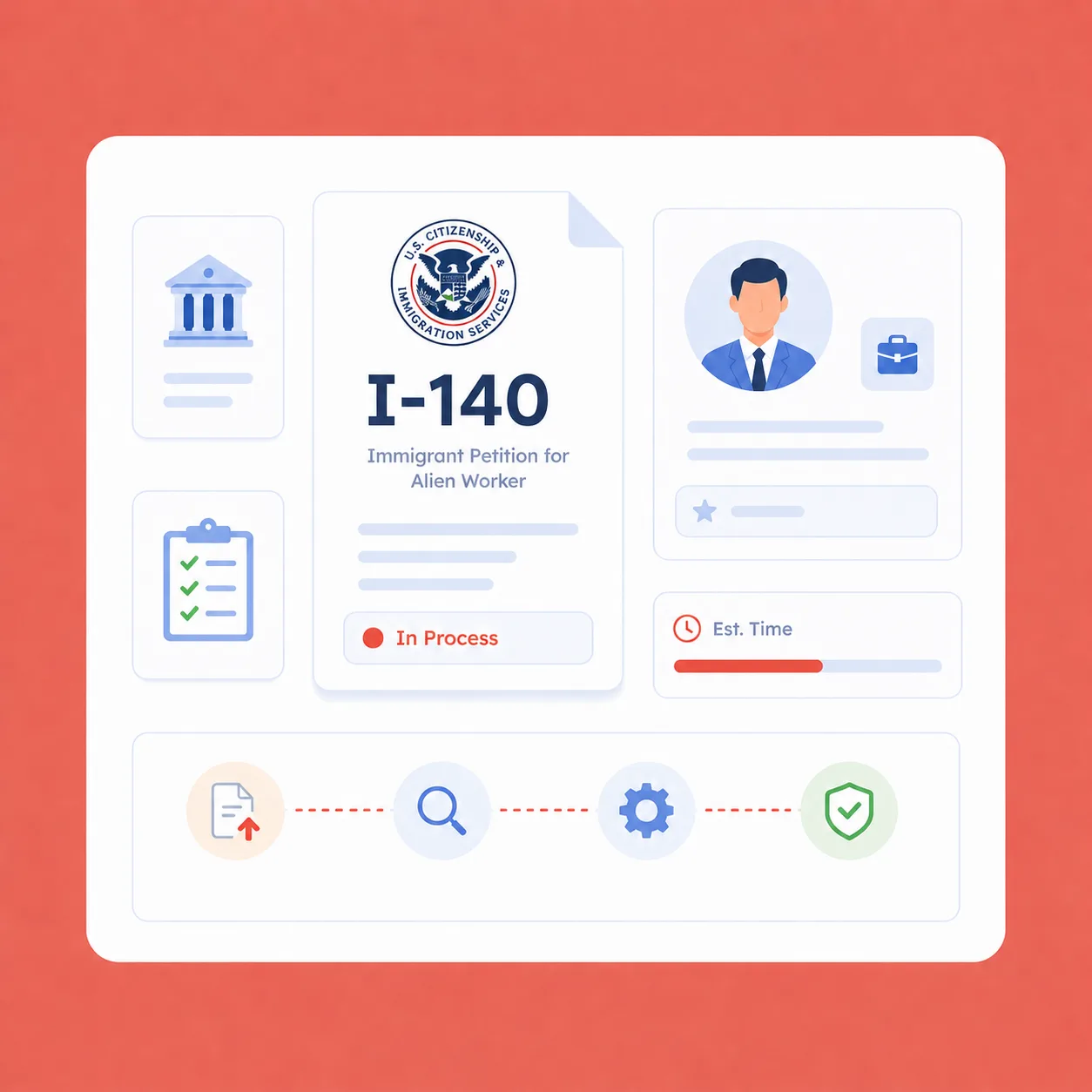
At its core, the USCIS I-140 Form, formally known as the immigrant petition for alien worker, is a document filed with United States Citizenship and Immigration Services (USCIS). Its purpose is to ask the U.S. government to classify a foreign national as eligible for an employment-based immigrant visa.
Filing the I-140 petition is typically the second major step in the employment-based green card process (following the PERM labor certification, if required). It represents a critical shift in your immigration journey: it formally establishes your "immigrant intent," meaning your documented desire to live and work in the United States permanently.
Unlike nonimmigrant visas (such as the H-1B, L-1, or O-1), which only allow you to work in the U.S. temporarily, the approval of an employment-based visa through this form guarantees that the U.S. government recognizes you as a qualifying candidate for permanent residency, subject to visa availability.
Understanding the broader scope of uscis immigration policies is crucial because the rules governing these petitions frequently evolve. Staying informed about how the government processes these requests will help you and your employer avoid unnecessary delays.
Understanding the Employment-Based Green Card Categories
Before you even look at the uscis form i 140 instructions, you must determine which preference category applies to your situation. The U.S. allocates employment-based green cards into different preference levels (EB-1, EB-2, and EB-3). Your eligibility, processing time, and document requirements will vary drastically depending on the category under which your I-140 petition is filed.
First Preference: EB-1
The EB-1 category is reserved for priority workers. The distinct advantage of the EB-1 category is that it generally bypasses the lengthy PERM labor certification process, significantly accelerating the timeline. There are three subcategories here:
1. Extraordinary Ability (EB-1A): To qualify, you must demonstrate that you have risen to the very top of your field in the sciences, arts, education, business, or athletics. The extraordinary ability visa criteria are notoriously strict. You must provide evidence of a major, internationally recognized award (like a Nobel Prize) or fulfill at least three of ten specific criteria, such as:
Receipt of lesser nationally or internationally recognized prizes.
Membership in associations demanding outstanding achievement.
Published material about you in major trade publications.
Evidence of your original scientific, scholarly, artistic, or business-related contributions of major significance.
2. Outstanding Professors and Researchers (EB-1B): This requires international recognition for outstanding achievements in a particular academic field. You must have at least three years of experience in teaching or research in that area and be entering the U.S. for a tenure-track teaching or comparable research position.
3. Multinational Managers or Executives (EB-1C): If you have been employed outside the U.S. for at least one year in the past three years by a firm or corporation, and you are entering the U.S. to continue working for that same company, you might qualify. The petition for multinational executives requires the U.S. employer to have been doing business for at least one year and have a qualifying relationship with your foreign employer.
Second Preference: EB-2
The EB-2 category is for professionals holding advanced degrees (or their equivalent) and individuals with exceptional ability in the sciences, arts, or business.
Advanced Degree Professionals: You must possess a master’s degree, a doctorate, or a bachelor's degree combined with five years of progressive, post-baccalaureate experience in your field.
Exceptional Ability: This requires a degree of expertise significantly above that ordinarily encountered in your field. You must meet at least three specific criteria, such as a degree related to your area of exceptional ability, evidence of 10 years of full-time experience, or a license to practice your profession.
National Interest Waiver (NIW): Usually, an EB-2 petition requires a job offer and an approved PERM labor certification. However, you can request that this requirement be waived if it is in the "national interest" of the United States. To meet national interest waiver eligibility, you must demonstrate:
Your proposed endeavor has both substantial merit and national importance.
You are well-positioned to advance the proposed endeavor.
On balance, it would be beneficial to the U.S. to waive the standard requirements of a job offer and labor certification. The NIW is incredibly popular for entrepreneurs, researchers, and highly skilled professionals who want to self-petition without relying on an employer.
Third Preference: EB-3
The EB-3 category is generally for skilled workers, professionals, and other workers.
Professionals: Require a U.S. bachelor's degree or foreign equivalent, and a bachelor's degree must be the normal requirement for entry into the occupation. Skilled Workers: Require at least two years of job experience or training. Other Workers (Unskilled): Capable of performing unskilled labor requiring less than two years of training or experience.
Analyzing EB2 vs EB3 Green Card Categories
A frequent dilemma for foreign professionals and employers is choosing between the EB-2 and EB-3 categories. When looking at the eb2 vs eb3 green card categories, the primary difference lies in the educational and experiential prerequisites, as well as the wait times.
While EB-2 requires an advanced degree or exceptional ability, EB-3 is accessible to those with just a bachelor's degree or two years of experience. Historically, EB-2 had faster processing times (shorter wait lines for a visa number) than EB-3. However, due to shifting demand and visa allocation, there have been times when the EB-3 line moved faster than EB-2. It is vital to consult the monthly Visa Bulletin published by the Department of State to understand current wait times and make a strategic decision regarding which category to file under.
The Foundation: PERM Labor Certification
Unless you are filing under the EB-1 category or applying for an EB-2 National Interest Waiver, your employer cannot simply fill out the USCIS I-140 Form and submit it. They must first obtain an approved PERM Labor Certification from the Department of Labor (DOL).
The primary goal of the PERM process is to prove to the U.S. government that there are no willing, able, qualified, and available U.S. workers for the position being offered to you, and that hiring you will not negatively affect the wages and working conditions of similarly employed U.S. workers.
Understanding perm labor certification requirements is crucial because the I-140 petition relies entirely on the successful completion of this step. The PERM process involves:
Prevailing Wage Determination (PWD): The employer must request a PWD from the DOL to determine the minimum wage that must be paid for your position in the specific geographic area.
Recruitment Efforts: The employer must conduct a series of mandatory recruitment steps. This typically includes placing two Sunday newspaper advertisements, posting a notice of filing at the worksite, and utilizing three additional recruitment methods (like job fairs, employer websites, or local ethnic newspapers) for professional positions.
Evaluating U.S. Applicants: If any U.S. workers apply, the employer must evaluate them in good faith. Only if no qualified U.S. worker is found can the employer proceed.
Filing the ETA Form 9089: Once recruitment is complete and a mandatory "quiet period" has passed, the employer files the actual PERM application with the DOL.
Only after the DOL certifies the ETA Form 9089 can the employer move forward with the immigration petition by filing the USCIS I-140 Form. It is important to note that an approved PERM certification is only valid for 180 days. The I-140 must be filed within this window, or the PERM expires, and the entire costly and time-consuming process must be restarted.
Essential I-140 Requirements and Documentation
A successfully approved I-140 petition relies heavily on the quality and comprehensiveness of the evidence submitted. The burden of proof is always on the petitioner (the employer, or the individual if self-petitioning) to prove that all i-140 requirements have been met.
1. Establishing the Employer's Ability to Pay
One of the most scrutinized aspects of the I-140 petition is the employer ability to pay evidence. USCIS wants to guarantee that the sponsoring employer has the financial bandwidth to pay you the prevailing wage stated on the PERM labor certification from the time the PERM was filed until you obtain your green card.
To prove this, the employer generally must submit one of the following primary forms of evidence:
Annual reports.
Federal tax returns.
Audited financial statements.
USCIS will look at the employer's net income or net current assets. If either of these figures is equal to or greater than the proffered wage, the ability to pay is established. Additionally, if the employer is already employing you and paying you a salary equal to or greater than the required wage, providing W-2s and pay stubs is excellent evidence.
In cases where the primary evidence falls short, employers with 100 or more workers can sometimes submit a financial officer's statement attesting to the company's ability to pay.
2. Proving the Beneficiary's Qualifications
The petition must also prove that you, the beneficiary, meet all the requirements for the job as outlined in the labor certification or the specific preference category. This usually requires:
Educational Degrees: Copies of your diplomas and transcripts. If your degree is from outside the United States, you will need a formal educational credential evaluation to prove it is the equivalent of the required U.S. degree.
Experience Letters: Letters from previous employers verifying your work experience. These letters must be specific, detailing your job title, exact dates of employment, whether the work was full-time or part-time, and a detailed description of your duties.
3. Dealing with Foreign Documents: The Role of Certified Translation
If any of your evidence—such as university diplomas, transcripts, birth certificates, or letters of experience from overseas employers—is in a language other than English, it must be accompanied by a full English translation.
USCIS regulations are strict regarding this. Any document translation must include a certification from the translator indicating that the translation is complete and accurate, and that the translator is competent to translate from the foreign language into English. This is commonly referred to as a certified translation.
Many applicants confuse translation with interpretation. While interpretation involves translating spoken language in real-time (such as during an immigration interview), translation refers to written text. For your I-140 packet, only written document translation is required.
Common documents that need certified translation include:
Foreign university diplomas and mark sheets.
Employment verification letters from non-English speaking countries.
Birth certificates and marriage certificates (if submitting concurrently with an I-485).
Any published materials, articles, or awards used to prove extraordinary ability (EB-1A) or exceptional ability (EB-2).
Do not attempt to translate these documents yourself, even if you are fluent in both languages. USCIS requires the translation to be completed by a neutral third party to ensure objectivity. Failing to provide a proper certified translation can result in immediate delays or rejections.
Step-by-Step Filing Procedures
Gathering the documents is only half the battle. Assembling and filing the packet correctly is just as critical. Because uscis updates filing procedures for form i 140 periodically—including changing filing fees, lockbox locations, and form editions—it is vital to consult the official USCIS website directly before mailing anything.
Reviewing USCIS Form I-140 Instructions
Before filling out the paperwork, thoroughly read the official uscis form i 140 instructions. These instructions dictate the current filing fee, where to send the application based on your category and geographic location, and how to organize the packet.
A well-organized packet should include:
Form G-28: If an attorney is representing the employer or the self-petitioning alien.
Form I-907: If you are requesting premium processing (more on this later).
Form I-140: The completed and signed petition.
Filing Fee: Ensure the check or money order is for the exact, currently required amount.
Cover Letter: A detailed letter from the employer (or attorney) explaining the petition, how the beneficiary meets the requirements, and an index of the attached exhibits.
Original PERM (ETA 9089): Signed by the employer, the alien, and the preparer.
Evidence of Employer's Ability to Pay.
Evidence of Beneficiary's Qualifications: Degrees, evaluations, and experience letters.
Navigating Form Editions and Updates
As a large bureaucracy, uscis immigration policies and forms are updated to reflect new laws or administrative streamlining. When uscis updates filing procedures for form i 140, they will usually post an alert on their main page. Using an outdated version of uscis forms will result in an automatic rejection, meaning your packet will be mailed back to you, delaying your process by weeks. Always check the "Edition Date" at the bottom of the form against the accepted dates listed on the USCIS website.
Concurrent Filing with Adjustment of Status
One of the most important strategic decisions you can make involves concurrent filing. If a visa number is immediately available in your preference category (meaning your priority date is "current"), you are permitted to file your I-140 petition simultaneously with Form I-485 (Application to Register Permanent Residence or Adjust Status).
The concurrent filing with adjustment of status offers several massive benefits:
Work Authorization: Filing the I-485 allows you to concurrently file for an Employment Authorization Document (EAD), giving you the freedom to work in the U.S. without relying on an H-1B or L-1 visa.
Travel Permits: You can also apply for Advance Parole (AP), allowing you to travel internationally while your green card is pending.
Speed: It consolidates the timeline, as USCIS can process your residency application immediately after approving the I-140, rather than forcing you to wait to submit the I-485.
However, if your priority date is not current, you cannot file concurrently. You must file the I-140 first and wait until your date becomes current before filing the I-485.
Timelines, Wait Times, and Premium Processing
Patience is a virtue in immigration, but it is entirely natural to wonder exactly how long you will be waiting. Processing timelines are influenced by the specific service center handling your case, the preference category, and the overall volume of applications.
Average Processing Times for Immigrant Petitions
The average processing times for immigrant petitions fluctuate wildly. For a standard I-140 petition filed under regular processing, it can take anywhere from 4 to 12 months, or sometimes even longer depending on backlogs at the Texas or Nebraska Service Centers.
USCIS provides a "Processing Times" tool on its website, where you can select your form, category, and service center to see a rough estimate of current wait times. Keep in mind that these are historical averages and not guarantees for your specific case.
Premium Processing for Employment Petitions
If waiting six months to a year is not viable—perhaps your nonimmigrant visa is expiring soon, or your employer urgently needs you to have long-term stability—you can utilize premium processing for employment petitions.
By filing Form I-907 and paying a substantial additional government fee, USCIS guarantees they will take adjudicative action on your I-140 petition within 15 calendar days (or 45 days for certain categories like the EB-1C multinational executive and EB-2 NIW).
"Adjudicative action" means that within the timeframe, USCIS will issue an approval notice, a denial notice, a Notice of Intent to Deny (NOID), or a Request for Evidence (RFE). If they issue an RFE, the premium processing clock stops. Once you submit the requested evidence, a new 15-day or 45-day clock begins.
Premium processing does not increase your chances of approval, nor does it speed up the issuance of the actual green card if your priority date is not current. It solely expedites the adjudication of the I-140 form itself.
Understanding the Priority Date for Green Card
Throughout this process, you will frequently hear the term "priority date." Your priority date for green card processing is essentially your place in the immigration line.
If your case required a PERM labor certification, your priority date is the exact day the Department of Labor received your PERM application.
If your case did not require a PERM (like an EB-1 or NIW), your priority date is the day USCIS physically receives your I-140 petition.
Because Congress limits the number of employment-based green cards issued each year—and limits how many can go to individuals from any single country—massive backlogs exist, particularly for individuals born in India and China.
Every month, the Department of State publishes the Visa Bulletin. You must check your priority date against the dates listed in the bulletin for your category and country of birth. You can only file your final green card application (I-485) and eventually receive your green card once your priority date becomes "current" (i.e., your date is earlier than the cutoff date listed in the bulletin).
Tracking and Managing Your Case
Once your petition is mailed, the waiting game begins. Fortunately, you don't have to wait entirely in the dark.
How to Check Case Status Online
Shortly after your petition is received, USCIS will send a Form I-797C, Notice of Action. This is your receipt notice, and it contains a highly important 13-character receipt number (usually starting with letters like LIN, SRC, EAC, or WAC, followed by numbers).
Knowing how to check case status online is simple. Go to the USCIS Case Status Online portal, input your 13-character receipt number (without dashes), and the system will provide the latest update on your case. Statuses range from "Case Was Received" to "Request for Additional Evidence Was Sent" to the highly coveted "Case Was Approved."
Responding to Request for Evidence (RFE)
It is relatively common for USCIS to pause processing to ask for more documentation. If you check your status and see that an RFE has been issued, do not panic. Responding to request for evidence rfe is a standard part of the immigration process, but it requires careful, deliberate action.
An RFE is issued when the adjudicating officer believes they do not have enough evidence to approve the case under the legal standards. Common reasons for an I-140 RFE include:
Ability to Pay Issues: The officer might want updated tax returns or clarification on the company's financial statements.
Degree Equivalency: If your foreign degree is a three-year bachelor's degree instead of a four-year degree, USCIS may challenge whether it is equivalent to a U.S. bachelor's degree.
Experience Verification: The letters from your past employers might lack specific details regarding your daily duties or fail to confirm you worked full-time.
Translation Deficiencies: If you submitted foreign documents without a proper certified translation, USCIS will demand the correctly translated and certified versions.
When responding to request for evidence rfe, you are given a strict deadline (typically 30 to 87 days). You must submit all requested documentation in a single response packet before the deadline. Failure to meet the deadline will result in an automatic denial of your I-140 petition. It is highly recommended to work closely with an immigration attorney to draft a robust response, as the RFE is essentially your final chance to prove your eligibility.
Life After the I-140 Approval
Receiving the approval notice for your USCIS I-140 Form is a massive milestone. It locks in your priority date and verifies your eligibility for a green card. However, because of the visa backlogs mentioned earlier, the approval of an I-140 does not mean you get a green card immediately. You may have to wait years before you can file the I-485.
Fortunately, an approved I-140 grants you several powerful rights and protections to ensure you can remain in the U.S. while you wait for your priority date to become current.
The H-1B Extension After Six Years
Normally, an H-1B visa is strictly capped at a maximum of six years. If your employer has not started the green card process for you by the time this limit is reached, you must leave the U.S. for a full year before you are eligible for a new H-1B.
However, under the American Competitiveness in the Twenty-First Century Act (AC21), having an approved I-140 petition fundamentally changes these rules. If your I-140 is approved and your priority date is backlogged (not current), you are eligible for an h1b extension after six years.
Specifically, you can apply for H-1B extensions in three-year increments indefinitely until your priority date becomes current and you are able to file your I-485. Furthermore, your spouse holding an H-4 visa becomes eligible to apply for an Employment Authorization Document (EAD), allowing them to work freely in the United States. This provides immense stability for families trapped in the green card backlog.
Changing Jobs After Petition Approval
Another major concern for foreign workers is being tied to a single employer for years while waiting for a green card. What happens if the work environment turns toxic, or you get an incredible offer from a competitor?
Historically, leaving your employer meant losing your green card process and having to start entirely from scratch. Today, thanks to USCIS retention regulations, changing jobs after petition approval is much safer.
If your I-140 petition has been approved for at least 180 days, your employer can no longer revoke the petition in a way that causes you to lose your priority date. Even if you move to a new company, you get to keep the priority date established by the original employer.
It is important to note, however, that keeping your priority date does not mean keeping the actual I-140 petition. Because the I-140 is employer-specific and job-specific (unless it's an EB-1A or NIW self-petition), your new employer will still need to start a new PERM and file a new I-140 petition on your behalf. But because you retain your original priority date, you do not lose your place in the immigration line.
Additionally, if you have reached the stage of concurrent filing with adjustment of status, and your I-485 has been pending for more than 180 days, the AC21 "portability" rules allow you to change jobs without needing a new PERM or a new I-140, provided the new job is in a "same or similar" occupational classification as the original job.
Expert Tips for a Smooth I-140 Process
As you prepare to embark on the employment-based visa journey, keep these expert strategies in mind to avoid delays and maximize your chances of approval.
1. Maintain Flawless Records: From the moment you begin your career, save every piece of documentation. Keep copies of your pay stubs, W-2s, employment contracts, and tax returns. Ensure your university degrees are kept safe.
2. Audit Your Translators: When obtaining a document translation for foreign language evidence, do not use a family member or a cheap, unverified online service. Use professional agencies that specifically understand USCIS requirements for certified translation and interpretation protocols. A rejected translation can add months to your timeline.
3. Proactive Credential Evaluation: Do not wait until it is time to file the I-140 to find out if your foreign degree is equivalent to a U.S. bachelor's or master's degree. Obtain a professional educational evaluation early in the process. If there are discrepancies, you will have time to address them before the PERM or immigration petition stages.
4. Keep Your Nonimmigrant Status Valid: It is an absolute requirement that you maintain your underlying lawful nonimmigrant status (such as H-1B, L-1, F-1 OPT, or O-1) while your I-140 is processing. An approved I-140 does not grant you lawful status by itself; it only categorizes you for an immigrant visa. If you let your nonimmigrant visa expire before you have a pending I-485, you will accrue unlawful presence and jeopardize your entire green card application.
5. Stay Updated on Government Changes: The Department of Homeland Security frequently updates its procedures. Stay vigilant. When uscis updates filing procedures for form i 140 or alters fee structures, compliance is mandatory, not optional. Bookmark the official USCIS pages and regularly check the Visa Bulletin.
6. Build a Strong Case for Self-Petitions: If you are bypassing the employer route via an EB-1A or EB-2 NIW, understand that the burden of proof is incredibly high. You must aggressively document your impact. Gather strong, detailed recommendation letters from independent experts in your field who have not worked with you directly but know of your work. Prove that your extraordinary ability visa criteria are met not just on paper, but in the real-world impact of your achievements.
Navigating Denials and Appeals
Despite best efforts, an I-140 petition can be denied. If USCIS denies the petition, they will issue a written notice explaining the reasons. A denial is disheartening, but it is not necessarily the end of the road. You generally have a few options:
File a Motion to Reopen or Reconsider: Within 30 days, you can file Form I-290B to ask the same USCIS officer to look at the case again. A Motion to Reopen is used if you have new factual evidence to present. A Motion to Reconsider is used if you believe the officer incorrectly applied the law or USCIS policy.
Appeal to the AAO: You can appeal the decision to the Administrative Appeals Office (AAO). The AAO is a higher authority within USCIS that conducts an independent review of the case. Be warned, however, that AAO appeals can take many months, if not over a year, to be resolved.
Refile the Petition: In many cases, especially if the denial was based on easily curable missing evidence (like a missing certified translation that you failed to provide during an RFE), it may be faster and more practical to simply refile a brand-new I-140 petition rather than waiting on a lengthy appeal.
Consulting with legal counsel is absolutely critical if your petition is denied to evaluate the best strategic path forward.
Conclusion
The journey to U.S. permanent residency is a marathon, not a sprint. The USCIS I-140 Form represents the most significant milestone in the employment-based green card process. By understanding the distinct requirements of your specific visa category, meticulously gathering required evidence like employer financials and certified translations, and staying proactive regarding your priority date and processing timelines, you can successfully navigate this complex system.
Whether you are managing an H-1B extension after six years, responding to a complex RFE, or anxiously checking your case status online, knowledge is your best defense against delays. Ensure your documentation is pristine, stay informed about changing USCIS rules, and maintain your nonimmigrant status meticulously.
With patience, strategic planning, and careful attention to detail, the approval of your I-140 petition will pave the way toward achieving your long-term personal and professional goals in the United States.