Key Takeaways
- USCIS regulations require a full English translation of every foreign-language document, with the translator's certification that it is complete and accurate and that the translator is competent in both languages.
- USCIS keeps no approved list of translators, issues no credentials, and does not certify companies, so "USCIS-certified translation" describes the certification and not an endorsement by the agency.
- The certification is the translator's signed statement about their own competence and work, so its value depends on who signs it.
- A separate certification for each document is the safer practice, carrying the translator's typed name, signature, date, contact information, competence statement, accuracy statement, and the document identified.
- When an applicant, petitioner, spouse, or relative signs the certification, that person certifies evidence in their own case, and officers may give the translation less weight or question it.
- The concern is greatest for documents like a marriage certificate, which proves the very relationship being decided, because a party to the case would vouch for its own proof.
- A translation company's certification is independent of the case: it names a translator, gives a company address and telephone number, and lets the same certified translation be reissued from records later.
- A complete translation covers stamps, seals, signatures, handwritten entries, marginal notes, headers, footers, and the back of the page, and marks unreadable passages as illegible instead of guessing.
- Summaries, partial translations, and machine translation alone do not meet the requirement, and a missing or uncertified translation can lead to a Request for Evidence or a Notice of Intent to Deny.
- Academic records, police certificates, medical records, and secondary evidence need certified English translations too, and the attorney or accredited representative decides which documents are submitted.
USCIS regulations require that every foreign-language document in a filing come with a full English translation and a certification from the translator. The certification states that the translation is complete and accurate and that the translator is competent to translate from that language into English. The rule names no license, degree, or approved provider, so the practical question is who can sign that statement credibly, and the answer depends on who stands behind it.
An officer reads the certification beside the translation and sees the name, the contact details, and how the signer relates to the case. A certification from someone with no stake in the outcome reads as an independent statement. A certification from the person asking for the benefit reads differently. A translation company that prepares certified document translation for USCIS supplies the independent version.
USCIS does not keep a list of approved translators
USCIS does not publish a list of approved translators or translation companies, does not issue translator credentials, and does not certify companies. The phrase "USCIS-certified translation" therefore describes a translation that carries the certification USCIS asks for. It does not describe an endorsement by the agency, and no company can truthfully claim one.
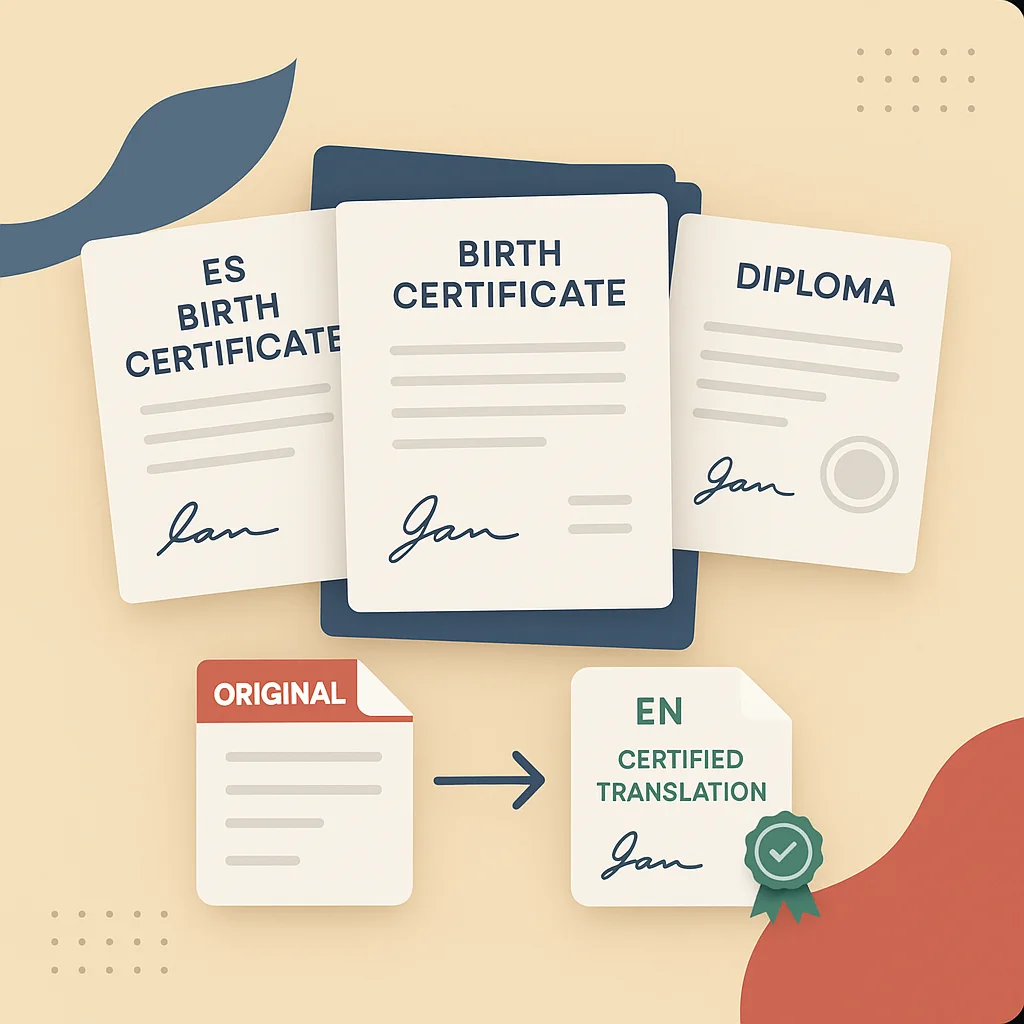
Because the regulation sets a statement and not a credential, the weight of a translation rests on the statement itself. The certification is a signed declaration by the translator about the translator's own competence and about the work. In practice it carries the translator's typed name, signature, date, and contact information, a statement of competence in both languages, a statement that the translation is complete and accurate, and an identification of the document that was translated. Preparing a separate certification for each document is the safer practice, because every document then travels with its own statement.
Why the applicant should not sign the certification
When an applicant, a petitioner, a spouse, or a close relative signs the certification, that person is certifying evidence in their own case. The regulation does not list who may translate, but the certification was not designed for this situation. It exists so that the officer can rely on a statement from someone other than the party who benefits from the document, and a signer who belongs to the case cannot give that.
Officers may give such a translation less weight, and they may question it. They can ask who prepared the translation, whether the signer reads the original at a professional level, and who the officer can contact to confirm how the translation was made. For a family member's certification, the only people to contact are other parties to the case.
The concern grows with the type of document. A marriage certificate translation filed with an I-130 or an I-751 is evidence of the relationship itself, so a translation certified by one of the spouses asks the officer to accept a party's own statement about the proof of the very thing being decided. Birth certificates, divorce decrees, and police records raise the same concern. When the officer doubts a translation, the usual result is a Request for Evidence (RFE), and in some cases a Notice of Intent to Deny (NOID). USCIS policy also allows officers to deny a filing without first issuing a request when the initial evidence is insufficient.
What a translation company's certification provides
A translation company's certification is independent of the case. The signer is a named translator with no interest in the result, the company has a physical address and a telephone number, and the officer can see whom to contact. If a page is lost, questioned, or needed again for a later filing, the company can reissue the same certified translation from its records, with the same wording and the same signer details. A translation prepared by the applicant leaves no such record behind it.
Competence is the other half of the statement. The translator must read the source language, including handwriting, abbreviations, and the style of a particular registry, and must write English that a US officer reads without confusion. Names, dates, and place names have to match the passport and the other evidence in the file. A Spanish birth certificate translation shows why: the two-surname naming pattern, the registry stamps, and the marginal notes all have to appear in the English text. A company that offers Spanish translation services applies the same checks to every Spanish record, and the same applies in other languages.
What a complete translation contains for the officer reviewing it
An officer reviewing a file compares the original, the translation, and the certification. The checks are practical. The officer looks at whether the translation accounts for every stamp, seal, and handwritten entry on the original, whether the spelling of names and the format of dates match the passport and the application form, and whether the certification says who the translator is and how that person can be reached.
The translation settles each of these points on the page when it is complete. "Complete" means everything on the original is represented: body text, headings, form-field labels, stamps, seals, signatures, handwritten entries, marginal notes, headers, footers, numbering, and the back of the page if it carries anything. A signature appears as "[signature]" and an unreadable passage appears as "[illegible]" instead of a guess. Blank sections are marked as blank. The layout follows the original closely enough that the officer can match each translated element to its source.
Summaries, extracts, and translations of only the relevant pages do not meet the requirement. The exception is a newspaper or publication, where only the relevant article is translated. Machine translation alone carries no human certification and mishandles names, dates, abbreviations, and legal terms, so it does not meet the requirement either.
Documents beyond civil records that need a certified translation
The rule applies to every foreign-language document in the filing, and civil records are only one group. Academic records, police certificates, medical records, and letters from employers all need a certified English translation when the original is in another language. Secondary evidence, such as church records, school records, or affidavits used when a primary record is unavailable, needs one too. Once a case is with USCIS, everything must be in English, so the official-language exception that applies at NVC and consulates does not help in a USCIS filing. The USCIS document translation requirements post lays out the general rule in more detail.
The attorney or accredited representative on the case decides which documents to submit. Before ordering, gather clear scans of every page of each original, including the backs, and check the spelling of every name against the passport. A diploma, for instance, needs its own certification and a certified diploma translation that includes the seal and the registrar's signature. Texliff prepares each translation with its own certification, so the file shows one signer's statement per document.