Key Takeaways
- A certificate of single status states that a person is unmarried or free to marry, and a foreign-language copy needs a complete certified English translation for USCIS and K-1 cases.
- The certificate has different names by country, such as certificado de soltería or certificat de célibat, and the translation renders the wording that appears on the page.
- Registry formulas, file numbers, clerk titles, stamps, seals, and signatures all appear in the translation, and partly unreadable text is marked as illegible instead of guessed.
- Documents filed with USCIS for a K-1 petition must be in English, while the consulate applies its own rules to documents presented at the visa interview.
- Applicants should check the Department of State Reciprocity Schedule for the issuing country before ordering a translation, so the correct version of the certificate is translated.
- The issuing country sets how long a certificate stays valid, and the translation reproduces the issue date and any expiry wording exactly as written.
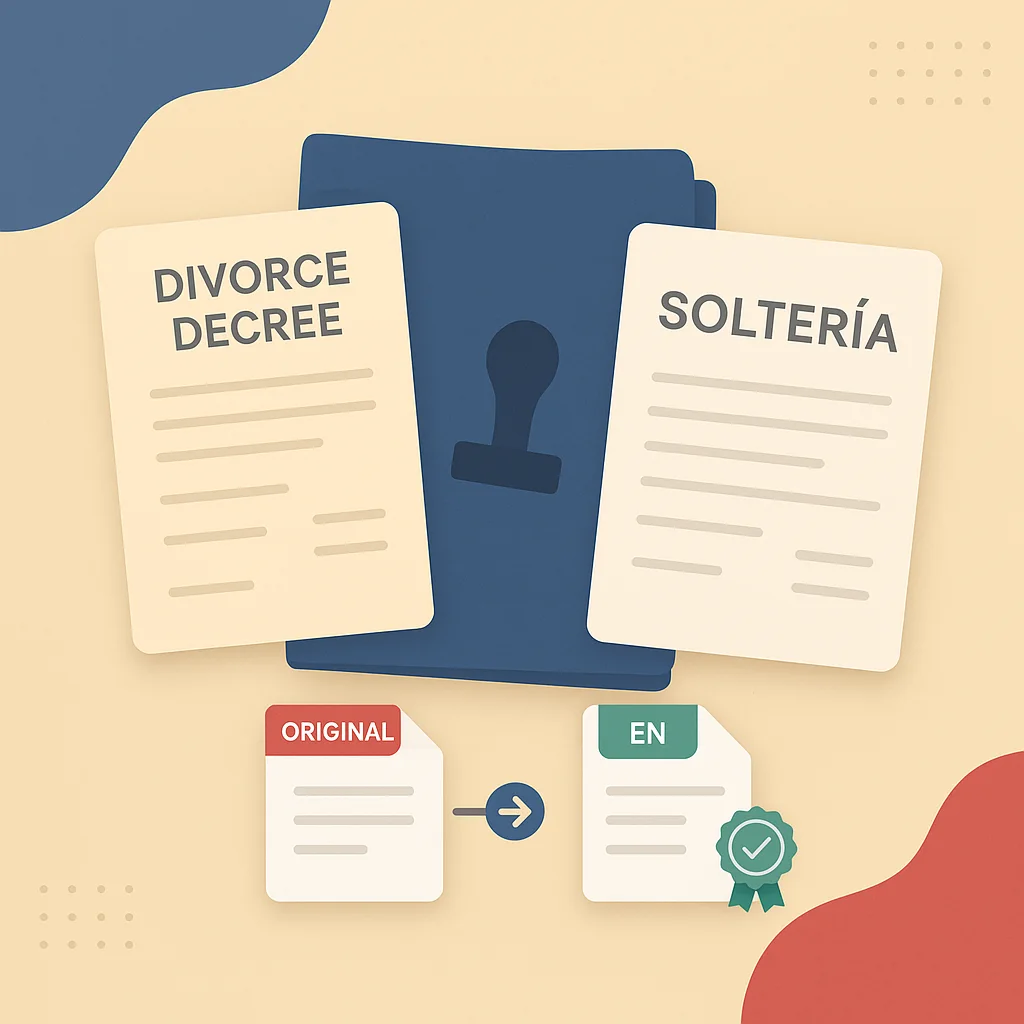
- A person with an earlier marriage may need a divorce decree or a death certificate translated along with the new civil status certificate.
- Names, dates, and places should be spelled consistently across all translated civil documents, and real differences between the sources are reproduced rather than corrected.
- A foreign registry may ask the US citizen for a statement of freedom to marry, and that statement is translated from English into the registry's language.
- The attorney or accredited representative decides which documents go into a K-1 filing, and the translation company prepares each document with its own certification.
A certificate of single status is a civil registry document stating that a person is unmarried or free to marry, and a copy in a foreign language needs a complete certified English translation before USCIS will accept it. The certified document translation for USCIS process treats it like any other civil record. In a K-1 case the consular officer may also ask for it, and a translated copy is the usual way to present it.
The document goes by different names depending on the country that issues it. Spanish-speaking registries issue a certificado de soltería, French-speaking ones a certificat de célibat, and German-speaking ones a Ledigkeitsbescheinigung. Some countries instead issue a certificate of no impediment to marriage, which says the registry knows of no legal obstacle to the marriage. Others record the statement as an affidavit of single status made before a local authority. The translation company renders whichever wording appears on the page and does not swap one type of certificate for another.
What a certificate of single status contains
Most of these certificates are short. They give the person's full name, date and place of birth, parents' names, and nationality, followed by a statement of civil status such as single, unmarried, or never married. The issuing office adds its name, a registry or file number, a date, a signature, and usually a stamp or seal. Some countries add a line stating the purpose, for example that the certificate is issued for a marriage abroad or for presentation to a consulate.
Each of these elements appears in the translation. Registry formulas such as "no consta que haya contraído matrimonio" or "n'a jamais contracté mariage" are translated as the formal statements they are, and the file number, the clerk's title, and the stamp text are carried over. A stamp that is partly cut off is marked "[illegible]" instead of being completed by guesswork. The whole certificate is translated, because USCIS regulations require a complete English translation with the translator's certification of accuracy and competence.
Certificate of single status translation for a K-1 case
The K-1 process begins with Form I-129F, Petition for Alien Fiancé(e), filed with USCIS, and the foreign fiancé(e) later attends an interview at a US consulate. Everything filed with USCIS has to be in English, so a single status certificate attached to the petition needs a certified translation. For documents presented at the consulate, the consular officer applies the rules of that post. Civil documents that are not in English or in the official language of the country generally need a translation with the translator's signed statement of accuracy and competence.
The foreign fiancé(e) usually obtains the certificate from the civil registry of the place of birth or residence. Before ordering a translation, the applicant should check the Department of State's Visa Reciprocity and Civil Documents by Country schedule for that country, since it describes which documents exist and which version is acceptable. A certificate that the consulate would not accept is a wasted translation.
Validity dates on foreign single status certificates
Many countries limit how long a certificate of single status stays valid after it is issued, and the issuing country sets that window, not USCIS or the translation company. The translation reproduces the issue date, any expiry wording, and any phrase such as "valid for the purpose stated" exactly as written, so the officer can read the date against the filing or interview date. If the original states no validity, the translation says nothing about it either. Whether a certificate is recent enough is a question for the consulate or the attorney handling the case.
Earlier marriages: divorce decrees and death certificates
A person who was married before may not be able to obtain a certificate saying they have never married. The registry may instead issue a certificate of civil status that records the earlier marriage and how it ended. The file then needs the paperwork showing that the earlier marriage is over: a translated divorce decree if it ended by divorce, or a death certificate translation if the former spouse died.
The names, dates, and places should be consistent from one document to the next. A spelling variant of one name, or a date that differs between documents, invites a question from the officer. A translation company keeps the spelling of names the same throughout, following the passport where one is available, and it reproduces any differences that actually exist in the sources rather than quietly fixing them. The marriage certificate translation for the earlier marriage belongs in the same set when the registry record refers to it, and a French marriage certificate translation follows the same rules as any other language.
What a foreign registry asks of the US citizen
The paperwork can also run the other way. A foreign civil registry that is about to record a wedding abroad may ask the US citizen for proof of freedom to marry. The United States does not issue a single national certificate of that kind, and registries often accept a signed statement made by the citizen, or a similar document, depending on local rules. The registry decides what it will take, so the citizen should ask it directly.
When the registry needs the statement in its own language, the translation runs from English into the foreign language. A signed Spanish affidavit translation for a wedding in Mexico or Spain is a typical example, and the same process applies to other registry languages. The foreign office tells the couple whether it accepts the translation company's certification.
How the translation is prepared
The certification attached to the translation carries the translator's typed name, signature, date, and contact information, a statement of competence in both languages, a statement that the translation is complete and accurate, and an identification of the document translated. A separate certification for each document is the safer practice. Machine translation alone has no human certification and mishandles names, dates, and legal terms, so it does not meet the requirement.
Layout follows the original closely enough that an officer can match each translated line to the source. The registry book and page reference, the printed form labels, the handwritten entries, and the signature (described as "[signature]") all stay in position. A certified French to English translation follows the registry vocabulary of the issuing country, and a term such as célibataire is translated according to the statement it makes on that page.
The attorney or accredited representative decides which documents to submit with a K-1 filing or consular case. For the translation itself, prepare a clear scan of the whole certificate, including any back page, along with the divorce or death records if an earlier marriage is involved. Texliff prepares the full set together, including an affidavit translation when the registry wants a signed statement in a second language.