Key Takeaways
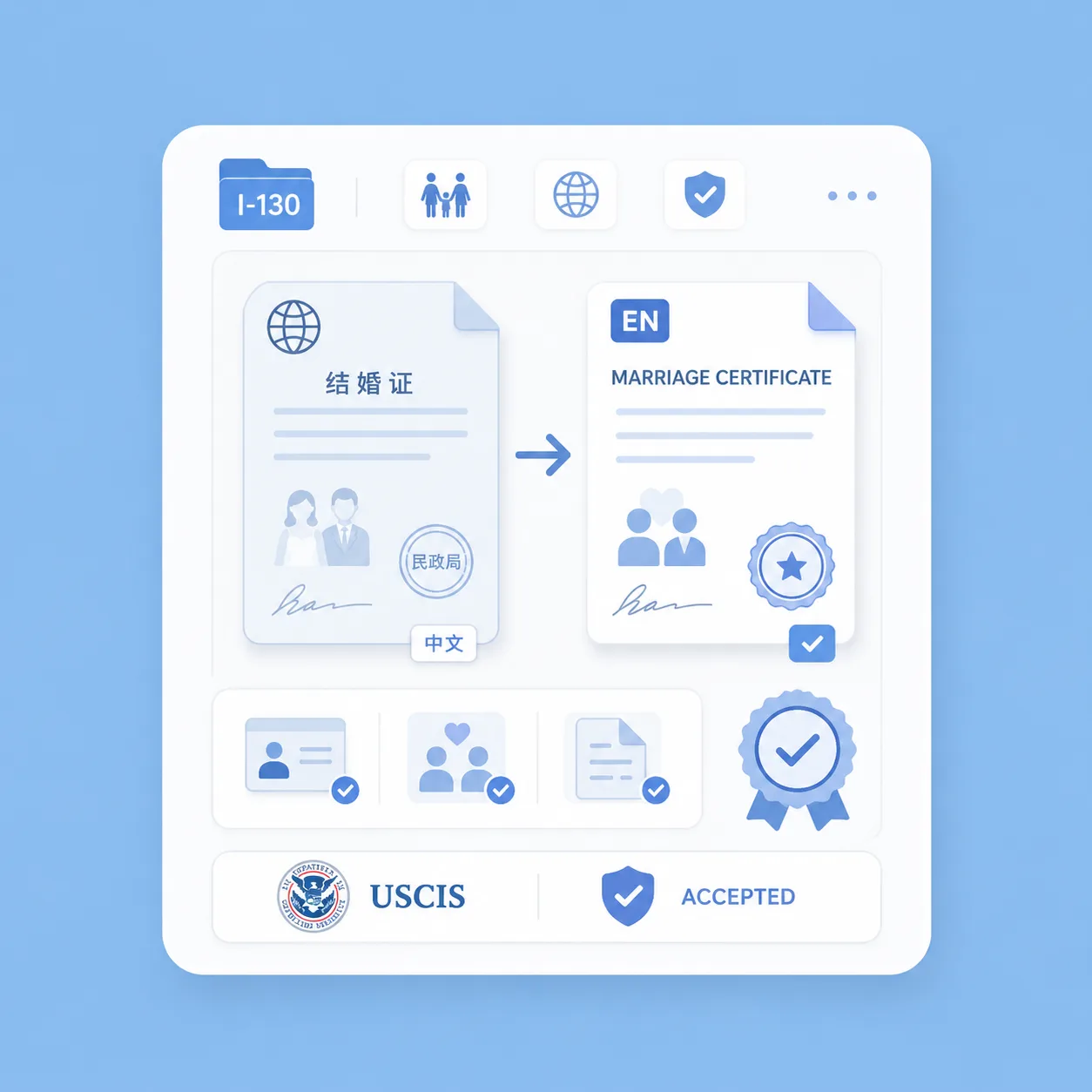
- Certified document translation is a key requirement for many Form I-130 applications when supporting documents are not originally in English.
- Form I-130 relies on vital records to prove the qualifying family relationship between the petitioner and the beneficiary.
- USCIS requires non-English documents to be translated fully and accurately so officers can review identity, family ties, and legal status clearly.
- A certified translation must include a signed translator statement confirming accuracy, completeness, and competence in both languages.
- Common I-130 documents requiring certified translation include birth certificates, marriage certificates, divorce decrees, death certificates, adoption records, and secondary evidence.
- Every stamp, seal, signature, annotation, and handwritten note should be translated or clearly marked if illegible.
- Applicants should not translate their own documents because self-translation creates a conflict of interest and may raise credibility concerns.
- Certified translation and notarized translation are different; USCIS generally requires certification of accuracy, while notarization only verifies the signer’s identity.
- Long-form vital records are often safer for I-130 petitions because they usually contain the parentage and relationship details USCIS needs to verify.
- Inaccurate, incomplete, or summary-style translations can trigger RFEs, delays, or possible denial.
- Name spelling, transliteration, dates, and document formatting should be checked carefully against passports, forms, and other immigration records.
- If a required civil record is unavailable, applicants may need a Certificate of Non-Existence and translated secondary evidence.
- Professional immigration translation services can help reduce risk by providing complete, certified, USCIS-ready translations.
- A final I-130 translation checklist should confirm clear copies, full translations, signed certification letters, translator contact details, translated seals and stamps, matching names, and saved copies for records.
Filing a Form I-130, Petition for Alien Relative, is often the most critical first step in bringing your loved ones to the United States. Whether you are a U.S. citizen or a lawful permanent resident, sponsoring a family member involves navigating a maze of paperwork, strict guidelines, and legal prerequisites. Among the most crucial, yet frequently misunderstood, components of this process is the Certified Document Translation for I-130 Applications.
When you submit an application to the United States Citizenship and Immigration Services (USCIS), every piece of evidence matters. If your relative’s foundational documents—such as a birth certificate or a marriage certificate—are not in English, they must be translated. However, you cannot simply hand these documents to a bilingual friend. USCIS requires absolute precision, demanding that all foreign-language documents be accompanied by a certified translation.
In this comprehensive guide, we will explore the ins and outs of certified document translation for I-130 applications. From understanding exact USCIS requirements to avoiding common pitfalls that could delay your processing time, you will learn everything necessary to ensure your family sponsorship visa petition is accepted without unnecessary hurdles.
Understanding Form I-130 and the Need for Translated Documents
The Form I-130 is the standard application used to establish a qualifying relationship between a U.S. citizen or permanent resident and an immigrant seeking a green card. Proving this relationship is the absolute foundation of your petition.
To prove this relationship, USCIS demands vital records. These documents serve as hard evidence of birth, marriage, divorce, or adoption. When these documents originate from outside the United States, they are typically issued in the official language of that foreign country.
USCIS adjudicators conduct their reviews in English. Therefore, any non-English document must undergo rigorous immigration document translation. The goal is to provide the reviewing officer with a completely accurate, word-for-word English rendition of the original document, allowing them to verify the immigrant's identity and their exact relationship to the sponsor.
Failure to provide a certified translation can result in your petition being rejected, denied, or significantly delayed through a Request for Evidence (RFE).
USCIS Requirements Decoded: What Makes a Translation "Certified"?
Many applicants wonder how to translate non-English documents for visa petitions correctly. To satisfy USCIS requirements, a translation must be "certified." But what does that actually mean in the context of U.S. immigration?
A certified translation is a translated document accompanied by a signed statement from the translator. This statement must attest that the translation is complete and accurate, and that the translator is fully competent to translate from the foreign language into English.
Can I Translate My Own Documents for USCIS?
One of the most common questions applicants ask is, "Can I translate my own documents for USCIS?"
The short answer is: No, it is highly discouraged and often rejected.
While the USCIS policy manual states that anyone competent in both English and the original language can theoretically provide a translation, translating your own documents is a massive conflict of interest. Adjudicators prefer objective, third-party translations to prevent fraud. Furthermore, specialized legal and bureaucratic terms in foreign vital records require a level of linguistic expertise that native speakers might not possess. Relying on professional translation services for green card applications is the safest, most reliable route to take.
Qualified Translator Signature Requirements
For a translation to be officially certified, it must meet specific qualified translator signature requirements. The certification letter must include:
A statement affirming the translator's fluency in both English and the source language.
A statement affirming that the translation is entirely accurate to the best of their abilities.
The translator’s full printed name and signature.
The date of the translation.
The translator's complete contact information (address, phone number, and email).
Translator Certification of Accuracy Sample
To give you a clearer picture, here is a standard translator certification of accuracy sample that satisfies USCIS criteria:
"I, [Translator's Full Name], certify that I am fluent (conversant) in the English and [Foreign Language] languages, and that the above/attached document is an accurate translation of the document attached entitled [Name of Document].Signature: ________________________Date: [Date]Typed Name: [Translator's Full Name]Address: [Translator's Address]Phone: [Translator's Phone Number]"
Ensuring your certified translation services include a letter formatted precisely like this will save you from bureaucratic headaches down the road.
Types of Vital Records You Need to Translate
Depending on your exact relationship with the beneficiary (spouse, child, parent, or sibling), the i-130 document translation requirements will vary. Here are the most common vital records that require certified immigration translation.
Birth Certificates
The birth certificate is the most vital document in any immigration case. It proves identity, age, and parentage. USCIS translation requirements for birth certificates are notoriously strict. The translation must include all seals, stamps, and signatures present on the original.
Marriage Certificates
If you are sponsoring a spouse, translating foreign marriage certificates for family sponsorship is mandatory. The translation must clearly show the date and location of the marriage, the names of both parties, and the official recording of the event by a civil authority.
Divorce Decrees and Annulment Papers
If either the sponsor or the immigrant has been married previously, you must prove that all prior marriages were legally terminated. Translating divorce decrees for permanent residency applications proves to the U.S. government that you are legally free to marry your current spouse.
Death Certificates
Similar to divorce decrees, if a previous marriage ended due to the passing of a spouse, a translated death certificate is required to prove the termination of that marriage.
Navigating Specific Language Needs for Global Immigration
Family immigration to the United States is incredibly diverse. Sponsors bring relatives from all over the world, meaning the demand for various language translations is vast. While the standard of accuracy remains the same across the board, different regions have unique document formats that translators must expertly navigate.
Translating Spanish to English
Because a large percentage of U.S. immigrants come from Latin America and Spain, the need to translate Spanish to English is incredibly common. However, a Spanish translation must account for regional dialects and bureaucratic phrasing. A birth certificate from Mexico, for example, looks very different and uses slightly different legal terminology than a birth certificate from Colombia or Spain. Professional translators understand these nuances.
Translating Vietnamese to English
Vietnamese translation presents unique challenges due to the use of diacritics and different naming conventions. When you translate Vietnamese to English, the translator must ensure that names match exactly with the passport and other identifying documents. Even a minor misspelling caused by misinterpreting a tonal mark can trigger an RFE.
Translating Haitian Creole to English
With robust Haitian communities in states like Florida and New York, Haitian Creole translation is frequently required for family sponsorship visas. When you translate Haitian Creole to English, translators often have to work with older, handwritten civil registry documents, requiring extreme attention to detail to decipher historical handwriting and official stamps.
Translating Russian to English
Russian translation, or translating Russian to English, involves transliterating the Cyrillic alphabet into the Latin alphabet. Consistency in transliteration is vital. If your relative's name is spelled one way on their translated birth certificate but a slightly different way on their passport, USCIS will flag the discrepancy.
French and Turkish Translations
From West Africa to Europe, French translation is a standard requirement for many I-130 petitions. Similarly, Turkish translation requires an understanding of specific civil registry formats used in Turkey (such as the "Nüfus Kayıt Örneği," or population registration extract). Using experienced translators familiar with the exact civil documents of these countries ensures a smooth application process.
Notarized vs Certified Translation for Immigration: Knowing the Difference
A frequent source of confusion for applicants is the debate between notarized vs certified translation for immigration. While they sound similar, they serve entirely different legal purposes.
Certified Translation: As discussed, this is a translation accompanied by a signed statement from the translator attesting to its accuracy and their competence. This is exactly what USCIS requires.
Notarized Translation: A notarized translation simply means a Notary Public has verified the identity of the person signing the certification statement. The Notary Public does not verify the accuracy of the translation itself, nor do they check if the translator is actually fluent in the languages.
In the past, USCIS required translations to be notarized. However, the rules have been updated. Today, a certified translation is required, and notarization is generally not necessary for USCIS unless explicitly requested. Adding a notary stamp does not fix an inaccurate translation. Focus your efforts on securing a highly accurate, certified document translation i-130 package rather than paying extra for unnecessary notarization.
Common Pitfalls and How to Avoid Them
Even with the best intentions, applicants frequently make errors when submitting translated documents. These errors can have severe consequences for a permanent residency or green card petition.
Extract Translation vs Full Translation for USCIS
Many foreign countries issue "extracts" or "short-form" versions of vital records. A common dilemma is extract translation vs full translation for USCIS.
USCIS strongly prefers the "long-form" or "full" version of a document. For example, a short-form birth certificate might only list the child's name and date of birth, whereas the long-form lists the parents' names—which is crucial for proving a family relationship in an I-130 petition.
You must translate whatever document you are submitting in its entirety. You cannot pick and choose which parts of a document to translate. Every stamp, seal, signature, and annotation must be translated. If a seal is illegible, the translator must note "[Illegible Seal]" in the translation. Do not provide an English "summary" of a foreign document; USCIS will reject it.
Consequences of Inaccurate Translation in USCIS Filing
The consequences of inaccurate translation in USCIS filing can range from annoying delays to outright denials. If USCIS discovers that a translation has omitted vital information, altered facts, or misrepresented legal terms, they may suspect immigration fraud.
At the very least, an inaccurate translation will result in an RFE for document translation accuracy. This means USCIS will pause your case and mail you a letter demanding a new, correct translation. Given that processing times for an I-130 can range from several months to over a year, an RFE can easily add 3 to 6 months of waiting time to your case, keeping your family separated for much longer than necessary.
Handling Missing Records: USCIS Secondary Evidence for Missing Birth Records
Sometimes, a vital record simply does not exist. Perhaps the records were destroyed in a natural disaster, or the birth was never officially registered with the civil authorities in the home country.
If you cannot obtain an original document to translate, you cannot simply write a letter explaining why. You must follow the protocol for USCIS secondary evidence for missing birth records.
Certificate of Non-Existence: First, you must obtain an official letter from the foreign government stating that the record does not exist. (This letter, if not in English, also requires a certified translation).
Secondary Evidence: Once you prove the document is unavailable, you can submit secondary evidence. This includes baptismal certificates, early school records, or census records that show the names of the parents, the date of birth, and the place of birth.
Affidavits: You may also need to submit sworn affidavits from people who have direct, personal knowledge of the event (like an older relative who was present at the birth).
Any non-English secondary evidence or affidavits you submit must also go through the translation for immigration process.
How to Choose the Best Translation Companies for Immigration Paperwork
Given the high stakes of an I-130 petition, finding the right professionals to handle your documents is critical. Not all translation services are created equal. When searching for the best translation companies for immigration paperwork, keep these criteria in mind:
100% USCIS Acceptance Guarantee: Look for document translation services that specifically advertise a guarantee that their translations meet all USCIS criteria. They should know exactly what format the U.S. government expects.
Human Translators: Avoid services that rely heavily on artificial intelligence or automated translation software like Google Translate. Legal documents feature archaic language, stamps, and handwritten notes that machines frequently misinterpret.
Speed and Efficiency: Immigration deadlines can be tight. Look for a service that can deliver your translated documents quickly without compromising on accuracy.
Transparent Pricing: Professional translation services should offer clear, upfront pricing per page or per word, so you aren't hit with hidden fees.
Customer Reviews: Check independent review sites to see if other immigrants have successfully used the company for their permanent residency applications.
Whether you need a Turkish translation of a marriage booklet or a Spanish translation of a divorce decree, choosing a reputable, certified agency provides peace of mind that your application will not be delayed by a paperwork technicality.
Document Translation Checklist for Petition for Alien Relative
Before you seal the envelope or hit "submit" on your online I-130 application, run through this document translation checklist for petition for alien relative to ensure everything is in order:
[ ] Gather Original Documents: Have you collected all necessary foreign-language vital records (birth certificates, marriage certificates, divorce decrees)?
[ ] Obtain Copies: Have you made clear, legible photocopies of the front and back of every original foreign document? (USCIS generally requires copies, not originals, unless specified).
[ ] Secure Certified Translations: Has every non-English document been translated word-for-word into English?
[ ] Check the Certification Letter: Does each translation include a signed certification of accuracy from the translator?
[ ] Verify Translator Credentials: Does the certification letter include the translator's name, signature, date, and contact information?
[ ] Review for Completeness: Did the translator include translations of all stamps, seals, and signatures?
[ ] Match the Names: Do the names on the translated documents match the names on the immigrant's passport and the I-130 forms perfectly?
[ ] Keep a Copy for Your Records: Have you saved a complete copy of both the foreign document and the certified translation for your own files?
By meticulously following this checklist, you safeguard your application against careless errors and ensure that the reviewing officer has a clear, legally acceptable understanding of your family ties.
Final Thoughts on Certified Translations and Your Immigration Journey
Applying for a family sponsorship visa is a deeply personal and often stressful journey. The Form I-130 is the gateway to your relative's permanent residency and their future life in the United States. While the legal jargon and strict rules can feel overwhelming, understanding the importance of accurate, certified document translation is incredibly empowering.
By familiarizing yourself with USCIS requirements, avoiding the temptation to translate your own documents, and utilizing professional translation services for green card applications, you are setting your petition up for success. Remember, a flawless translation does more than just satisfy a bureaucratic rule; it tells the undisputed truth of your family’s history, ensuring your loved ones can take their rightful place by your side in the United States. Take the time to get it right, invest in professional certified translation services, and take your next step toward family reunification with confidence.