Key Takeaways
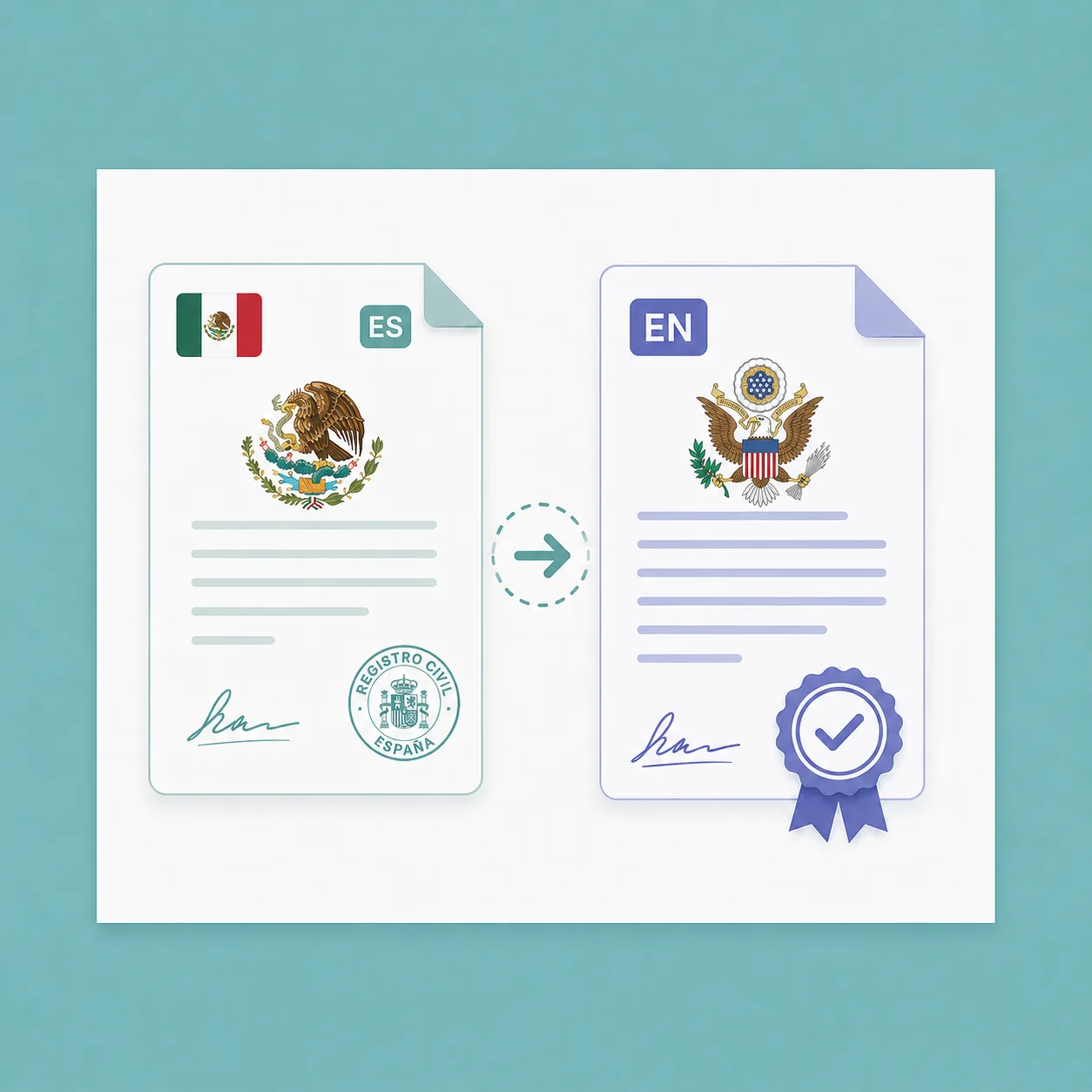
- Certified Spanish to English translation is required for many official documents submitted to USCIS, universities, courts, banks, and other institutions.
- A certified translation includes a signed Certificate of Accuracy confirming that the translation is complete, accurate, and prepared by a qualified translator.
- Applicants should not translate their own official documents because institutions require an impartial third party to avoid bias, omissions, or fraud concerns.
- Common Spanish documents requiring certified English translation include birth certificates, marriage certificates, divorce decrees, police clearances, academic transcripts, diplomas, bank statements, and legal records.
- USCIS requires any non-English document to be submitted with a complete certified English translation.
- Spanish dialects and regional vocabulary can affect translation accuracy, so translators must understand the source country and local terminology.
- False cognates, idioms, gender agreement, syntax differences, and cultural expressions make Spanish to English translation more complex than simple word replacement.
- Certified translators should preserve meaning while adapting grammar and phrasing so the English version reads naturally and accurately.
- Official translations should include all visible text, seals, stamps, signatures, tables, and formatting details from the original document.
- Machine translation may help with casual understanding, but it is not suitable for legal, immigration, medical, academic, or certified document translation.
- A professional translation process usually includes document review, terminology research, translation, editing, proofreading, formatting, certification, and delivery.
- When choosing a translation provider, applicants should check credentials, subject-matter expertise, reviews, USCIS compliance, data security, turnaround time, and transparent pricing.
Whether you are preparing to move to an English-speaking country, expanding your business globally, or applying for an international university program, language should never be a barrier to your success. In today’s interconnected world, the need to seamlessly bridge the gap between Spanish and English is more critical than ever.
If you are dealing with official procedures—such as immigration, university admissions, or international legal matters—a simple, casual translation will not suffice. You need a certified Spanish to English translation. This rigorous process guarantees that your documents are rendered accurately, legally valid, and universally understood by official institutions.
In this comprehensive guide, we will explore everything you need to know about navigating the Spanish to English translation landscape. From understanding exactly what a certified translation is and when you need one, to exploring the linguistic nuances of Spanish dialects, and evaluating machine vs human translation quality, this article will equip you with the knowledge to handle your bilingual needs flawlessly.
What Exactly is a Certified Translation?
A certified translation is much more than just a direct translation from one language to another. It is a formal, legally binding document produced by a professional translator or a recognized translation agency.
When you convert Spanish to English for official purposes, the receiving institution needs absolute certainty that the translated text is a true, accurate, and complete representation of the original document. To provide this assurance, a certified translation includes a signed "Certificate of Accuracy."
This official statement typically includes:
A declaration of the translator's competency and qualifications.
A statement affirming that the translation is complete and accurate to the best of their knowledge.
The translator's name, signature, and the date.
Contact information for the translation agency or the certified translator.
Why You Cannot Translate Your Own Documents
A common question people ask is, "If I am bilingual, can I translate my own documents?" For official purposes, the answer is no. Even if your bilingual communication skills are flawless, institutions require an objective third party to prevent fraud, bias, or omissions. Using accurate document translation services provided by an independent professional ensures that your paperwork is accepted without delays.
When Do You Need Certified Document Translation?
The demand for Spanish to English translation spans across numerous sectors. Below are the most common scenarios where a certified translation is legally mandated.
1. Immigration and USCIS Requirements
If you are applying for a visa, a green card, or citizenship in the United States, you must deal with the United States Citizenship and Immigration Services. USCIS requirements dictate that any document not originally in English must be accompanied by a complete, certified English translation.
A single error or an omitted seal on a translation can result in a Request for Evidence (RFE), which can delay your immigration process for months. Documents commonly required for immigration include:
Birth certificate: Essential for proving your identity, age, and parentage.
Marriage certificate: Required for spousal visas or adjusting status based on marriage.
Divorce decrees: Necessary to prove that previous marriages were legally terminated.
Police clearance certificates: Required to demonstrate good moral character.
2. Academic Admissions
Applying to a high school, college, or graduate program in the US, UK, Canada, or Australia requires you to submit your academic history. Admissions boards need to understand your educational background to ensure you meet their entry criteria.
Academic transcript: Every class, grade, and credit hour must be translated accurately.
Diploma: A certified translation of your diploma proves you have officially graduated and received your degree.
Actionable Tip: When submitting an academic transcript, do not attempt to convert your grades (e.g., changing a 10/10 to an A). A certified translator will translate the document exactly as it appears. Grade equivalency is a separate process handled by credential evaluation services.
3. Financial and Banking Needs
Whether you are applying for a mortgage, proving your financial independence for a student visa, or entering a cross-border business partnership, your financial records must be transparent.
Bank statement: Financial institutions need to verify your income and savings.
Account statement: Used for business audits, tax filings, or investment tracking.
4. Legal Proceedings
When dealing with courts, lawyers, or international contracts, there is zero room for error. A certified translation for legal documents is mandatory for:
Custody agreements
Wills and trusts
Business incorporation documents
Property deeds
Understanding Spanish Dialects and Cultural Nuances
Spanish is a beautifully diverse language, spoken natively by over 460 million people across more than 20 countries. However, this vast geographic spread means that Spanish is not a monolith. When you translate English to Spanish, or vice versa, understanding regional variations is crucial.
Castilian vs Mexican Dialect Nuances
The Spanish spoken in Madrid is quite different from the Spanish spoken in Mexico City. Castilian vs Mexican dialect nuances go far beyond just pronunciation.
Pronouns: In Spain (Castilian), "vosotros" is used for the informal plural "you." In Mexico and the rest of Latin America, "ustedes" is used exclusively.
Vocabulary: The word for "car" is coche in Spain, but carro or auto in Mexico. A computer is ordenador in Spain, but computadora in Latin America.
If you are a translator or someone looking to translate Mexicano slang or official documents from a specific region, you must be intimately familiar with these localized terms to avoid confusing the end reader.
Accents and Regionalisms
Spanish accents and dialects can drastically alter the meaning of a word. For example, the word guagua means "bus" in the Caribbean (Puerto Rico, Cuba, Dominican Republic) but translates to "baby" in Andean countries like Chile and Peru.
The Role of the Royal Spanish Academy
The Real Academia Española (RAE) is the official royal institution responsible for overseeing the Spanish language. While professional translators respect the Royal Spanish Academy standards for formal grammar and spelling, they also know when to apply cultural adaptation in localization. Localization ensures that the translated text feels natural to the specific target audience, rather than rigidly adhering to a textbook definition that nobody actually uses in daily life.
The Complexities of Translating Between Spanish and English
If translation were as easy as swapping out one word for another, anyone with a Spanish to English dictionary could do it. However, language is deeply intertwined with culture, history, and unique grammatical structures.
Syntax Differences Between Romance Languages and English
English is a Germanic language, while Spanish (Español) is a Romance language derived from Latin. The syntax differences between Romance languages and English can be a major stumbling block for amateur translators.
Adjective Placement: In English, adjectives typically precede the noun (e.g., "The red car"). In Spanish, the noun usually comes first (e.g., "El carro rojo").
Sentence Length: Spanish sentences are traditionally 15% to 20% longer than English sentences. A direct, literal translation often sounds excessively wordy or "flowery" in English. A professional translator knows how to condense the text without losing the core message.
Resolving Gender Agreement Issues
Unlike English, Spanish is a highly gendered language. Every noun has a gender (masculine or feminine), and adjectives must agree with the noun in both gender and number. Resolving gender agreement issues is a constant background task when translating. For instance, translating the English phrase "The tall teachers" requires knowing the gender of the teachers to determine if it should be Los profesores altos or Las profesoras altas.
Avoiding Common False Cognates
False cognates—often referred to as "false friends"—are words in two languages that look or sound similar but differ significantly in meaning. Avoiding common false cognates is one of the hallmarks of an expert Spanish translator. Here are a few notorious examples:
Embarazada: Looks like "embarrassed," but the meaning in Spanish is actually "pregnant."
Éxito: Looks like "exit," but it actually means "success."
Asistir: Looks like "assist," but it usually means "to attend" (e.g., attending a meeting).
Recordar: Looks like "record," but it means "to remember."
Failing to spot a false cognate can drastically change the meaning of a legal or medical document, leading to severe real-world consequences.
How to Translate Idioms Naturally
Idioms are phrases that have a figurative meaning completely different from their literal translation. Understanding how to translate idioms naturally separates fluent bilinguals from machines.
Spanish Idiom: No tener pelos en la lengua.
Literal Translation: To not have hairs on the tongue.
Natural English Translation: To be straightforward or to speak one's mind.
Spanish Idiom: Tomar el pelo.
Literal Translation: To take the hair.
Natural English Translation: To pull someone's leg (to tease or joke).
What Are Spanish Untranslatable Words?
There are certain concepts in Spanish that simply do not have a direct, one-word English equivalent. When asked, "what are Spanish untranslatable words?" linguists often point to deeply cultural concepts:
Sobremesa: The time spent lingering around the table talking with family or friends long after a meal has finished.
Estrenar: To wear or use something for the very first time.
Friolero: A person who is very sensitive to the cold.
Madrugar: To wake up very early in the morning.
When these words appear in a text, a skilled translator must use context to explain the concept efficiently without interrupting the flow of the document.
The Professional Step-by-Step Translation Process Guide
Achieving a flawless Spanish to English translation is not a spontaneous event; it is a methodical procedure. For those curious about how professionals guarantee accuracy, here is a step-by-step translation process guide:
Step 1: Document Analysis and Scope Assessment
Before a single word is translated, the translator reads through the original document. They assess the subject matter (e.g., is it a medical report, a birth certificate, or a marketing brochure?), the target audience, and the required formatting.
Step 2: Terminology Research and Glossary Creation
For highly technical documents—such as a bank statement or an academic transcript—the translator researches specific industry terminology. They may create a glossary of English to Spanish words to ensure consistency throughout the document.
Step 3: The Initial Draft (Translation)
The translator begins to convert Spanish to English. During this phase, the focus is on capturing the exact meaning while adapting the syntax and tone to fit the English language.
Step 4: Editing for Flow and Natural Tone
Once the draft is complete, the translator steps away from the original Spanish text. They read the English text purely as an English document to ensure it sounds natural, checking that they have successfully managed cultural adaptation in localization and avoided awkward literal translations.
Step 5: Proofreading and Quality Assurance
A meticulous line-by-line comparison between the original Spanish document and the English translation is performed. The proofreader checks for missing text, spelling errors, numerical accuracy (crucial for a financial account statement), and proper formatting.
Step 6: Formatting and Desktop Publishing
Official documents often feature complex layouts, such as stamps, seals, tables, and signatures. The translated document should visually mirror the original as closely as possible.
Step 7: Certification and Delivery
For a certified Spanish translation, the final step is appending the Certificate of Accuracy. The translator signs and dates the document, preparing it for submission to entities like USCIS or a university admissions board.
Machine vs Human Translation Quality: Which is Better?
In the age of Artificial Intelligence, a common question arises: why pay for accurate document translation services when you can use automated software for free? The debate over machine vs human translation quality comes down to the purpose of the translation.
When Machine Translation is Useful
Machine translation tools and real-time voice translation apps (like Google Translate, Microsoft Translator, or SayHi) are incredible innovations. They are highly effective for:
Grasping the general gist of a casual email or article.
Helping tourists navigate a foreign city (e.g., asking for directions).
Quickly finding out English to Spanish words for everyday conversations.
When Human Translation is Non-Negotiable
Despite rapid advancements, machines still struggle profoundly with context, idioms, and legal formatting.
Lack of Context: A machine might translate "banco" as a financial "bank," even if the context clearly implies a park "bench."
Legal Invalidation: Institutions like USCIS strictly reject documents translated by automated software. They require a human touch to ensure legal accountability.
Cultural Nuance: AI often misses the subtle tone, humor, or regional dialect present in the text, resulting in translations that feel robotic or unintentionally offensive.
For official, legal, medical, or academic documents, the expertise of a human certified translator remains entirely unmatched and fundamentally necessary.
Tools for Everyday Bilingual Communication
While official documents require certified translation services, there are many instances in daily life where you simply want to improve your own language skills or look up a quick phrase. Whether you are learning the language or working in a bilingual environment, utilizing the right tools is essential.
Top-Rated Bilingual Dictionary Reviews
If you want to look up a meaning in Spanish or find the perfect English equivalent, a reliable dictionary is your best friend. Based on top-rated bilingual dictionary reviews, here are the best options for different needs:
WordReference: Widely considered the best all-around Spanish to English dictionary online. It provides extensive definitions, audio pronunciations, and most importantly, active user forums where native speakers discuss regional nuances and context.
Linguee: Excellent for professional and academic writers. Linguee functions as a translation search engine, showing you how a specific word or phrase has been translated in thousands of real-world bilingual texts and parallel corpora.
SpanishDict: Highly user-friendly and great for learners. It offers interactive quizzes, verb conjugation tables, and comprehensive video pronunciations.
Real-Time Voice Translation Apps
For face-to-face communication, real-time voice translation apps have revolutionized how we interact. Apps like Google Translate's conversation mode or Apple's built-in Translate app allow two people to speak in their native tongues while the phone simultaneously outputs translated audio. While not perfect for complex business negotiations, they are invaluable tools for travel and basic hospitality.
Improving Bilingual Communication Skills
If your goal is to reduce your reliance on translation apps, improving bilingual communication skills requires consistent immersion.
Consume Media: Watch Spanish television shows with English subtitles, or vice versa. This helps you understand pacing, slang, and how to translate idioms naturally in your head.
Read Bilingual Books: Reading texts side-by-side helps you grasp the syntax differences between Romance languages and English organically.
Practice Daily: Incorporate simple English to Spanish words into your daily routine. Label items around your house to build vocabulary through visual association.
How to Choose the Right Document Translation Service
If you have decided that you need a professional, certified Spanish translation, the next step is choosing the right provider. The internet is flooded with options, but not all translation services are created equal. Here is a checklist of what to look for when hiring a professional translator or agency:
1. Verify Their Credentials
Ensure the translator or agency clearly advertises "certified translation" and complies with USCIS requirements. Look for affiliations with professional organizations, such as the American Translators Association (ATA) in the US, or the Chartered Institute of Linguists (CIOL) in the UK.
2. Industry-Specific Expertise
Translating a medical record requires a different vocabulary than translating a business contract. If you need a certified translation for legal documents, ask the agency if they use linguists who specialize in the legal sector. Legal terminology is incredibly precise, and an industry expert will know exactly how to handle complex clauses.
3. Check Reviews and Track Record
Look for customer testimonials specifically mentioning the acceptance of their documents. A reliable agency should proudly showcase their success rate with government entities and academic institutions.
4. Data Security and Confidentiality
Documents like a birth certificate, marriage certificate, or bank statement contain highly sensitive personal information. Ensure that the translation service uses encrypted portals for file transfers and adheres to strict non-disclosure agreements (NDAs) to protect your privacy.
5. Turnaround Time and Pricing Transparency
Official deadlines, such as visa applications or university enrollment dates, are often rigid. A reputable Spanish to English translation service will provide a clear, upfront quote and a guaranteed delivery timeline. Be wary of services that offer prices that seem "too good to be true," as this often indicates the use of unedited machine translation.
Conclusion
The ability to accurately convert Spanish to English is a vital bridge in our globalized society. Whether you are an immigrant fulfilling USCIS requirements to build a new life, a student submitting an academic transcript to your dream university, or a professional presenting a bank statement for international investment, the quality of your translation matters immensely.
While real-time voice translation apps and online dictionaries are fantastic for everyday interactions, they simply cannot replace the nuanced, culturally aware, and legally binding work of a professional translator. A certified Spanish to English translation provides peace of mind, ensuring that your official documents are treated with the respect, accuracy, and legal validity they deserve.
By understanding the complexities of Spanish dialects, the intricacies of grammar, and the rigorous step-by-step translation process, you are now fully equipped to make informed decisions for all your bilingual communication needs. Do not let language barriers hold you back—invest in accurate document translation services and communicate with the world confidently.