Key Takeaways
- USCIS regulations require every page of a foreign court record to be translated into English and sent with the translator's signed certification of completeness, accuracy, and competence.
- Form I-485 and Form N-400 ask about arrests, charges and convictions abroad, and a certified court disposition is the document that usually supports the applicant's answers.
- Each court paper, including a judgment, a dismissal order and a later expungement order, is translated and certified as its own document so the officer sees the whole history.
- Charges are translated in the court's own wording, the statute citation is kept exactly as written, and the original term is placed in square brackets after the English.
- A translator does not convert a foreign charge into a US offense name, because classifying an offense is a legal decision that belongs to the attorney.
- Procedural terms with no US counterpart are translated closely and may carry a short bracketed translator's note that describes the procedure without naming a US equivalent.
- Sentences are translated with every figure intact, including term length, fine amounts and currency, probation conditions, and whether the sentence was suspended, served or converted.
- Expungement orders, sealing orders and certificates of finality follow the original wording, and stamps, dates and the signing official's name are translated along with them.
- Custody orders, divorce judgments, name change judgments and inheritance decisions are translated like other foreign judgments, and attached papers such as powers of attorney are certified separately.
- The translation reports what the court wrote and does not say whether an offense affects eligibility, which the attorney or accredited representative decides when choosing what to file.
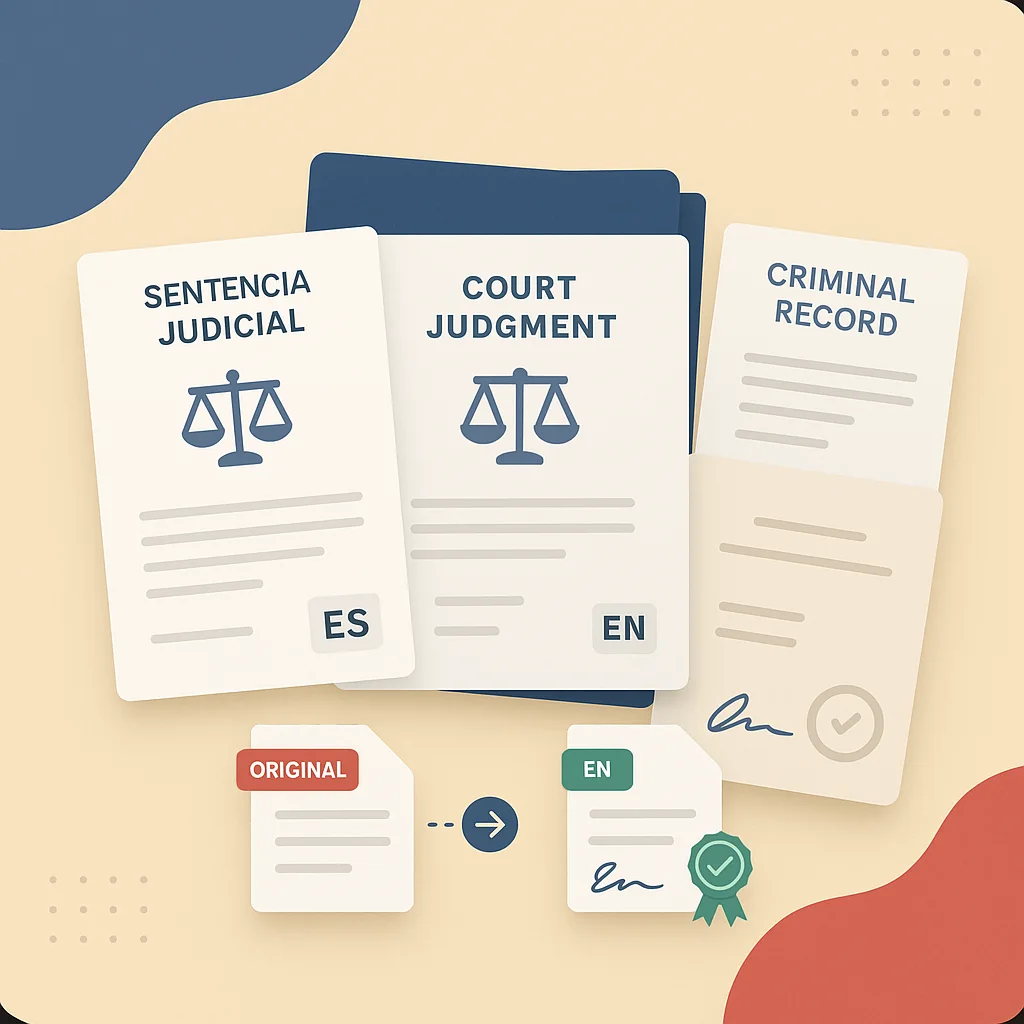
A foreign court record filed with USCIS needs a full English translation of every page, sent with the translator's signed certification. The rule covers a conviction, a dismissal, an expungement order, a custody decision and a divorce judgment alike, because USCIS regulations require a complete translation of any document in a foreign language, and certified document translation for USCIS is built around that requirement.
Court records turn up in several kinds of filings. Adjustment of status on Form I-485 and naturalization on Form N-400 both ask about arrests, charges and convictions, including those that happened abroad, and applicants usually support their answers with a certified disposition from the court. Family cases add custody orders, divorce judgments and similar civil rulings. The attorney or accredited representative decides which records to file; the translation company renders whatever is filed faithfully.
Court records that come with Form I-485 and Form N-400
The forms ask about the applicant's history, and the documents that answer them are the court's own papers. The set includes the judgment or sentencing decision, the dismissal or acquittal order, the charging document when the disposition refers to it, and any later order that changes the outcome. A police certificate issued by a national authority is a separate document from a court record, although a case file often contains both. The instructions for Form I-485 describe the evidence the form calls for.
Each court paper is translated as its own document and carries its own certification. If a conviction was later overturned or expunged, the original judgment and the later order are both translated, because an officer reading only one of them would see an incomplete history. A file from a Spanish-speaking court is a typical case, and a Spanish criminal record translation normally covers the police certificate, the judgment and the closing order as separate documents. Texliff handles the language side through its certified Spanish to English translation service.
Charges and statute references are translated literally
A charge in a foreign judgment usually cites a statute: an article number of a penal code, sometimes with a paragraph or subsection. The translator renders the wording of the charge as written and keeps the citation exactly as it appears. Where the original uses a legal term with a fixed meaning in that country's law, the translation gives the closest English wording and puts the original term in square brackets after it, so a reviewer can see what the court actually wrote.
The translator does not convert the charge into a US offense. Rendering a foreign "unlawful appropriation" as "theft" or "larceny" would be a legal classification, not a translation, and whether a foreign offense matches a US category is a question for the attorney. The translation stays at the level of the words on the page.
Procedural terms that have no US counterpart
Courts in civil law countries use procedures that do not exist in US practice. A prosecutor may issue a decision not to proceed, a court may suspend a case on conditions, a judge may issue a "decree of dismissal for lack of merit," or a trial may end with a finding that the facts are proven but no penalty is imposed. Substituting the nearest US term would change what the record says.
The better method is to translate the term closely, add the original in brackets, and, where the closest English wording would mislead, add a bracketed translator's note that describes the procedure in plain words without naming a US equivalent. The note is short and marked as the translator's, so nobody mistakes it for text from the court. Court names and levels are handled the same way. A "Court of First Instance, Criminal Section" is rendered as written, and the city and the court number stay in the translation.
Sentences, suspension, expungement and sealing orders
A sentence has several parts, and each one appears in the translation with its figures intact: the length of any term, the amount of any fine and its currency, the conditions of probation, and whether the sentence was suspended, served or converted. When a judgment says a sentence is suspended for a set period, the translation says so in the court's words and adds no conclusion about whether the sentence counts as served.
Expungement and sealing orders need particular care. Foreign systems use different terms for erasing a record, such as cancellation, rehabilitation, deletion from the register, or the end of a record's legal effect. Each term describes a different act in the country that issued it, so the English wording follows the order's own language. The same applies to a certificate of finality, the stamped statement that no appeal was filed and the decision is now final. It is translated with its stamp, its date and the name of the clerk or official who signed it, since the date a decision became final may matter to the attorney's analysis.
Custody orders, divorce judgments and other civil judgments
Civil judgments reach USCIS in family cases. A custody order may support an I-130 petition for a child or an intercountry adoption case under Form I-600, and the file often includes the order, the court's findings and any later modification. A certified translation of adoption documents frequently covers court decrees as well as civil registry entries. A divorce works the same way: the judgment is what proves that an earlier marriage ended. A Russian court decision is translated like any other foreign judgment, and a Russian divorce decree translation keeps the case number, the court's seal and the date the decree took effect.
Name change and inheritance judgments follow the same rules. The judgment is translated with its recitals, the operative order and every signature block. Documents attached to the judgment, such as a power of attorney or a guardian's appointment, are separate documents and are translated and certified separately. For a divorce, the divorce certificate translation page lists the entries a decree usually contains.
Multi-page judgments and what the translation does not decide
Judgments are long, and the pages carry repeated headers, page numbers, initials, stamps and handwritten corrections. A complete translation reproduces each of these elements where it appears. A header that repeats on every page is translated on every page, and a stamp is described in brackets with its text, for example "[round stamp: Second Criminal Court of the District]". Illegible parts are marked "[illegible]". The translated pages follow the order of the original so that an officer can lay the two side by side.
The translation reports what the court wrote. It does not say what the record means under US immigration law, whether an offense affects eligibility, or whether an expunged conviction still has to be disclosed. Those questions belong to the attorney or accredited representative, who decides what to file and how to answer the form. A translator who adds such an opinion goes beyond the document, and USCIS regulations ask for a statement about the translation only.
Before ordering, gather the full set of certified court papers, the stamped final version where the court issues one, and the closing orders that follow the judgment. Our certified criminal record translation page explains how Texliff prepares these files, with one certification for each document.