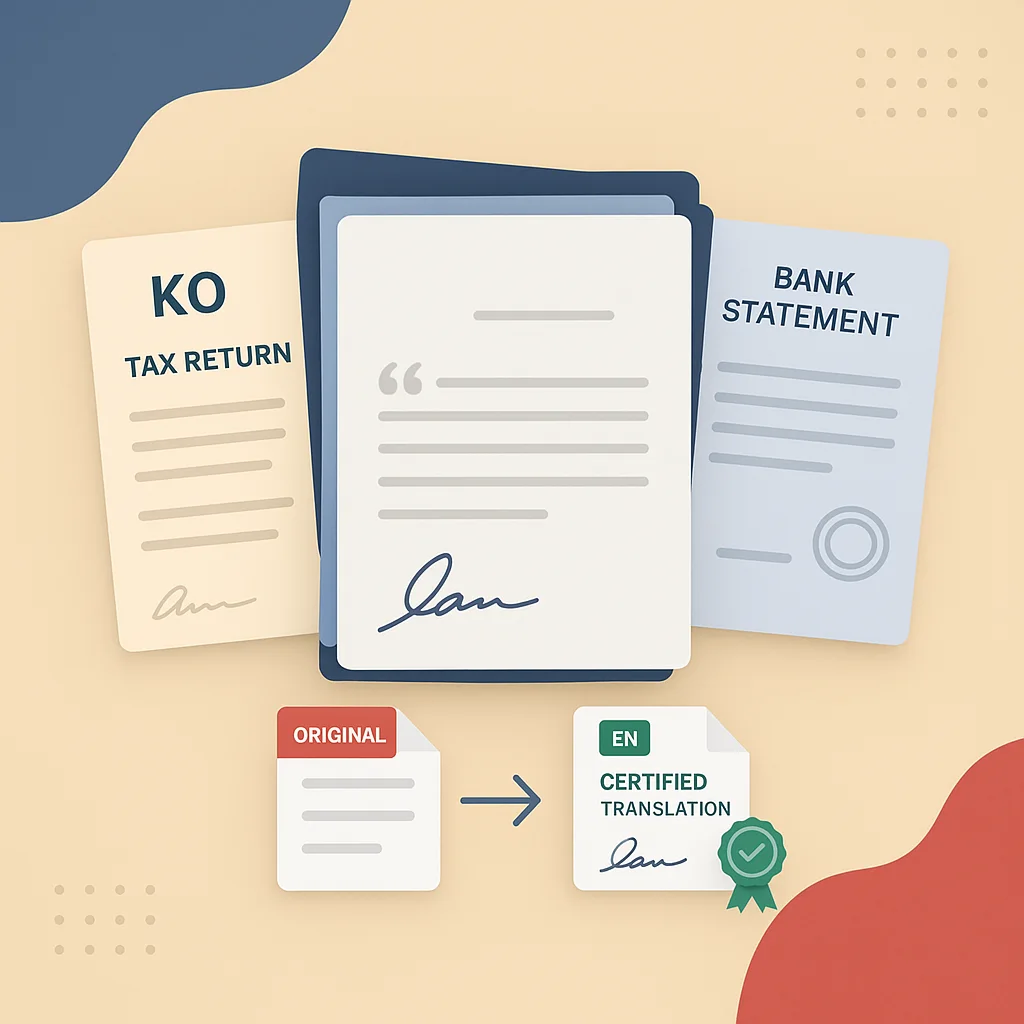
Key Takeaways
- Form I-864 is an English form, so only the foreign-language evidence attached to it, such as tax returns and bank statements, needs a certified English translation.
- USCIS regulations require a full English translation with the translator's certification of completeness, accuracy, and competence for every foreign-language document in the filing, including financial records.
- IRS tax transcripts are already in English and need no translation, while a tax return issued by a foreign tax authority must be translated in full.
- A foreign tax return is translated with its field labels, schedules, attachments, stamps, and receipt pages so an officer can match each figure to its source line.
- Ambiguous numeric dates such as 03/04/2025 are written with the month in words, and a fiscal year that differs from the calendar year is kept as printed.
- Foreign bank statements are translated in full, including headers, transaction descriptions, running balances, stamps, and the notes at the foot of each page, even when a page shows few entries.
- Assets abroad are documented with ownership and value, so property titles, valuation reports, and pension statements in a foreign language also need certified translation.
- The translator writes each currency amount exactly as printed and names the currency, and does not convert it into US dollars unless the source document itself states the conversion.
- Form I-864W is in English, but any foreign-language record attached to it needs the same certified translation as evidence under Form I-864.
- A household member who signs Form I-864A brings their own foreign records, and each one needs its own translation and certification.
Foreign tax returns, foreign bank statements, employer letters, property valuations and pension statements attached to Form I-864 each need a full English translation with the translator's certification, because USCIS requires one for every document that contains a foreign language. Documents that are already in English, such as IRS tax transcripts, need no translation. The Form I-864 Affidavit of Support itself is an English form, so the question only comes up for the evidence a sponsor, a joint sponsor, or a household member attaches to it. The USCIS page for Form I-864 carries the current form and instructions, which say which supporting records belong with the affidavit.
Which I-864 attachments need a certified translation
A sponsor who lives abroad, a joint sponsor with income from another country, or a household member who counts assets held overseas will often have records that were never issued in English. USCIS regulations require each of those records to be accompanied by an English translation, and the translator has to certify that it is complete and accurate and that the translator is competent in both languages. The same standard applies to every other foreign-language document in the filing under certified document translation for USCIS, and a general explanation of it is in the Texliff post on USCIS document translation requirements.
Five kinds of record most often arrive in a foreign language:
- A foreign tax authority issues income tax returns and assessment notices.
- A foreign bank issues statements, passbooks, and account confirmation letters.
- A foreign employer writes letters that state position, salary, and length of employment.
- A valuer or a land registry issues property valuations, title deeds, and registry extracts.
- A foreign provider issues pension and retirement account statements.
The attorney or accredited representative handling the case decides which of these belong in the filing. The translation company only prepares the English version of what is chosen.
Foreign tax returns and tax authority records
A foreign tax return is a form with printed field labels, boxes of figures, and often a stamp or an electronic receipt number. A complete tax return translation renders the field labels along with the entries, so the officer can match every figure to the line it came from. Schedules, attachments, and the tax authority's assessment or receipt page are translated as well, since they belong to the same document.
Numbers and dates need particular care. A figure written with a period as the thousands separator and a comma as the decimal mark must appear in the translation in a form the officer reads correctly, and a date written 03/04/2025 can mean March 4 or April 3, so the translator writes the month in words. The layout otherwise stays as close to the original as possible, and a fiscal year that does not match the calendar year is kept as printed. A Korean income tax filing, for example, can be read line by line against its Korean tax return translation, with each Korean field label followed by its English rendering in the same order as the original.
Bank statements and assets held abroad
When a sponsor relies on assets, the I-864 evidence has to show who owns the asset and what it is worth. A foreign bank statement usually carries the account holder's name, the account number, a balance, and a list of transactions, and every one of those lines is part of the document. A bank statement translation covers the header, the transaction descriptions, the running balances, the bank's stamps, and the notes printed at the foot of each page.
Statements from banks in Brazil or Portugal are a common case, and the transaction descriptions often use abbreviations that only the issuing bank defines. A Portuguese bank statement translation can keep the original abbreviation and add its English meaning in brackets, so the officer sees both the source and the reading. Statements that run to many pages are translated in full, including the pages that show only a few entries.
Ownership documents sit next to the statements. A property title, a valuation report, or a pension statement is translated like any other record, and the account holder's name should be spelled the same way in each translation as on the passport and on the Form I-864. Where the foreign record spells the name differently, the translation follows the record and the sponsor's legal team explains the difference separately.
How currency amounts appear in the translation
The translator writes each amount exactly as the document gives it and names the currency, for example 4,250.00 Brazilian reais or 3,100,000 Korean won. The translator does not convert the amount into US dollars. A conversion is a calculation that depends on a rate and a date, and the translator has no authority to add a figure that the source does not contain.
When the source itself states an exchange rate or an amount in two currencies, the translation reproduces both as printed. Any conversion the sponsor wants the officer to see belongs in a separate cover note or worksheet prepared by the sponsor or the legal team, clearly marked as theirs and not as part of the translated record.
Employer letters from abroad
An employer letter is short, but every part of it is translated: the letterhead, the reference number, the job title, the salary, the signature block, and any stamp. A salary is given as the letter states it, including whether it is paid monthly or yearly, because the translator cannot turn a monthly figure into an annual one. When the letter is signed, the translation shows "[signature]" at the same place, with the signer's name and title as printed.
Form I-864W and Form I-864A
Form I-864W is filed in place of a full affidavit when the immigrant qualifies for an exemption from the affidavit of support. The form is in English. Any foreign-language record attached to it, such as a foreign civil document, needs a certified translation in the same way as the evidence under Form I-864.
Form I-864A is the contract between a sponsor and a household member who adds income or assets to the sponsor's financial picture. The household member's own foreign records, whether tax returns, bank statements, or employer letters, follow the rules above. Each one is translated in full and carries its own certification.
What to prepare before ordering the translations
Collect the complete originals first, with every page, attachment, and stamp, and check the Department of State's Reciprocity and Civil Documents schedule for any civil document that belongs in the same filing. Write the sponsor's, joint sponsor's, and household member's names exactly as they appear on their passports so the translations match. Texliff prepares each record as its own translation with a separate certification, whether it is one bank statement or an entire financial statement translation.