Key Takeaways
- A K-1 case involves two offices, and one certified translation can serve both the USCIS petition and the consular stage if its certification meets what each office requires.
- For the Form I-129F petition, USCIS requires a full English translation of every foreign-language document, certified as complete and accurate by a translator who states competence in both languages.
- A separate certification for each document is the safer practice, because the officer can match every translation to its source without guessing which pages a single statement covers.
- Proof of an in-person meeting, such as boarding passes, hotel receipts, and stamps, needs every printed line, stamp, and handwritten entry translated, including lines that seem irrelevant.
- Message screenshots keep their sender names, usernames, timestamps, and message order in the translation, so the officer can see who wrote each line and when.
- Foreign divorce decrees and death certificates showing that an earlier marriage ended are translated in full, including the court, case number, ruling, effective date, signatures, and stamps.
- The Department of State's Reciprocity Schedule shows which version of a civil document is acceptable, and checking it before ordering prevents paying for a translation of the wrong version.
- At the consular stage, documents not in English or the official language of the country where the beneficiary applies need certified translations, and the beneficiary brings originals or certified copies to the interview.
- The official-language exception applies only to the National Visa Center and consulates, so any document filed with USCIS, including after the marriage, must be in English.
- Keeping each translation together with its certification and a scan of the source lets the same translation be reused for the consulate and for the later Form I-485.
A K-1 case passes through two offices, and one certified translation can serve both if it carries the certification each office asks for. The Form I-129F petition goes to USCIS, which requires English for every foreign-language document. The visa stage that follows is handled by the National Visa Center and a US consulate, which accept documents in the official language of the country where the beneficiary applies as well as in English.
I-129F evidence that needs a certified translation
For the petition, USCIS requires a full English translation of any document that contains a foreign language, certified by the translator as complete and accurate, with a statement that the translator is competent to translate from that language into English. The Form I-129F page on the USCIS site lists the petition requirements, and the translation rule is the same one that applies to every other filing. Foreign-language evidence is translated before the packet is mailed, so certified document translation for USCIS belongs at the start of assembling the petition.
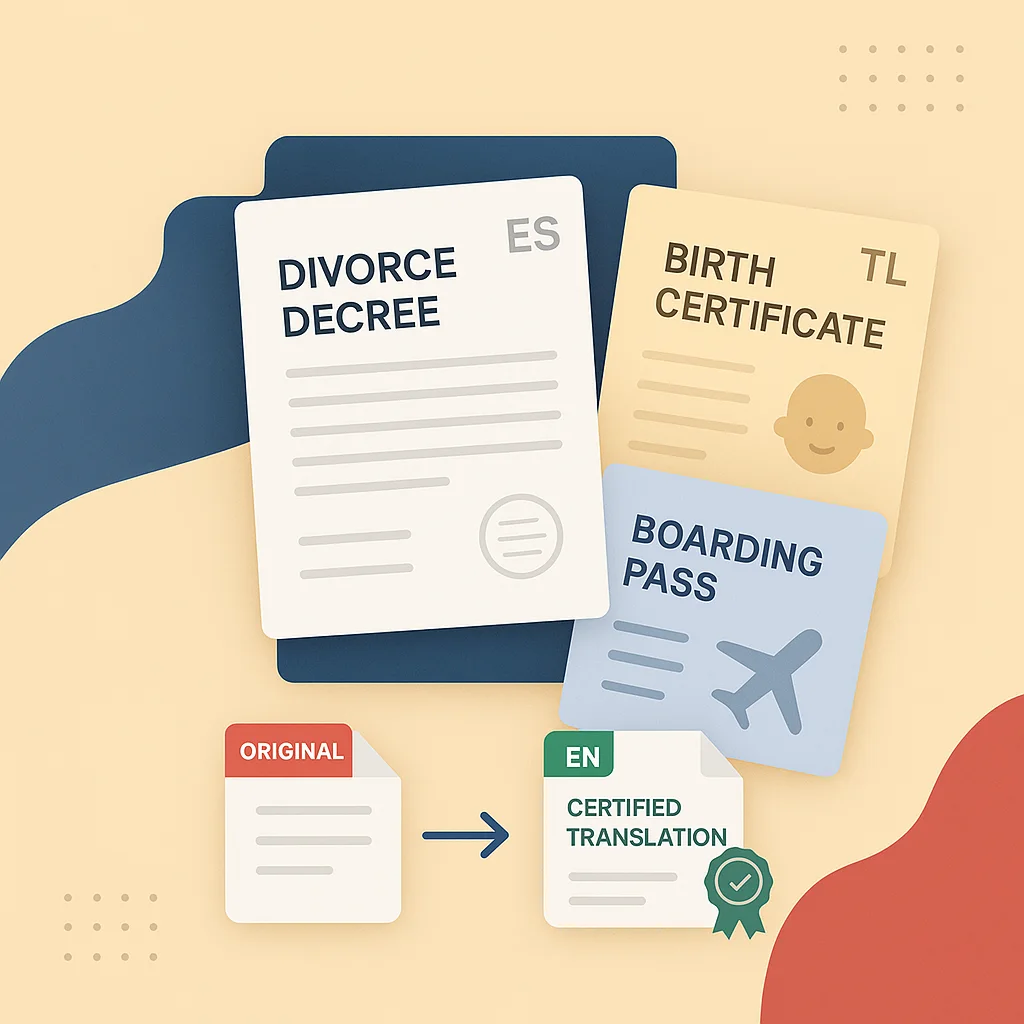
The petition itself is in English, so the foreign-language pages come from the evidence: proof of an in-person meeting, records showing that earlier marriages ended, and statements from relatives or friends who wrote in another language. The certification should say which documents it covers. One certification per document is the safer way to file, because an officer can then match every translation to its source.
When a translation is missing, incomplete, or uncertified, USCIS may issue a Request for Evidence, and USCIS policy also allows an officer to deny a filing without one when the initial evidence falls short. The attorney or accredited representative decides what goes into the petition. The translation company handles the language of whatever is chosen.
Translating proof of an in-person meeting
A petition has to show that the couple met in person, and the proof often arrives in a language other than English. Boarding passes, hotel and restaurant receipts, entry and exit stamps, event tickets, and handwritten notes are typical examples. A hotel receipt is evidence only when the officer can read the name, the dates, and the amount, so every printed line, stamp, and handwritten entry is translated, including lines that seem irrelevant.
Messages need separate handling. Conversations saved as screenshots carry sender names, usernames, timestamps, and a message order, and the translation keeps all of them visible. A certified text message translation reproduces the interface labels and the date format of the original, so the officer can see who wrote each line and when. A pasted block of translated text with the labels removed cannot show that.
Machine translation alone is not enough for any of this evidence. It carries no human certification, and it often mishandles names, dates, abbreviations, and the slang that fills chat messages.
Foreign divorce decrees and death certificates for earlier marriages
When either person was married before, the filing has to show that the earlier marriage ended. The proof is a divorce decree or a death certificate, and both are translated in full: the court or office that issued it, the case number, the ruling, the dates, the signatures, and every stamp. A translated divorce decree that leaves out the final-judgment stamp or the date the decree took effect can raise the very question it was filed to answer.
Court language has its own vocabulary, and the translation has to follow what the decree says about when the marriage ended. A Spanish divorce decree translation starts from the full decree rather than a summary of its outcome. Where a country issues both an abridged extract and a full record, the Department of State's Visa Reciprocity and Civil Documents by Country schedule shows which version is acceptable. Checking it before ordering saves the fee for a translation of the wrong version.
Birth certificates and police certificates at the consular stage
After USCIS approves the petition, the case moves to the National Visa Center and then to a consulate. At that stage, civil documents that are not in English, or not in the official language of the country where the beneficiary applies, need certified translations. Each translation carries a statement signed by the translator that it is accurate and that the translator is competent to translate. The beneficiary uploads scans to the CEAC portal and brings originals or certified copies to the interview.
The beneficiary's birth certificate is a civil document of this kind. When the record is written in Tagalog, a Tagalog birth certificate translation covers every printed field, stamp, and handwritten entry, and Tagalog translation services can handle the other civil records that travel with it.
Police certificates are civil documents too. A police certificate from a country where the beneficiary has lived, if it is not in English or the consulate's official language, needs a certified translation. A criminal record translation includes the issuing office, the stamps, and any statement printed on the page about whether a record was found.
The official-language exception belongs to the National Visa Center and consulates only. A document that goes to USCIS, including a filing made after the marriage, has to be in English.
Reusing one certified translation from the petition to the green card
USCIS and the consulate both ask for a translator's signed statement of completeness, accuracy, and competence, so a certified translation prepared for the petition can be used again at the consular interview. A translation prepared for the consulate can likewise go into later USCIS filings, as long as it covers the whole document and the certification identifies it. The beneficiary does not pay to translate the same birth certificate twice.
After the marriage, the beneficiary files Form I-485 to adjust status, and the earlier translations come back into use. A marriage certificate issued abroad in another language joins the packet with its own translation. Keeping each translation together with its certification and a scan of the source document makes the later filing a matter of copying rather than rebuilding.
Three points decide whether a translation carries over from one stage to the next:
- The translation covers the entire document, including the back of the page when it carries anything.
- The certification names the document, the translator, the date, and the translator's contact information.
- Names and dates are written the same way in every translation that belongs to the case.
Before the packet is assembled, lay each translation next to its source and confirm that nothing on the page is missing, from the stamps to the last message screenshot. We prepare each certification to name the document it covers, and the beneficiary's own records are the place to begin, starting with a certified birth certificate translation.