Key Takeaways
- An N-600 filing needs a certified English translation of every foreign-language record that proves the family chain, from the child's birth certificate to the parents' marriage and court records.
- The attorney or accredited representative decides which documents a particular N-600 filing calls for, and each of them that is not in English must be translated in full.
- Records that ended earlier marriages, including divorce decrees and death certificates of former spouses, belong to the chain and need the same certified translation as the birth and marriage records.
- Foreign court orders on legitimation, custody, or adoption must be translated as written, including case numbers, the court's name, stamps, and handwritten clerk's notes in the margins.
- USCIS regulations require a full English translation with the translator's certification of completeness, accuracy, and competence, and a separate certification for each document is the safer practice.
- USCIS keeps no list of approved translators or companies, so a USCIS-certified translation only means that the translation carries the certification USCIS asks for.
- Machine translation has no human certification and mishandles names, dates, and legal terms, so it does not meet the requirement, and a missing certification can lead to an RFE or NOID.
- A translation company can keep one name list for the whole family across records written decades apart, reproducing differences in the source and explaining them in a bracketed translator's note.
- The Department of State's Reciprocity Schedule shows which version of a civil document is acceptable, so applicants should check it before ordering to avoid translating a version that cannot be used.
- When a primary record is unavailable, the applicant shows that it is unavailable and submits secondary evidence such as church, school, or medical records, each with its own certified translation.
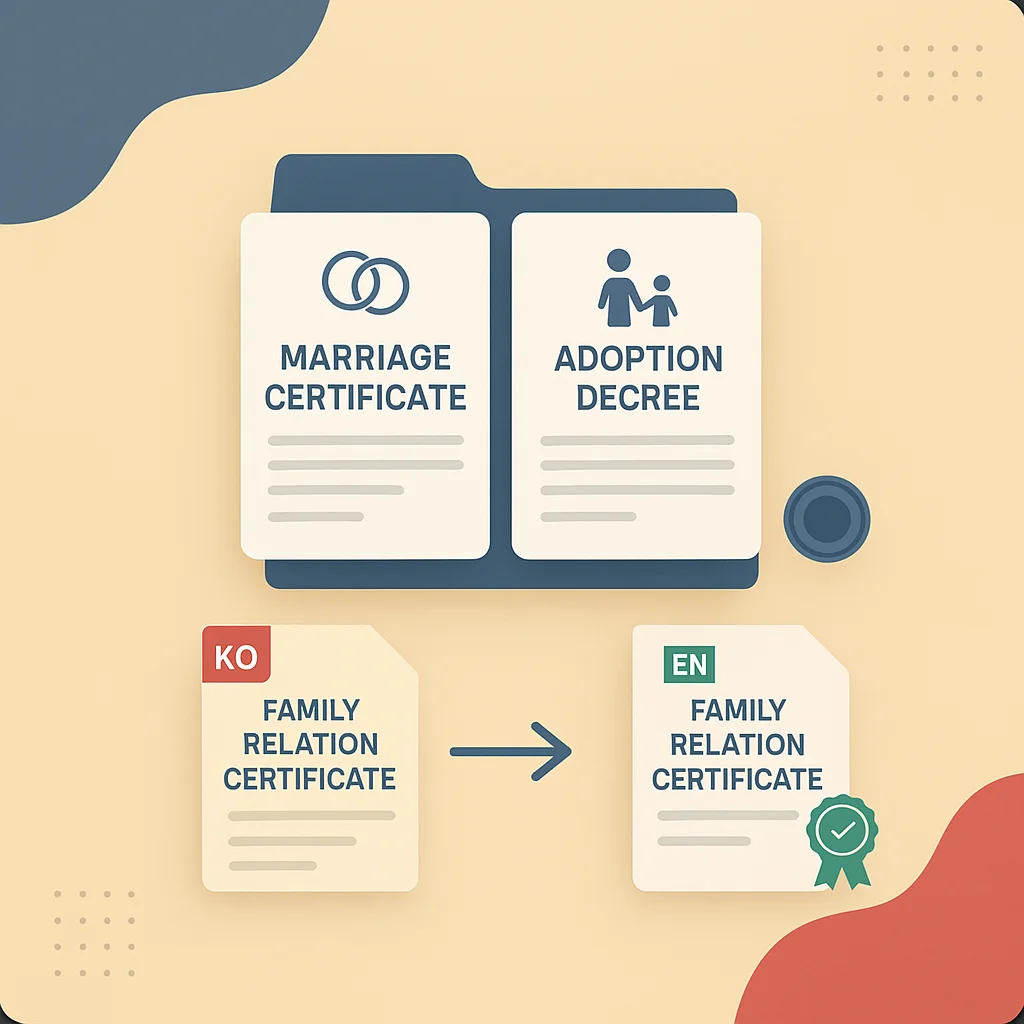
Every foreign-language record that proves the family chain in an N-600 filing needs a full English translation with the translator's certification. For a child who acquired or derived citizenship through a parent, the chain usually runs through the child's birth certificate, the parents' marriage certificate, records that ended earlier marriages, and any court papers on custody, legitimation, or adoption.
Which N-600 documents need translation
Form N-600 is the Application for Certificate of Citizenship, and the USCIS page for Form N-600 lists the evidence it asks for. Whether the child acquired citizenship at birth or derived it later, the case rests on a parent who is or was a U.S. citizen and on documents that show how the child and that parent are related. The attorney or accredited representative decides which of those documents a particular filing calls for, and every one of them that is not in English has to be translated.
The child's foreign birth certificate translation comes first, because it names the parents and fixes the child's date and place of birth. The parents' marriage certificate follows when the filing depends on the parents being married. If either parent was married before, the decree or record that ended that earlier marriage is part of the chain, and so is the death certificate of a former spouse when death ended the marriage. A parent's own foreign records may also be needed when the filing turns on custody or on where the parent lived, such as a custody order or a residence record.
Foreign court records for legitimation, custody, and adoption
Some N-600 cases depend on a court order instead of a civil registry entry. A foreign court may have recognized a father, legitimated a child born outside marriage, or granted custody to one parent after a divorce. Each of those papers is a legal record from the country that issued it, and the translation has to reproduce it as written, including the case number, the court's name, the judge's title, stamps, and any handwritten clerk's note in the margin.
Adoption cases add another set of papers. A foreign adoption decree, the court file behind it, and the new birth record issued after the adoption each need translation, and the adoption documents translation should keep the original and the amended names apart so that an officer can see which name belongs to which stage. When a parent has died, the death certificate translation follows the same rule as every other record: all printed text, entries, and seals appear in English.
Certified translation rules USCIS applies to N-600 evidence
USCIS regulations require that any foreign-language document be accompanied by a full English translation and by the translator's certification that the translation is complete and accurate and that the translator is competent to translate from that language into English. In practice the certification carries the translator's typed name, signature, date, and contact information, along with an identification of the document it covers. Each document is safer with its own certification, and it makes sense for a file that mixes documents from several countries and decades. A translation company's certified document translation for USCIS provides that statement independently of the case, which a parent or child signing for their own evidence cannot do.
USCIS keeps no approved list of translators and does not certify translation companies, so the phrase "USCIS-certified translation" only means that the translation carries the certification USCIS asks for. Completeness covers headings, form-field labels, stamps, seals, signatures, handwritten entries, and anything printed on the back of a page. Unreadable parts are marked "[illegible]" instead of guessed, and blank sections are marked blank. Machine translation has no human certification and mishandles names, dates, and legal terms, so it does not meet the requirement. A missing or uncertified translation can lead to a Request for Evidence or a Notice of Intent to Deny, and USCIS policy also allows an officer to deny a filing without one when the initial evidence is insufficient.
Keeping parents' and children's names consistent across decades
An N-600 file often combines records written 30 years apart by different offices, and the same person may appear under slightly different spellings in each of them. A birth record from the 1990s, a marriage record from the 1980s, and a court order from 2005 may romanize one name three ways, switch the order of surnames, or list a maiden name in one place and a married name in another. Translating each document in isolation produces mismatches that an officer then has to resolve.
A translation company handling the whole set keeps one name list for the family and applies it to every document, so a name appears the same way unless the source itself differs. When the source differs, the translation reproduces what each document says and adds a bracketed translator's note, and the spelling on the parent's passport and the child's identity documents usually guides the choice. Date formats get the same treatment: a year-first Chinese date, a Solar Hijri date from Iran, or a day-first date from Mexico is converted once, consistently, in the English text.
Korean records show how much the issuing system matters. Since 2008 Korea has used the family relation certificate (가족관계증명서), the basic certificate (기본증명서), and the marriage relation certificate (혼인관계증명서), which replaced the older hojeok (호적) family register. A family whose records straddle that change may hold both formats, and a Korean birth certificate translation has to match the names and dates in the old register entry. Texliff handles the whole family set through its certified Korean to English translation service, so the old and new formats are read against each other.
Checking the Reciprocity Schedule before ordering
The Department of State's Visa Reciprocity and Civil Documents by Country schedule lists, country by country, which civil documents exist, who issues them, and which version is acceptable. Some countries issue both a short extract and a long-form record, and the schedule says which of them is acceptable. Translating the wrong version wastes the fee and may lead to a second order.
When a primary record cannot be obtained, the applicant shows that it is unavailable, either with a written statement from the issuing authority or with a Reciprocity Schedule entry saying the record is generally unavailable. Secondary evidence then takes its place, for example church or baptismal records, school records, medical records, or affidavits from people with personal knowledge of the event. Each foreign-language item of secondary evidence needs its own certified translation.
Before ordering, gather the full set of originals or clear scans, including every page and the back of each page, and list the names as they appear on the passports. Send the records together so the names can be matched across them. Texliff prepares each record with its own certification, starting with the marriage certificate translation when the parents' marriage is the first link to be proved.