Key Takeaways
- A religious marriage record counts for USCIS only when the issuing country treats it as the official marriage record, and the Reciprocity Schedule shows which version applies.
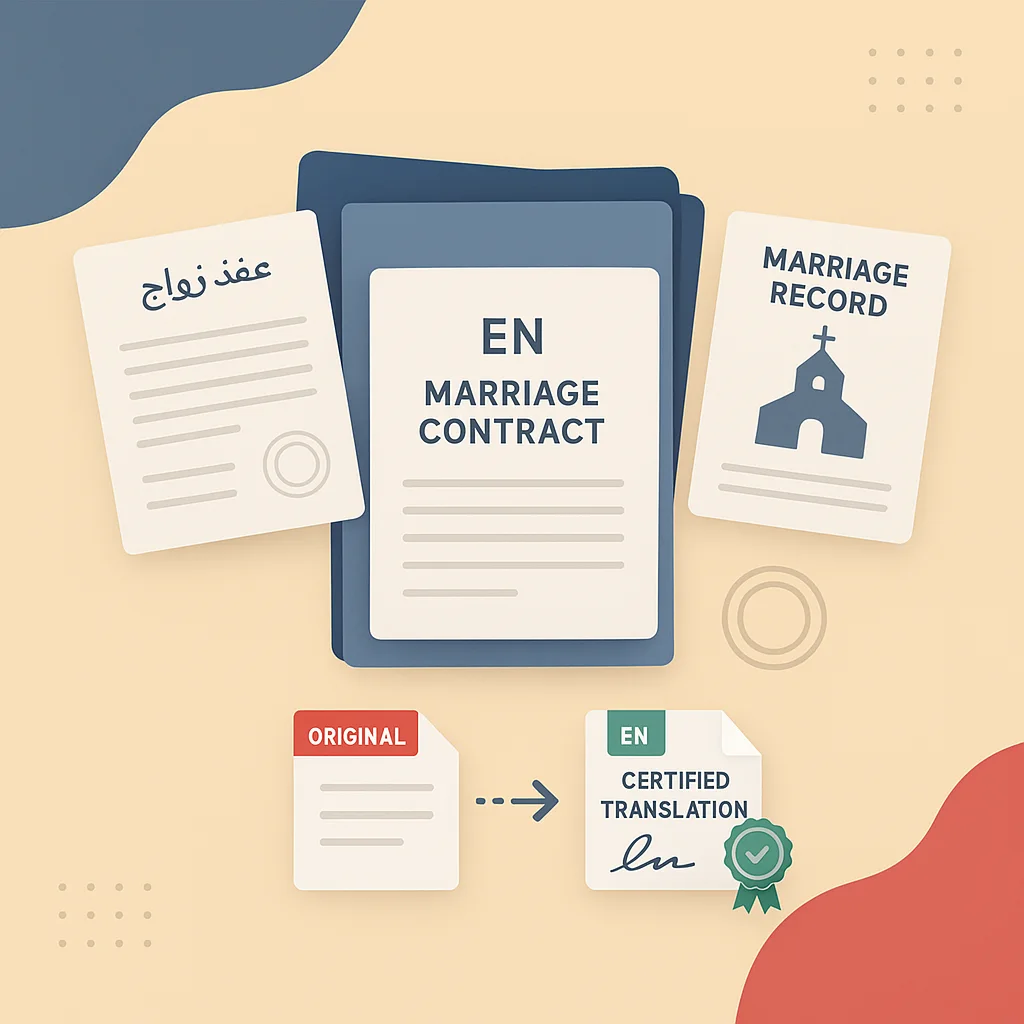
- Any marriage record in a foreign language that goes to USCIS needs a full English translation with the translator's certification, whether it is a civil or a religious document.
- Check the Department of State Reciprocity Schedule before ordering a translation, because translating the wrong version of a marriage record wastes the translation fee.
- Whether a religious record is also the civil record depends on the country's law, so a Catholic or Orthodox parish certificate may be the official record in one country and supporting evidence in another.
- A ceremony certificate and a civil registration are separate documents, so a filing may call for both, each translated in full with its own certification.
- When the primary marriage record is unavailable, the applicant shows that it is unavailable and submits secondary evidence, and every foreign-language item among that evidence also needs a certified translation.
- Religious terms such as mahr keep their original wording in the translation, followed by a short explanation in brackets written by the translator.
- An Arabic marriage contract is separate from the civil status certificate issued from it, and the translation keeps the mahr clause, witnesses, Hijri date, and name spellings as written.
- Dates on Islamic and Jewish records may follow the Hijri or Hebrew calendar, and the translation gives the written date with the Gregorian equivalent in brackets.
- Scans should cover every page at full size, including blank pages, backs, and stamped inserts, so the translation can match each element to the original.
A religious marriage record counts for USCIS only when the country that issued it treats that record as the official proof of the marriage, and the Department of State's Reciprocity Schedule says whether it does. Whatever the answer is, a record in a foreign language must go to USCIS with a full English translation and a translator's certification. The translation is the last step; the first is working out which document the filing needs.
Check the Reciprocity Schedule before ordering any translation
The Reciprocity Schedule lists, country by country, which marriage documents exist, which office issues them, and which version is acceptable. USCIS adjudicators and consular officers both rely on it. For some countries the entry names a civil marriage certificate and says nothing about religious ceremonies. For others it names a record that a religious body or a local office produces. A translation of the wrong document wastes the translation fee, so the entry for the country comes first.
A Form I-130 Petition for Alien Relative based on marriage calls for proof that the marriage was valid where it took place, and the attorney or accredited representative decides which record to submit. The translation company works from that document, and the Schedule is where the document is identified. Every foreign-language page in the filing then needs certified document translation for USCIS, whether the record is civil or religious. The broader rules on civil documents are covered in the guide to reciprocity and civil documents.
Church marriage records and when they serve as the civil record
Whether a religious record is also a civil record depends on the country's law, not on the faith. In some countries the church keeps the civil registration, and the church certificate is the official marriage record. In other places a priest, imam, rabbi, or other officiant performs the ceremony, and the couple then has to register the marriage with a civil office to receive the civil certificate.
Catholic and Orthodox church records are the usual example, and they turn up often from Latin America, the Philippines, Ethiopia, and Eastern Europe. A parish entry is written in the local language and typically carries the parish name, the officiant's title, the sponsors, and a book and page number. In the Philippines and across Latin America, a parish record and a civil certificate are usually issued by different offices, so a couple often holds both. A Spanish marriage certificate translation covers the parish record and the civil certificate as two separate documents.
A religious record that has no civil standing is still a foreign-language document. If it is sent to USCIS, it needs a certified translation like any other page, even when it is only supporting evidence that a ceremony took place.
When a civil registration extract is also needed
A ceremony certificate and a civil registration are two separate documents, and a filing may call for both. A couple may hold a ketubah, a Jewish marriage contract, and a civil marriage certificate from the registry office. A couple married in a church may hold a parish certificate and an extract from the civil registry. Each one is translated in full, as its own document, with its own certification.
When the primary record is unavailable, the applicant shows that it is unavailable, usually with a written statement from the issuing authority or a Reciprocity Schedule entry saying the record is generally unavailable. Secondary evidence then takes its place, such as church records or an translated affidavit from people with personal knowledge of the wedding, commonly two. Every foreign-language item among that evidence needs a certified translation as well.
How the translation renders religious terms
Religious marriage records use vocabulary that has no exact English equivalent. The translation keeps the original term and adds a short explanation in brackets, so the officer can see both what the document says and what the term means. Mahr, the payment or property the groom agrees to give the bride, appears as "mahr [dower]". An officiant appears with the title written on the page, followed by a bracketed description such as "[officiating cleric]". Witnesses are translated with their names, relationships, and signatures described as "[signature]".
The bracketed notes belong to the translator, not to the document, and they stay short. Stamps, seals, handwritten entries, and marginal notes are translated or described too, because a complete translation covers everything on the page, including the back if anything is written there. Anything unreadable is marked "[illegible]" rather than guessed.
Islamic marriage contracts from Arabic-speaking countries
In Arabic-speaking countries such as Egypt, Jordan, Morocco, Iraq, Lebanon, and Syria, an Islamic marriage usually begins with a marriage contract, the aqd zawaj. The contract is drawn up before a religious court or before the court official who records marriages. The details differ from country to country, so the Reciprocity Schedule entry decides which document a filing calls for.
The civil registry later issues a civil status certificate based on the contract. The two are different documents with different wording, and a filing may need both. The contract names the spouses and the witnesses and sets out the mahr clause, while the certificate gives a shorter record of the marriage and its registration. Both Arabic marriage certificate translation and the wider Arabic translation services follow one rule: nothing on the page is skipped because it looks like standard wording.
Names need particular attention. One Arabic name has several accepted English spellings, and the contract may use one while the passport uses another. The translation follows the source document exactly, and the attorney can explain any difference in spelling in the cover letter. The contract often gives the Hijri date next to the Gregorian date, and the translation reproduces both as written.
Dates on religious records follow other calendars
Religious documents often date the ceremony by a calendar other than the Gregorian one. Hijri dates are common on Islamic records, and the Hebrew calendar appears on a ketubah. A church record may write the date out in words in the local language. The translation reproduces the date exactly as it is written and adds the Gregorian equivalent in brackets, so the officer can check it against the other evidence. The bracketed date names the calendar it was converted from, so the converted date is never shown on its own.
A religious certificate may carry a different date from the registrar's certificate for the same wedding, and the translation reproduces each date as written instead of correcting one to match the other. Only the issuing authority can correct a record.
What to prepare before the translation starts
Scan each page of every marriage record at full size, including blank pages, backs, and any stamped or handwritten inserts, and gather the Reciprocity Schedule entry for the country with the passports of both spouses. A translation company can then translate the full set against the same name spellings. For the certificate itself, our certified marriage certificate translation comes with a separate certification for each document.