Key Takeaways
- A Vietnamese birth or marriage record for USCIS needs a complete certified English translation of the exact version being filed, not a summary or a short extract.
- USCIS regulations require a full English translation with the translator's certification of accuracy and competence in both languages, and a separate certification for each document is the safer practice.
- A giấy khai sinh, a bản sao, and a trích lục are different versions of a birth record, so the translation must identify which one is filed.
- The Department of State's Reciprocity Schedule for Vietnam shows which civil documents exist and which version is acceptable, so applicants should check it before ordering a translation.
- The translation keeps Vietnamese diacritics in names and records the passport spelling, because Vietnamese passports drop diacritics and the two forms can look like different names.
- Commune, district, and ward names stay in Vietnamese and are rendered the same way throughout the file, and older records keep the place names they show.
- Seals are described with the text they bear, and signatures and handwritten entries are marked, so an officer can match each translated element to the source page.
- A sổ hộ khẩu household registration book must be translated in full, including changes, handwritten entries, and the backs of pages that carry anything.
- When a primary record is unavailable, the applicant shows why and submits secondary evidence, and each foreign-language piece of that evidence needs its own certified translation.
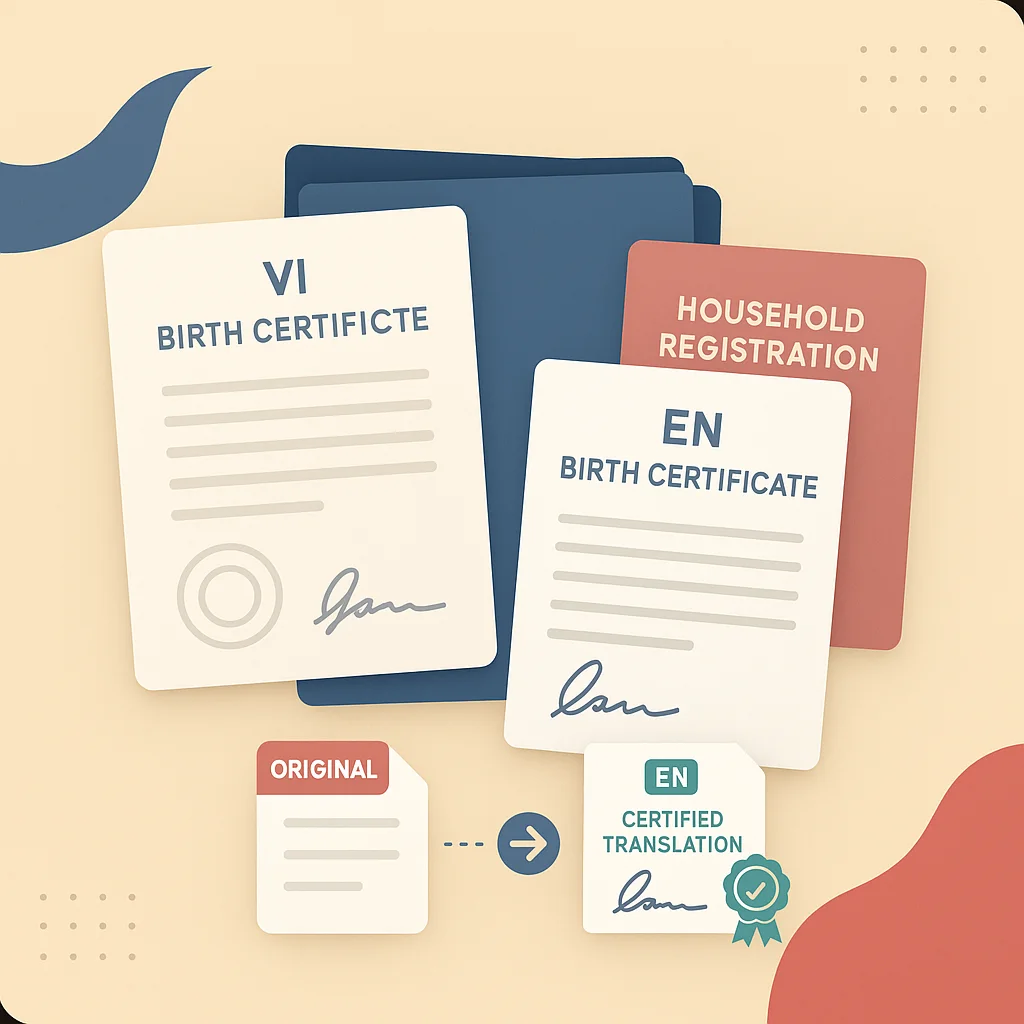
A Vietnamese civil record filed with USCIS needs a complete certified English translation of the exact version the officer will read. For birth and marriage records, the version that matters is the one the Department of State lists as acceptable for Vietnam, and the translation keeps the Vietnamese diacritics in every name next to the passport spelling.
USCIS requirements for Vietnamese documents
USCIS regulations require that any document in a foreign language come with a full English translation, certified by the translator as complete and accurate, together with a statement that the translator is competent to translate from Vietnamese into English. In practice the certification carries the translator's typed name, signature, date, contact information, and an identification of the document. Each document is safer with its own certification. USCIS keeps no list of approved translators and does not certify translation companies, so "USCIS-certified translation" only means a translation with the certification USCIS asks for.
When an applicant or a close relative signs the certification, that person is certifying evidence in their own case, and officers may give it less weight. A translation company provides a certification with no stake in the outcome. A certified document translation for USCIS follows this format for every Vietnamese record described below, and Vietnamese to English translation is handled by translators who read the source language directly.
Giấy khai sinh, bản sao and trích lục: which birth record to translate
The giấy khai sinh is the birth certificate created when the birth was registered. A bản sao is a copy issued from the civil registry, and a trích lục is an extract issued later, often after the original was lost or when a new copy was requested. The three can look alike, but they carry different issuing offices, issue dates, and reference numbers, so the translation has to show which one the applicant is filing.
Before ordering a translation, check the Department of State's Visa Reciprocity and Civil Documents by Country entry for Vietnam. It states which civil documents exist, who issues them, and which version is acceptable. USCIS officers and consular officers both rely on it, and translating the wrong version wastes the translation fee.
A complete certified birth certificate translation covers the form labels, registration numbers, both parents' details, the remarks column, every stamp, and the registrar's signature, which appears as "[signature]". If the page states that the copy was issued from the register, that line is translated too.
Vietnamese names, diacritics and the passport spelling
Vietnamese names are written with the family name first, then the middle name, then the given name, as in Nguyễn Thị Lan. The translation keeps that order and the diacritics exactly as the record shows them. Vietnamese passports print the same name without diacritics, as NGUYEN THI LAN, so a passport and a civil record can look like two different spellings of one name.
The translation of the civil record keeps the diacritics, and a short translator's note can record the passport form when the passport translation is filed with it. Whichever form is chosen should then appear the same way on the I-130, I-485, DS-260, or N-400, so the officer is not left comparing spellings across the file.
Commune, district and ward names, seals and signatures
Addresses in Vietnamese records name the commune (xã), district (huyện), and province (tỉnh), or in cities the ward (phường), district (quận), and city. The translation keeps the Vietnamese place names and renders each administrative level in English the same way throughout the file. Some units have been merged or renamed over the years, and an older record shows the name in use when it was issued. The translator reproduces what is written and does not update it.
Each record carries the seal of the office that issued it and the signature of the official. The translation describes every seal with the text it bears, marks signatures as "[signature]", and marks handwritten entries, so the officer can match each element to the source page.
Sổ hộ khẩu and the documents that replace it
The sổ hộ khẩu, or household registration book, lists the members of a household and their relationship to the head of household. Vietnam has been phasing it out, and residence is now confirmed through other documents issued by the authorities. Applicants may still hold an old book, and some files include one to show family relationships or past addresses.
A household book has to be translated completely. That covers every page that carries an entry, including changes, crossed-out lines, handwritten notes, and the back of a page when it holds anything. Translating only the page that lists the applicant does not meet the USCIS requirement. A residence confirmation issued in place of the book is translated the same way, with its issuing office, date, and seal.
Giấy chứng nhận kết hôn and confirmation of single status
The giấy chứng nhận kết hôn is a marriage certificate that records both spouses' names, dates of birth, and identity numbers, the date of registration, and the office that registered the marriage. A Vietnamese marriage certificate translation reproduces each of those fields and the stamps beside them. Vietnamese dates are written day, month, year, so a date such as 05/03 can be read two ways by a U.S. officer. The translation writes the month out in words and keeps the original numbers beside it where the layout allows. The same rules apply to any marriage certificate translation.
Some consular cases also ask for a giấy xác nhận tình trạng hôn nhân, a confirmation of single status. Its text is short, but the translation still covers the stated purpose, any validity period it mentions, the issuing office, and the seal. For civil documents that go to the National Visa Center, the same certified translation format applies, and scans are uploaded to the CEAC portal.
Older records and documents that cannot be obtained
Older Vietnamese records may be handwritten, use earlier place names, or follow a layout that differs from current forms. Parts that cannot be read are marked "[illegible]" in the translation, not guessed, and blank fields are marked blank.
When a primary record is not available, the applicant shows that it is unavailable, either with a written statement from the issuing authority or with a Reciprocity Schedule entry, and then submits secondary evidence such as school or medical records or affidavits from people with personal knowledge of the event. Each foreign-language piece of secondary evidence needs its own certified translation. The attorney or accredited representative decides which documents to submit.
Before the translation is ordered, gather the document the registry issued, both sides of every page, and the passport for the spelling check. We translate these files through our Vietnamese birth certificate translation service.