Key Takeaways
- A foreign bank statement filed with USCIS needs a full certified English translation of every printed element, not a summary of the balance, because USCIS regulations require complete translations.
- Bank statements appear with Form I-864 assets, Form I-751 joint accounts, Form I-539 extensions, F-1 financial support, and source-of-funds documentation for E-2 and EB-5 filings.
- A translation company's certification stands apart from the case, while a certification signed by the applicant or a relative may be given less weight by the officer.
- A complete translation covers the bank name, branch, account holder names exactly as printed, account type, account number, statement period, and the opening and closing balances.
- Every transaction line is translated with its date, description, debit and credit columns, and running balance, and amounts keep the separators the bank printed.
- Repeated transaction lines are never skipped, and an abbreviation is expanded once and then rendered with the same wording throughout the statement.
- Bank letters and balance certifications are translated in full, including letterhead, reference numbers, signatures, and stamps, while portal printouts without stamps are translated as they appear.
- The translated statement follows the original column layout so an officer can match each translated row and header to the source page.
- The translator does not convert currency, and any exchange amount in the translation appears only because the bank printed it on the statement.
- Translating only some pages or months leaves an incomplete document, which can lead USCIS to issue a Request for Evidence or a Notice of Intent to Deny.
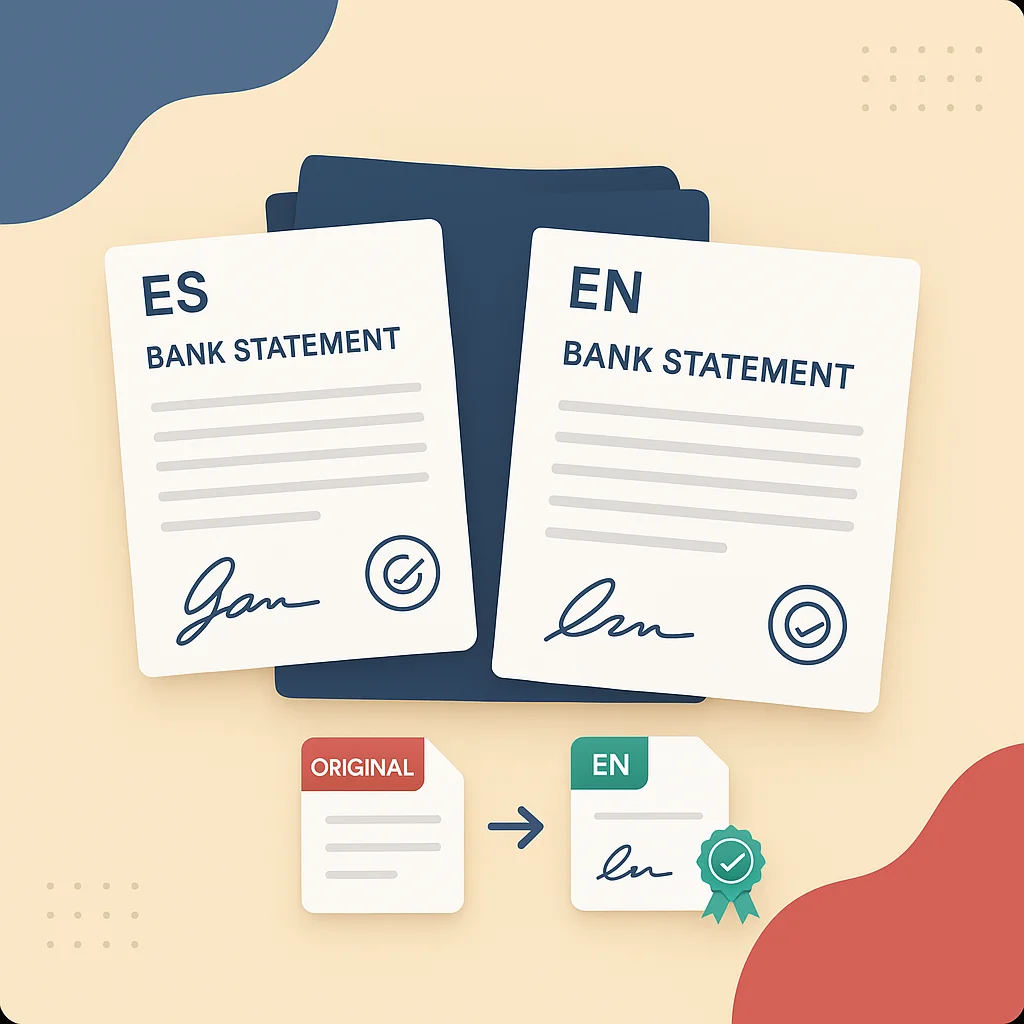
A foreign bank statement filed with USCIS needs a full English translation of every printed element, with the translator's certification attached. The bank name, the account holder, every transaction line and every stamp are translated, and the closing balance is only one line among them. Bank statements accompany more filings than most applicants expect, and a statement translated only in part gives the officer nothing reliable to read.
Where bank statements appear in USCIS filings
The Form I-864 Affidavit of Support is the clearest case, because a sponsor who relies on assets lists savings and checking accounts and attaches statements as proof. A joint account is common evidence in a Form I-751 petition to remove conditions on residence, where shared finances can help show that a marriage is genuine. Statements are also filed with extension requests such as Form I-539, as proof of financial support for F-1 students, and as source-of-funds documentation in E-2 and EB-5 cases.
The attorney or accredited representative decides which statements go into a filing. The translation rule is the same for all of them: USCIS regulations require a full English translation of any foreign-language document, with a certification that the translation is complete and accurate and that the translator is competent in both languages. USCIS keeps no list of approved translators, so the certification itself is what the officer reads. An applicant or relative who signs it is certifying evidence in their own case, and officers may give it less weight, while certified document translation for USCIS from a translation company comes with a certification that stands apart from the case.
What a complete bank statement translation contains
Complete means everything on the page. The translation starts with the letterhead: the name of the bank, the branch and its address. Account holder names are copied exactly as printed, because the officer reads them against the rest of the filing. The translation then covers the account type, the account number as written, the statement period, and the opening and closing balances.
The transaction table follows, and every line is translated, including the date, the description, the debit and credit columns and the running balance. Currency symbols, decimal separators and thousands separators stay as the bank printed them. A statement that shows 1.250,50 is not rewritten as 1,250.50, since a changed figure is a different document and gives the officer a reason to doubt the rest. Stamps, seals, signatures and handwritten notes are described in brackets, and anything unreadable is marked "[illegible]" instead of guessed.
Translating long runs of repetitive transaction lines
A monthly statement for a busy account can run to dozens of near-identical entries such as card purchases, transfer fees and salary deposits. The translator still translates each line. Skipping the repeated ones or writing "similar entries continue" turns the translation into a summary, and a summary does not meet the requirement.
Banks abbreviate heavily, and abbreviations are where inconsistency creeps in. A careful translation expands an abbreviation once, in wording an English reader understands, and then uses that wording for every later occurrence. Merchant names, payee names and reference numbers stay in their original form, and only the descriptive text is translated. The officer can then match any English line to the same line in the source.
Bank letters, balance certifications and online statements
Some applicants file a letter from the bank instead of, or alongside, the monthly statements. A balance certification or an account verification letter is short, but it is translated like any other document: the letterhead, the reference number, the date, the signer's title, the signature and the bank stamp are all included. A letter confirming how long an account has been open is handled the same way.
Online statements are often printed from a banking portal and carry no stamp or signature. The translator adds none. The translation reproduces what is on the printout, including portal headers, page footers such as "Page 1 of 4" and any disclaimer text at the bottom. If the applicant later obtains a stamped copy from the bank, that copy is a separate document and receives its own translation and certification.
Layout, currency and partial statements
Statements are built on columns, and a translation that turns them into running text is hard to check. The translated version follows the original layout closely enough that each column header and each row can be matched to the source. When the original is in landscape orientation or has a side panel with interest and fee details, the translation keeps that arrangement.
The translator does not convert currency. If a statement is in Mexican pesos, the translation shows pesos, and the only exchange rate in it is one the bank itself printed on the statement. Any conversion a filing needs belongs in the form or in a separate exhibit prepared by the applicant, not inside the certified translation.
Partial translations create the opposite problem. Translating only the page with the closing balance, or only the months the applicant thinks are relevant, leaves the officer with an incomplete document. When a petitioner wants to file a shorter period, that choice is made before translation, and each statement that is filed is translated whole. A missing, incomplete or uncertified translation can lead USCIS to issue a Request for Evidence or a Notice of Intent to Deny, and USCIS policy also allows a denial without a prior request when the initial evidence is insufficient.
Bank statement translation in Spanish, Chinese and Vietnamese
The language of the statement changes the details, not the standard. Spanish statements use bank-specific abbreviations for withdrawals, deposits and fees, and a Spanish bank statement translation has to render each of them the same way every time; the Spanish translation services page covers the language itself. Chinese statements often put the year first in dates, so a Chinese bank statement translation keeps the date readable without changing it. Vietnamese statements carry diacritics in names and transaction descriptions, and the translation preserves the marks exactly as the bank printed them.
Other financial records filed with bank statements
Bank statements are rarely filed alone. A sponsor may also attach a translated financial statement that lists assets and liabilities, and a foreign tax return translation is common in Form I-864 packages. When one translation company handles the whole set, the account holder's name and the amounts can be kept consistent across every document.
Before ordering, the applicant should gather the full statements for the period the lawyer has chosen, every page including blank ones and pages with only fine print, plus any bank letters. Scans should be legible at full size, with stamps and handwriting visible. We translate each page and provide a separate certification for each document, so each one can be filed as its own exhibit, starting from our certified bank statement translation page.