Key Takeaways
- A child's school record in another language must be filed with a full English translation and a signed translator certification stating that the translation is complete and accurate.
- Enrollment certificates, report cards, attendance records, school leaving certificates, diplomas, and transcripts each show different facts, and each one is translated in full rather than summarized.
- Marks and grading scales are reproduced exactly as printed, because converting them to letter grades or a grade point average is an evaluation and not part of a translation.
- Subject names are translated into plain English equivalents, and the original term can stay in brackets where one English word could be read in more than one way.
- Stamps, seals, signatures, headers, footers, marginal notes, and the back of the page are all translated or described, and unreadable text is marked as illegible.
- Handwritten report cards are translated like printed ones, and blank cells stay blank so an officer can match each translated line to the source record.
- School records often repeat a child's name and date of birth, so the spelling and date format should match the birth certificate or passport, with any school variation noted in brackets.
- Credential evaluation compares a foreign education to a United States level, is done by a separate evaluation service, and is not included in a certified translation.
- A separate certification for each document is the safer practice, and a missing or incomplete translation can lead to a Request for Evidence or a denial.
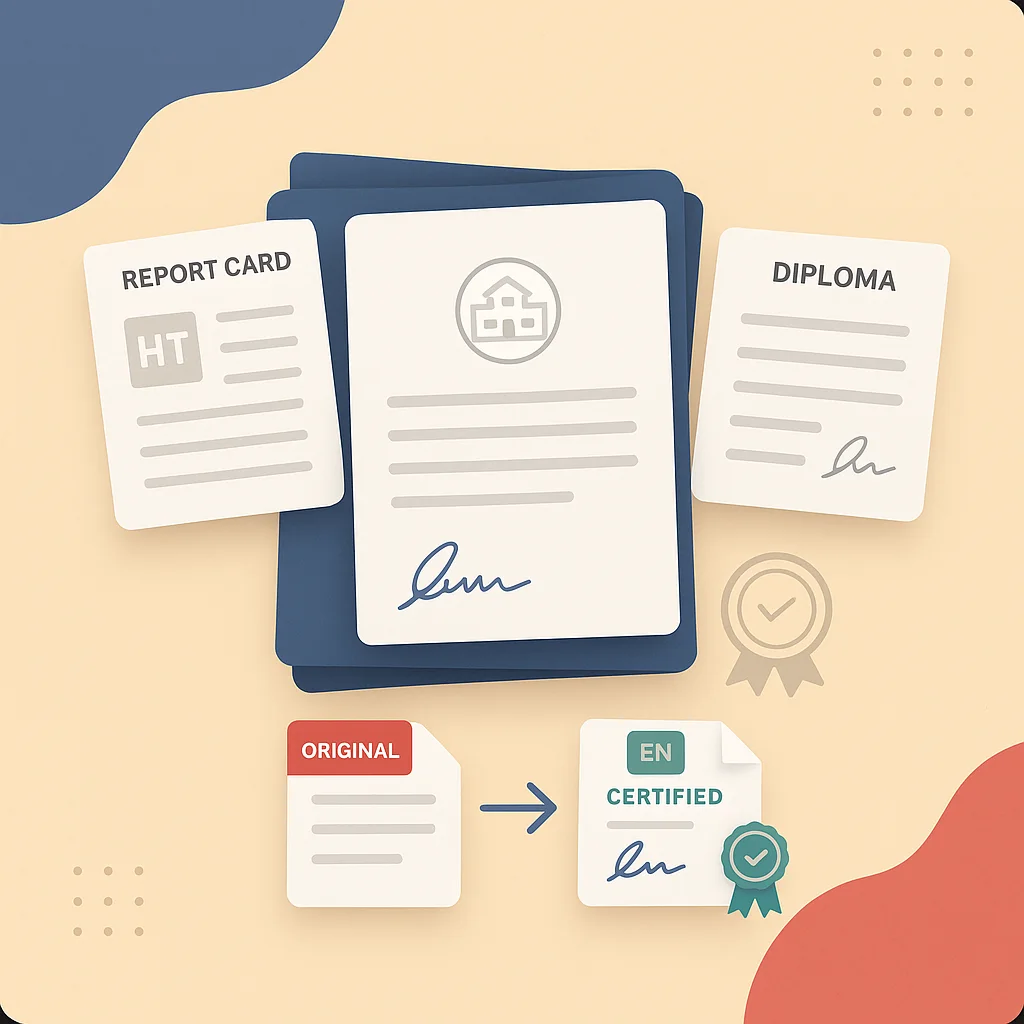
A child's school record written in another language has to be filed with USCIS together with a full English translation and a signed translator certification before an officer will weigh it. The records translated most often are enrollment certificates, report cards, attendance records, school leaving certificates, secondary school diplomas, and transcripts. Each is translated completely, with its grading scale, stamps, and signatures, and the translation changes nothing on the page.
School records turn up in several kinds of filings. A Form I-130 for a child, a Form I-751 packet that includes children's records, and a Form I-360 petition for a special immigrant juvenile can all call for them. In DACA (Form I-821D) and TPS (Form I-821) filings, an enrollment certificate or report card can show where a child lived and when. The attorney or accredited representative decides which records go into the file, and the translation company translates what the file contains. For USCIS, certified document translation for USCIS covers every foreign-language page, school records included.
School record types and what each one shows
An enrollment certificate states that a child attended a named school during a named period or grade. A report card lists subjects, marks, and teacher comments for a term or a year, and an attendance record lists days present and absent. A school leaving certificate is issued when a child transfers or finishes, and it usually gives the last grade completed, the dates of attendance, and sometimes the reason for leaving.
Secondary school diplomas and transcripts record several years of study. A transcript shows each subject under its original name, with marks, credits or hours where the school uses them, and the grading scale printed on the form. A Haitian school's records, for example, can be handled as a Haitian Creole academic transcript translation or a Haitian Creole to English translation of other school papers, and the same rules apply in every other language.
Grading scales and subject names stay as the school wrote them
A translation reproduces marks exactly as printed. If a Mexican report card shows an 8 on a scale to 10, the translation shows 8 and the scale of 10. If a French lycée uses a scale to 20, the translation carries that scale unchanged. Turning marks into letter grades or a grade point average is an evaluation, and a translation company does not add one to the certified document.
Subject names are translated into plain English equivalents. The original term can stay in brackets where one English word could be read in more than one way, so "Formación Cívica y Ética" becomes "Civic and Ethical Education" and nothing is added about what the course covered. Course descriptions that sit in a separate syllabus are a different document, and a course guide translation covers that material.
School names, towns, and districts keep their original spelling. A grade level is written as the school wrote it, such as "5th year of primary," because grade numbering differs between school systems and the officer needs to see the original structure.
Stamps, seals, signatures, and handwritten report cards
USCIS requires a complete translation, and for a school record that means every element on the page. Each stamp and seal is described with its text. Each signature appears as "[signature]" with the printed name and title of the person who signed. Headers, footers, folio numbers, and marginal notes are included, and a principal's stamp that overlaps printed text is described where it sits. Text that cannot be read is marked "[illegible]" instead of being guessed.
Handwritten report cards are common, especially for younger children and for records from small or older schools. Handwritten marks, comments, and signatures are translated like printed ones, and any unclear word is marked. Blank cells in a table are shown as blank, which lets the officer match every translated line to the source. The back of a card or certificate is checked too, and anything written there is translated.
Name and date of birth on school records next to the birth certificate
School records usually repeat a child's full name and date of birth, so an officer can read them next to a translated birth certificate. The name should be rendered the same way on every document in the packet. The translator follows the spelling in the birth certificate or passport where the source supports it. When the school spelled the name differently, the translation reproduces the school's spelling and adds a bracketed note rather than a silent correction.
Dates need equal care. A date written 03/04/2015 can mean the third of April or the fourth of March depending on the country, so the translation writes the date in an unambiguous form based on the document's own convention. If a school lists a different birth date or name from the civil record, the translation reports what the school wrote. Whether the difference matters is for the attorney to decide.
Diplomas, credential evaluation, and a certification for each record
A secondary school diploma is translated like any other record, with its seals, signatures, and registration numbers; the post on certified Spanish diploma translation shows how one is laid out, and a separate diploma translation page covers the document type. Credential evaluation is a different step. It states how a foreign education compares to a United States level, an evaluation service does it, and a translation does not include it.
USCIS regulations require the translator's certification to state that the translation is complete and accurate and that the translator is competent in both languages. In practice it carries a typed name, signature, date, and contact information. Giving every document its own certification is the safer practice, so a report card, a school leaving certificate, and a transcript each receive their own. Machine translation alone has no human certification and mishandles names, dates, and abbreviations, so it does not meet the requirement. A missing or incomplete translation can bring a Request for Evidence, and USCIS may also deny a filing without first issuing one when the initial evidence is insufficient.
Before ordering, gather the original school records, including the back of every page, and list the names and birth dates they show. Group the pages by child and by school year so each record can be matched to its translation. We prepare each record as an academic transcript translation with its own certification, and the same order can include the child's civil records.