Key Takeaways
- A Consular Report of Birth Abroad is a Department of State process, so foreign-language documents need English translations with the translator's signed statement of competence and accuracy.
- The foreign civil birth certificate, the parents' marriage certificate, and proof that earlier marriages ended are the records most often translated in a CRBA application.
- Citizenship at birth depends on the parents' citizenship and marital status and on the citizen parent's time in the United States, and the consular officer decides it.
- Every translation covers the whole page, including stamps, seals, handwritten entries, and marginal notes, and unreadable parts are marked as illegible instead of guessed.
- A hospital birth record is a medical document, while the civil registry certificate establishes the birth officially, so the civil certificate is the one the CRBA file is built around.
- The Visa Reciprocity and Civil Documents by Country schedule shows which version of a civil document is acceptable, and families should check it before ordering any translation.
- The English spelling of the child's name on the translation should match the spelling planned for the CRBA and the first passport, and the translation company needs it before work begins.
- When a certificate lists several given names, as German birth certificates do, the translation keeps every name in the order shown so the documents match across the file.
- A full divorce decree or death certificate is translated to show that an earlier marriage ended, including case numbers, stamps, and the date the decree became final.
- The same certified translations can later support an N-600 filing with USCIS or a school enrollment, provided the names and dates still match the child's current documents.
A Consular Report of Birth Abroad is issued by the Department of State, not by USCIS, and every foreign-language document in the application needs an English translation with the translator's signed statement of competence and accuracy. A US citizen parent applies at a US embassy or consulate on Form DS-2029, and the family can apply for the child's first US passport at the same time. The records translated most often are the foreign birth certificate, the parents' marriage certificate, and proof that any earlier marriage of either parent has ended.
CRBA document translation: what the consulate looks at
The consular officer has to establish who the child is, who the parents are, and whether the citizen parent meets the requirements for passing on citizenship. A child born abroad is a citizen at birth only if the parents' citizenship and marital status and the citizen parent's time spent in the United States before the birth fit the statute. The officer decides that question, and an attorney can advise a particular family on it.
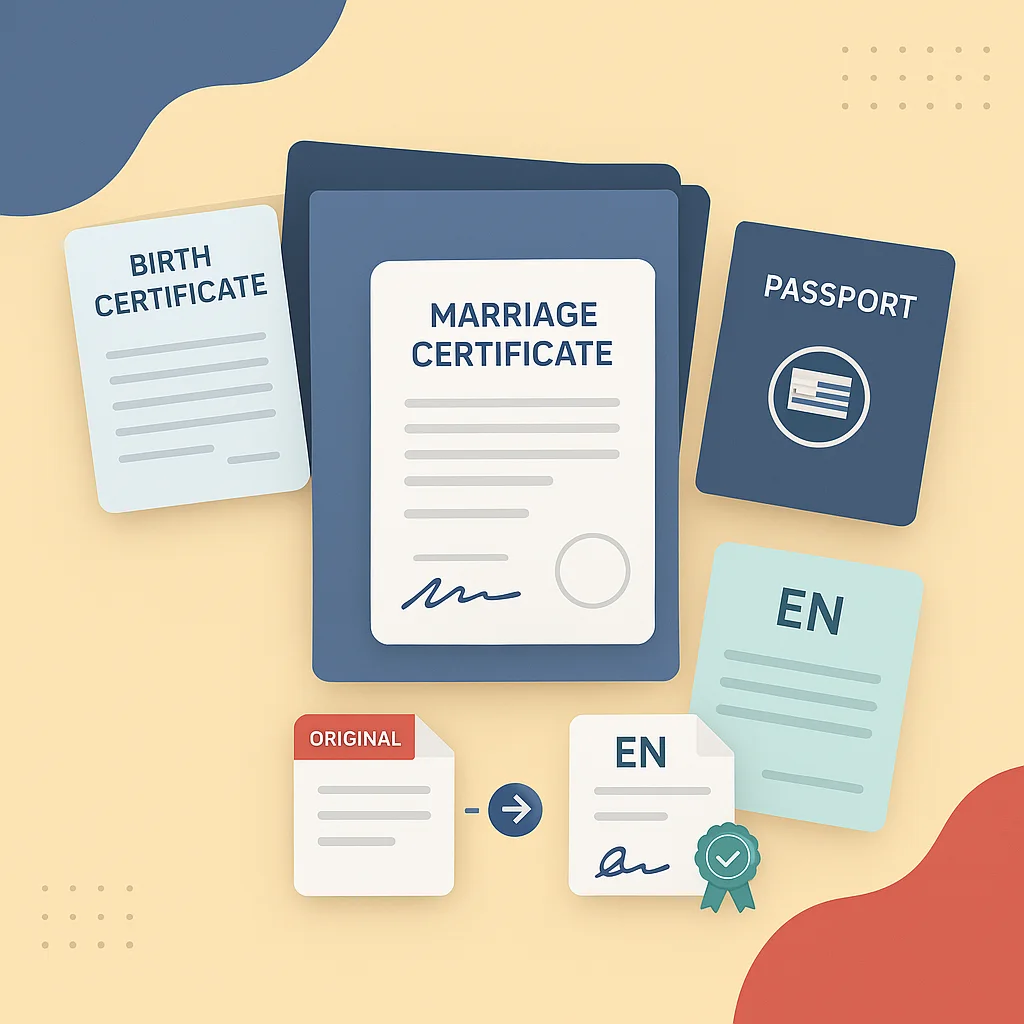
Each point is proved with paper, and whatever is not in English has to be translated. In a typical file the foreign-language documents are the following.
- The civil birth certificate issued by the registry of the country where the child was born.
- The parents' marriage certificate, or the registry entry that records the marriage.
- Divorce decrees or death certificates showing that an earlier marriage of either parent has ended.
- School, employment, or other records issued abroad that the citizen parent adds as supporting evidence of time spent in the United States or abroad.
Every item is translated in full. Stamps, seals, handwritten entries, and marginal notes are described in the translation, and anything unreadable is marked "[illegible]" rather than guessed. Extracts and "relevant parts only" translations do not meet the requirement, and machine translation alone carries no human certification at all.
Hospital birth record versus civil birth certificate
Two different papers are often both called a birth certificate. The hospital or midwife produces a record of the birth, which is a medical record in nature. The civil registry then registers the birth and issues the certificate that establishes it officially. The CRBA file is built around the civil document, so the hospital record is translated only when the consulate asks for it or when the family chooses to include it as supporting evidence.
The version of the civil certificate matters as well. The Department of State publishes a Visa Reciprocity and Civil Documents by Country schedule that lists, country by country, which documents exist, who issues them, and which version is acceptable, such as a long-form certificate instead of an abridged extract. Checking the schedule before ordering a translation avoids paying for a version the consulate will not accept.
The child's name on the translation and on the passport
The English spelling of the child's name on the translation should match the spelling the family plans to use on the CRBA and the passport. A translator working from a certificate in Korean or Japanese script has to choose a romanization, and several are in common use, so the family should give the translation company the intended spelling before work starts. A Korean birth certificate translation then carries the same spelling as the parents' names on the marriage certificate translation and on any divorce papers, because the officer compares names across documents.
Name order needs the same care. Korean and Japanese names are written family name first, and a German Geburtsurkunde lists every given name of the child, so the translation keeps each name in the order shown. A German birth certificate translation that drops a middle name creates a mismatch the family then has to explain at the appointment. Records from other countries are covered on the German translation services page and the pages for other languages.
Divorce decrees and other proof that earlier marriages ended
When either parent was married before, the file needs evidence that the earlier marriage ended before the current one began. The evidence is a divorce decree translation from the court or registry, or a death certificate where the earlier spouse died. Court decrees are longer than civil certificates, and the whole decree is translated, including case numbers, the names of judges, stamps, and the date the decree became final.
One certification per document is the safer way to file. It shows the officer that each translation was checked as its own piece of evidence, and it allows one document to be replaced later without redoing the others. The certification carries the translator's typed name, signature, date, and contact information, along with statements that the translator is competent in both languages and that the translation is complete and accurate.
Reusing the translated set for an N-600 or school enrollment
The translated birth and marriage records do not have to be redone for later steps. A citizen child may later apply to USCIS for a Certificate of Citizenship on Form N-600, and USCIS requires a full English translation with the translator's certification for every foreign-language document. A consulate may accept some documents in the official language of the country where the family lives, but once a case is with USCIS everything must be in English, so a set that already has certifications attached carries over directly. Texliff's certified document translation for USCIS follows that same format, so no second order is needed.
A US school may also ask for an English version of a foreign birth certificate at enrollment. The same translation can be handed over, provided the names and dates on it still match the child's current documents. If a spelling was corrected after the CRBA was issued, the translation should be updated so that every paper in the family's file reads the same way.
Before the appointment, gather the civil birth certificate, the marriage certificate, and any divorce or death records, confirm each version against the Reciprocity Schedule, and settle the spelling of every name. We prepare each record as a separate certified translation, starting with the certified birth certificate translation.