Key Takeaways
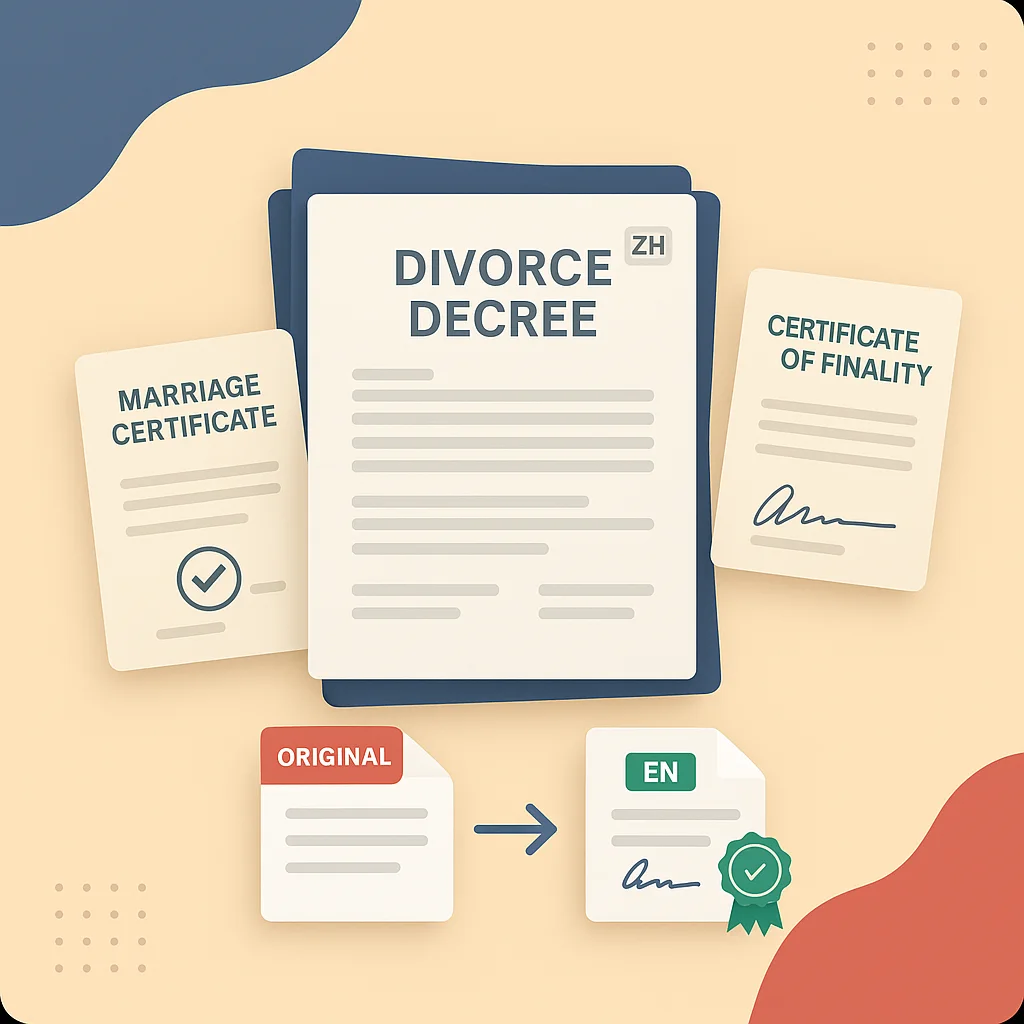
- A foreign divorce decree or annulment judgment is translated in full, and the English must show the operative order and the date the order became final.
- Filings that depend on a valid current marriage call for proof that every earlier marriage of either spouse ended, and foreign-language proof needs a certified translation.
- Divorce records differ by legal system and may be a court judgment with a certificate of finality, a civil registry record, a registered religious divorce or a mutual-consent registration.
- An annulment declares that a marriage was never valid, so the translation keeps the document's own term, whether it says divorce, dissolution, annulment or nullity.
- Every page needs translation, including stamps, seals, handwritten entries, marginal notes and the backs of pages, because a summary or a relevant-pages translation does not meet the requirement.
- When the finality statement sits on a separate sheet from the judgment, that sheet is translated and certified together with the judgment.
- The court's name is translated, the case number is copied exactly, and the spouses' names follow the spelling used in the passport and other identity documents in the filing.
- Custody, support and property clauses are translated even when a filing does not rely on them, because the requirement covers the whole document and a shorter translation invites questions.
- A name restoration clause can explain why a later name differs from the one on the marriage certificate, so its wording and the former name must be translated exactly and spelled consistently.
- Before ordering, check the Department of State Reciprocity schedule and have the attorney or accredited representative confirm which version of each record the filing needs.
A foreign divorce decree or annulment judgment is translated in full, and the translation has to show both what the order decided and the date it became final. Any filing that depends on a valid current marriage, such as a spousal Form I-130 petition, an I-485 adjustment, an I-129F fiancé(e) petition or an N-400 naturalization application, calls for proof that every earlier marriage of either spouse ended. When that proof is in another language, USCIS requires a full English translation with the translator's certification, the same certified document translation for USCIS that applies to every other foreign civil record.
Divorce decree translation for USCIS starts with the type of document
Countries end marriages in different ways, and the paper that results looks different in each system. In some countries a court issues a judgment and a separate certificate that the judgment is final. In others a civil registry office records the divorce and issues an extract. A religious divorce, such as a talaq or a get, is sometimes registered later with a civil authority, and the civil record is what the filing usually relies on. In several countries, China and Japan among them, a mutual-consent divorce is registered at a civil office, so no court judgment may exist at all.
An annulment is a different legal act from a divorce. A court declares that the marriage was never valid, and the judgment says so in its own terms. The translation keeps the document's own word, whether it is "divorce", "dissolution", "annulment" or "nullity", and does not replace it with a more familiar one. The attorney or accredited representative decides which of these documents the filing needs.
The Department of State publishes a Reciprocity and Civil Documents schedule that lists, country by country, which civil documents exist and who issues them. Checking it before ordering a translation matters, because translating the wrong version of a record wastes the fee.
Which pages of a court judgment need translation
Every page needs translation. A divorce judgment often runs several pages, and an applicant sometimes assumes that the cover page or the operative order is enough. USCIS regulations require a complete translation, which means body text, headings, form-field labels, stamps, seals, signatures, handwritten entries, marginal notes, headers, footers and anything printed on the back of a page. A summary or an extract of the pages that seem relevant does not meet the requirement.
Two parts of the judgment still get the closest reading, because the officer looks for them first: the operative order that dissolves or annuls the marriage, and the date on which the order became final. Courts record finality in different ways. It may appear as a stamp on the judgment or as a separate certificate of finality. When the finality statement sits on a different sheet from the judgment, that sheet is translated and certified together with it.
How the translation treats the court name, case number and parties
The court's name is translated, and the original name is kept beside it so a reader can match the translation to the source. The case number is copied exactly as it appears, with every letter, slash and digit in place. Names of the spouses follow the spelling in the passport or the other identity documents in the same filing. When the decree spells a name differently, the translation records the spelling that is on the page, and the applicant explains the difference elsewhere in the filing.
Dates are the second place where errors enter. A translation can show a date the way the source writes it and then give the same date in month, day and year order for a US reader. Chinese documents put the year first, and records from some Arabic-speaking countries use Hijri dates, so the conversion needs a careful hand. Where the source uses a calendar other than the Gregorian one, the translation says which calendar it is.
Custody, support and property clauses are translated too
Many decrees contain more than the end of the marriage. They may set custody of children, parenting time, child support, spousal support, the division of property or an order about the family home. A filing may not rely on most of these terms, but the translation covers them anyway, since the requirement is a complete translation of the document and not of the parts that look useful. An officer who sees a translation shorter than the original has a reason to question it.
Clauses that look routine get the same treatment: appeal periods, fees assessed against a party, notices to the registry. They are translated as written. Passages that cannot be read, for example because of a faded stamp or a photocopy that cut off a line, are marked "[illegible]" and not guessed. A seal or signature is described in brackets, such as "[signature]" or "[court seal]".
Name restoration clauses and the link to a name change
Some decrees include a clause that lets one spouse resume a former name, often a maiden name. Applicants later use that clause to explain why the name on a passport, a green card application or a naturalization form differs from the name on the marriage certificate. The clause is therefore translated with its exact wording, including the former name in its original script and the translator's spelling of it in English.
When the clause is the only link between two names, the divorce decree, the marriage certificate translation and any change of name document translation should use the same spelling for the same person. Documents translated one at a time, with no check against the others, are how name mismatches reach the officer.
Chinese and Arabic divorce records and what comes with them
The wording of a divorce record depends on the language and the legal system behind it. A Chinese divorce certificate translation often covers a short registration certificate issued after mutual consent, and the same applicant's household and family records are handled under Chinese translation services. An Arabic divorce certificate translation may involve a court judgment, a registered talaq and Hijri dates in the same file.
Each foreign-language document in the packet needs its own certification, and a separate certification for each document is the safer practice. Machine translation does not meet the requirement, since it carries no human certification and tends to mishandle names, dates and legal terms. When a translation is missing, incomplete or uncertified, USCIS may issue a Request for Evidence or a Notice of Intent to Deny, and it can also deny a filing without first asking for more.
What to prepare before ordering
Gather the full judgment, any certificate of finality, any civil registry extract that records the divorce, and the identity documents that show how each name is spelled. Scan every page, including blank pages and the backs of sheets that carry a stamp. Order the translation after the attorney or accredited representative has confirmed which version of each record the filing needs. For the divorce record itself, we prepare a certified divorce certificate translation with a separate certification for each document.