Key Takeaways
- A derivative spouse and each child file a separate I-485, and every foreign-language record in each family member's file needs a full English translation with a certification.
- Records the principal already filed earlier still need their certified translation attached to the dependent's I-485, so a copy with its certification goes in each filing.
- The marriage date and the spelling of both spouses' names in the translation should match the principal's earlier petition, and any real difference is explained separately.
- A marriage registered long after a religious ceremony shows two dates, and the translation reproduces both exactly as written without reconciling them.
- A child's birth certificate must name the principal applicant as a parent, so an abridged extract that omits the parents cannot prove the relationship even when translated well.
- The Department of State Reciprocity Schedule lists which version of each civil record is acceptable, and it should be checked before a translation is ordered.
- Adoption decrees, custody orders and guardianship papers are translated in full, including case numbers, seals and handwritten entries, with illegible passages marked as illegible.
- One certification for each translated document is the safer practice, and shared records such as the marriage certificate should carry the same translated text in every family member's packet.
- Machine translation carries no human certification and mishandles names and dates, so it does not meet the USCIS requirement for a certified translation.
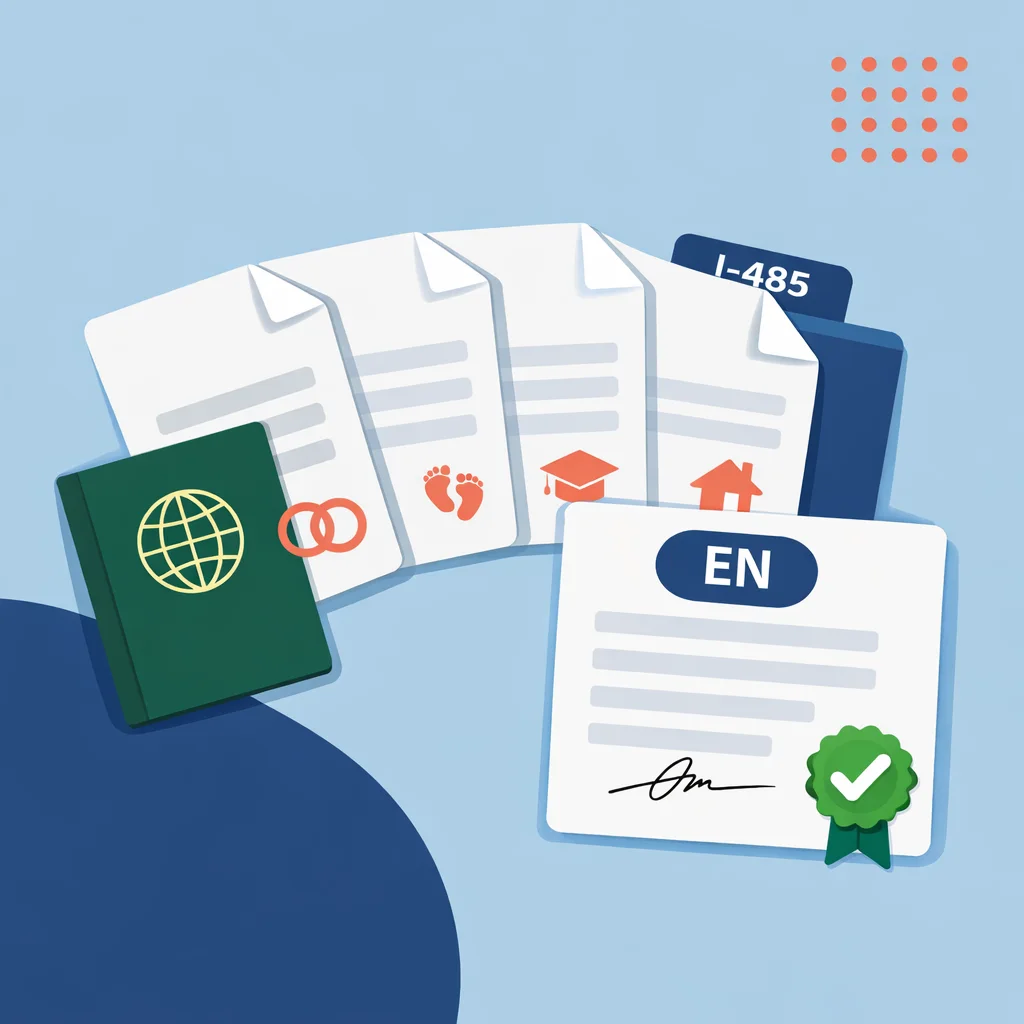
A spouse or child who adjusts status as a derivative files a separate Form I-485, and each of those forms needs its foreign-language civil records translated into English with a certification. The marriage certificate proves the spouse's tie to the principal applicant, and each child's birth certificate proves the child's tie to the parent. Passports, adoption or custody records, and proof that earlier marriages ended complete the set.
USCIS regulations require a full English translation of any foreign-language document, certified by the translator as complete and accurate, with a statement that the translator is competent in both languages. When the principal holds H-1B, L-1, E-2 or another status, the family members usually hold the matching dependent status, such as H-4 or L-2. The attorney or accredited representative decides who qualifies and what to submit, so what follows covers only the records. The general rules are on the certified document translation for USCIS page.
Which derivative I-485 documents need translation
Every record that is not in English needs a translation in each family member's filing, including records the principal already filed earlier. If an earlier I-129 or I-140 included a translated marriage certificate, the dependent's I-485 should carry a copy of that translation together with its certification.
For a typical family the list is short:
- the marriage certificate that links the spouse to the principal applicant;
- a birth certificate for each child that names both parents;
- the passport pages of each family member that carry the biographic data and any visas or stamps;
- adoption, custody or guardianship records for a child who is not a biological child;
- a divorce decree or death certificate for any earlier marriage of either spouse.
Each record has to agree with the others. A family file in which the spouse's name appears in three different spellings invites questions that one more document would not.
Marriage certificate translation for the spouse's I-485
The marriage record is the main proof of the relationship, so the marriage certificate translation has to carry every printed and handwritten element: the names of both spouses, the date and place of the marriage, the registry number, the issuing office, and any stamps or marginal entries. The marriage date and both spouses' spellings should match the principal's earlier petition. If the earlier filing used a different spelling, the translator still reproduces what the certificate itself shows, and the family explains the difference separately instead of altering the translation to match.
Some records need extra attention. A Korean marriage relation certificate (혼인관계증명서) is issued under the family relations register system that replaced the hojeok in 2008, and a Korean marriage certificate translation has to follow its fields exactly, as any certified Korean to English translation does. Other countries issue a certificate at the time of the wedding and a separate registry extract later. The Department of State's Reciprocity Schedule says which version is acceptable for each country, and it should be checked before the translation fee is spent.
A marriage registered after a religious ceremony
In some countries a couple marries in a religious ceremony and registers the marriage with the civil authority months or years afterward. The civil certificate then shows a registration date later than the wedding date the couple gives. The translation shows both dates exactly as written. A religious certificate, if the family also files it, is translated as a separate document with its own certification. The translator does not reconcile the two dates inside the translation.
Birth certificates must show both parents
A child's relationship to the principal applicant is proved by the birth certificate, so the certificate needs to name the principal as a parent. Many countries issue an abridged extract that lists only the child's name, date and place of birth. Such an extract often leaves out the parents, so it cannot prove the relationship even when it is translated perfectly. Poland, for example, issues both a full copy (odpis zupełny) and an abridged copy (odpis skrócony), and the same split exists elsewhere.
The family should therefore order the long-form record from the issuing authority before translation begins. A Chinese birth certificate translation also has to convert the year-first date order carefully, and the parents' names should be spelled the way they appear in their passports. If a parent's name differs between the birth record and the passport, the translation follows the record.
Adoption, custody and passport records
A child who is not the biological child of the principal needs records that show how the legal relationship was formed: the adoption decree, the court order or guardianship paper, and the amended birth certificate if one was issued. Adoption documents translation covers every page of the court file that is submitted, including case numbers, judge names and seals. Where a passage is illegible, the translator marks it [illegible] and does not guess. For stepchildren, see the separate post on stepchild green card documents translation.
For passports, the data page and any page that carries a visa, entry stamp or amendment matter most when they are not in English. The passport spelling of each name often becomes the reference point for the whole family file, so the person translating the other records should see it first.
Organizing one family packet with one certification per document
A family packet holds many records for several people, and the officer has to match each translation to its source. The safer practice is one certification for each translated document, with the translator's typed name, signature, date, contact information, a statement of competence, a statement that the translation is complete and accurate, and a line that identifies the document. The marriage certificate translation then stands on its own, and so does the translation of each child's birth certificate.
The spouse and each child may each file an I-485 with copies of the marriage certificate and the principal's own records, so the translation of those shared records should be the same text in every packet. Different spellings of the same name from one packet to the next are easy to spot when the files are read together.
USCIS may issue a Request for Evidence or a Notice of Intent to Deny when a translation is missing or uncertified, and USCIS policy also allows an officer to deny a filing without a request when the initial evidence is insufficient. Machine translation carries no human certification and mishandles names and dates, so it does not meet the requirement.
What to gather before ordering translations
Collect the long-form version of each civil record, clean scans of every page including the back, and the principal's earlier petition so that spellings and the marriage date can be compared. Check the Reciprocity Schedule entry for the country, then have the birth certificate translation for each child done together with the marriage record, so the whole family file is translated against one set of spellings. Texliff prepares each translation with its own certification.