Key Takeaways
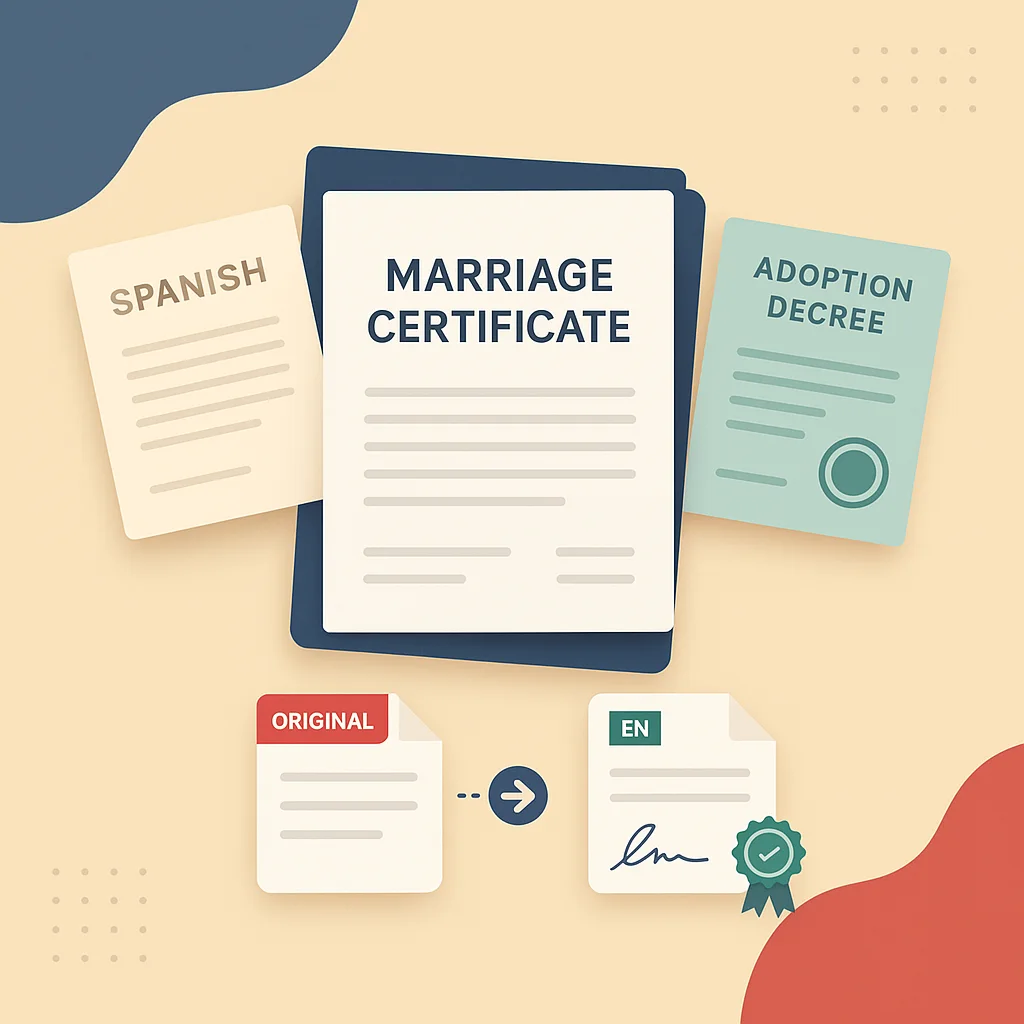
- A petition for a stepchild, adopted child, or child born outside marriage depends on a chain of records, and each foreign-language record needs its own full English translation and certification.
- A stepchild file generally pairs the child's birth record with the marriage certificate of the biological parent and the petitioner, and both are translated in full with separate certifications.
- Write marriage and birth dates with the month as a word, since a month-first or day-first reading can move a date by several months in the translated record.
- The full birth record is needed rather than an extract, because abridged copies often omit the father's name and the marginal entries these cases depend on.
- Check the Department of State Reciprocity Schedule for the country before ordering a translation, so the fee is not spent on a version that the schedule does not accept.
- Each marginal annotation on a birth record, such as a paternity acknowledgment, is translated as its own element with its date, issuing office, wording, and a bracketed description of stamps and signatures.
- A court legitimation order is translated like any other court document, including the court name, case number, ruling, and signature block, and illegible handwriting is marked [illegible] instead of guessed.
- Adoption files often contain a decree, a custody record, an amended birth certificate, and sometimes the original birth record, and the translation keeps these documents separate with their own dates and names.
- The child's names are translated exactly as printed in each record, with one romanization used throughout the set and the passport spelling as the usual reference point.
- Machine translation carries no human certification and mishandles names and dates, so it does not meet the requirement, and the attorney or accredited representative decides which records to file.
A petition for a stepchild, an adopted child, or a child born outside marriage rests on a chain of records, and every foreign-language record in that chain needs a full English translation with a translator's certification. Texliff handles this as certified document translation for USCIS, one record at a time. The chain starts with the child's complete birth record and adds the document that shows the legal link to the petitioner: a marriage certificate, an adoption decree, or a legitimation or paternity record. The attorney or accredited representative decides which of these a particular Form I-130 filing calls for.
Stepchild green card documents: the birth record and the marriage certificate
In a stepchild case, the file generally pairs the child's birth record, which names the biological parent, with the marriage certificate of that parent and the petitioner. Both are translated in full, and the translation of each carries its own certification. USCIS regulations require a complete and accurate English translation together with the translator's statement of competence, and a separate certification for each document is the safer practice.
The birth record is the starting point, so a certified birth certificate translation has to reproduce every name, date, and registry number exactly as the source prints them. The marriage record is handled the same way. A marriage certificate translation should show the date of the marriage in a form that cannot be misread, because a month-first or day-first reading can move a date by several months. Writing the month as a word removes the doubt.
Where one of the parents had an earlier marriage, a divorce decree or a death certificate may also belong in the file. Each of those is a separate document and gets its own translation and certification.
Why the full birth record matters more than an extract
Many countries issue both a short extract and a full copy of a birth record. The Department of State's Visa Reciprocity and Civil Documents by Country schedule lists, country by country, which version is acceptable, and applicants should check it before ordering a translation. Polish records are a good example, since an odpis zupełny is the full copy and an odpis skrócony is the abridged one. Brazil issues a certidão de nascimento de inteiro teor for the same reason.
The difference matters in these three case types because the extract often leaves out exactly what the case depends on. Civil registries in many countries record later events as marginal entries on the original birth record, such as an acknowledgment of paternity, a court order, or an adoption. An abridged copy may omit the father's name or every annotation. Translating the wrong version costs the fee and leaves the file without the evidence it was meant to hold. A Spanish birth certificate translation of a Mexican acta de nacimiento, for instance, should include any marginal note printed on the page along with the main entry.
Paternity and legitimation records: translating annotations in sequence
A child born outside marriage may have a birth record that names only the mother. The father can be added later through an acknowledgment entered in the margin of the record, or through a court order of legitimation that is issued as a separate document. In both situations the sequence of events is the evidence, so the translation has to keep it intact.
The translator treats each annotation as its own element and does not merge it into the main entry. A complete translation of an annotated birth record shows these points for every entry:
- the date of the annotation, kept separate from the date of birth
- the office or court that made the entry
- the full wording of the entry, including any case or file number
- a bracketed description of each stamp and signature, such as [signature] or [stamp]
- a bracketed note on where the entry sits, such as [marginal note, left side]
A court legitimation order is translated like any other court document, with the court name, the case number, the parties, the ruling, and the judge's signature block. Records written by hand are common in this category, and anything that cannot be read is marked [illegible] rather than guessed. Registry records and family statements from the Philippines may be partly in Tagalog, and Tagalog translation services cover those pages as well.
Evidence of the father's relationship with the child sometimes includes statements from relatives or neighbors who know the family. Each statement is a foreign-language document in its own right. An affidavit translation reproduces the statement in the first person, with the signature, the date, and any contact details, and does not tidy up the wording.
Adoption decrees and the amended birth certificate
An adoption usually leaves two or three documents behind: the court decree or administrative approval, a custody record from the period before the adoption became final, and a new or amended birth certificate that names the adoptive parents. The original birth record may still exist as well. The documents carry different dates, and the translation keeps them apart. A decree and an amended certificate can show different names for the same child, and the translation reports each as written.
Korean adoption papers are one case where the pieces come from more than one source. A court approval may sit beside entries in the family relation certificate (가족관계증명서), which replaced the hojeok system in 2008. A Korean adoption documents translation covers each of those papers, with the original Korean terms given beside the English where a term has no exact equivalent.
Keeping the child's name consistent across every record
A child in these cases may appear under several names: the name at birth, the name given after legitimation or adoption, and the spelling in a passport. The translator does not harmonize them. If the birth record shows one name and the decree shows another, both are translated exactly as printed, and a bracketed translator's note can point out that the source itself differs.
For languages written in another script, the romanization stays the same in every document of the set. The spelling in the child's passport is the usual reference point. Dates follow one format throughout, and the same person is never spelled two ways in two translations. Machine translation alone carries no certification and often mishandles names, dates, and abbreviations, so it does not meet the requirement.
Preparing the records before translation
Gather the full-length records, both sides of every page, and any later annotated copies, and check the country's entry in the Reciprocity Schedule first. When the primary record cannot be obtained, the applicant shows that it is unavailable and submits secondary evidence, and each piece of that evidence needs a certified translation too.
Texliff prepares each record as a separate certified translation, and an adoption file in particular goes through adoption documents translation as one set, so the decree, custody record, and amended certificate stay in order.