Key Takeaways
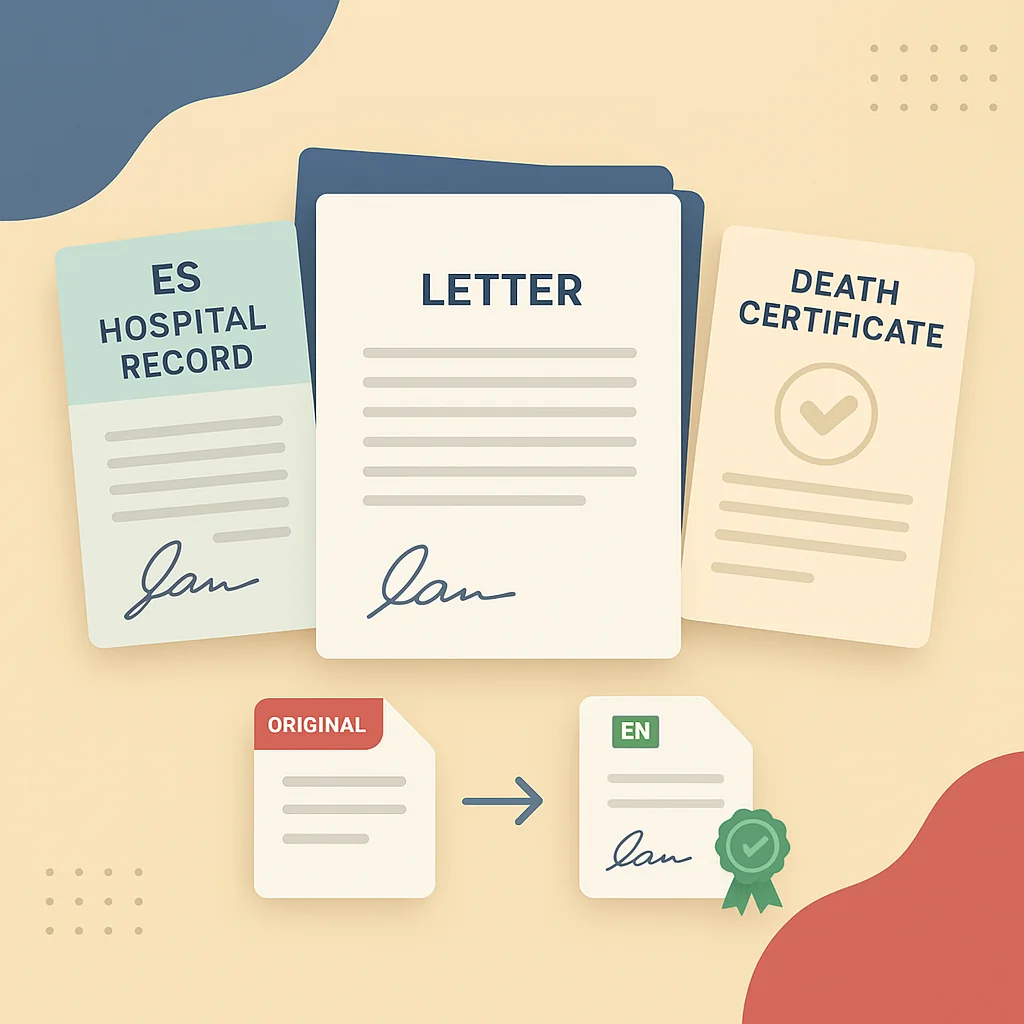
- Hardship evidence for an I-601 or I-601A waiver needs a full certified English translation whenever any part of a document, letter, or record is written in another language.
- USCIS keeps no approved translator list, so a USCIS-certified translation means one that carries the certification USCIS asks for, not one that USCIS has endorsed.
- Medical records are translated as written, with diagnoses, abbreviations, hedged wording such as probable, and test units kept exactly as the physician recorded them.
- Unreadable words in a medical record or handwritten letter are marked as illegible instead of guessed, because one guessed word can change what the document appears to say.
- Letters and affidavits from relatives are translated word for word, with letterhead, dates, stamps, and signatures described in brackets, and without tidying the grammar or condensing the statements.
- The State Department's Reciprocity Schedule should be checked before ordering a death certificate translation, because translating the wrong version of a civil record wastes the fee.
- Financial documents keep every figure, currency, date, and account label as printed, and any currency conversion belongs in the attorney's exhibit instead of the certified translation.
- Each document is translated page for page, including the back of a page that carries anything, and only a newspaper or publication may be limited to the relevant article.
- Names and dates in new translations should match the passport and the civil documents already filed with the I-130 or I-485, unless the source document itself shows a different spelling.
- The attorney or accredited representative decides which evidence goes into the packet and how it supports the waiver, while the translation company only translates what the documents say.
Every hardship document for an I-601 or I-601A waiver that is written in another language needs a full English translation with the translator's certification. USCIS regulations require this for each foreign-language document in a filing, and a doctor's letter from abroad is held to the same rule as a birth certificate.
The Form I-601, the Application for Waiver of Grounds of Inadmissibility, and the Form I-601A, the Application for Provisional Unlawful Presence Waiver, are decided on the evidence in the packet. Much of that evidence comes from another country: medical files, school reports, letters from relatives, financial papers. Certified document translation for USCIS is what makes each of those papers readable to the officer.
Which hardship documents from abroad need a certified translation
A hardship packet is built from whatever shows the situation of the qualifying relative and the family. When that relative lives abroad, or the family keeps its records in the home country, many of the papers are not in English. Typical examples are hospital discharge summaries, laboratory results, prescriptions, letters from treating physicians, school records for children, employer letters, pay slips, bank records, property papers, and written statements from relatives.
Each of them gets the same treatment: a complete English translation and a signed certification from the translation company. USCIS does not keep an approved list of translators and does not issue translator credentials, so "USCIS-certified translation" only means a translation that carries the certification USCIS asks for. Which documents go into the packet, and how they support the waiver, is decided by the attorney or accredited representative, not by the translation company.
Medical records are translated as written, never interpreted
Medical records are the most technical part of most hardship packets. A hospital in Mexico or Colombia may record a diagnosis in clinical shorthand, with abbreviations, drug names, and dosage notations that differ from US practice. If the source says "DM2" or "HTA", the English text keeps the abbreviation as written, and a bracketed expansion is added only when the meaning is beyond doubt.
The translator does not diagnose, correct, or explain. A diagnosis stays exactly as the physician wrote it, including hedged wording such as "probable" or "rule out", and test values keep their original units. Stamps, physician license numbers, signatures, and handwritten margin notes are described in brackets. Anything unreadable is marked "[illegible]" instead of guessed, because a guessed word in a medical record can change what the document appears to say. Spanish medical records translation follows these same rules.
Machine translation does not meet the requirement. It carries no human certification, and it mishandles names, dates, abbreviations, and the clinical terms that matter most in a hardship report.
Letters and affidavits from relatives are translated in full
Family members abroad often write about the qualifying relative's health, the household's finances, or the conditions the family would face. A letter, or a signed affidavit translation from a person with personal knowledge, is translated word for word. The translator does not tidy the grammar, join short sentences, or soften the tone, and a first-person statement stays in the first person.
Everything on the page belongs to the translation: the letterhead, date, address block, closing words, signature, and any stamp or witness mark. A signature appears as "[signature]". Handwritten letters are common in these packets, and a word the translator cannot read is marked rather than filled in. Many letters from relatives in Latin America are written in Spanish, and Spanish translation services prepare them under the same rules as any other record.
Death certificates, school records, financial papers, and news articles
When a close relative has died, the death certificate translation has to follow the format of the issuing country. The State Department's Visa Reciprocity and Civil Documents by Country schedule lists which civil documents each country issues and which version is acceptable, so the right version should be located before anything is ordered for translation.
School records of children living abroad are translated with grades, subject names, grading scale, and seals intact. Financial documents are treated just as literally. A financial statement translation keeps every figure, currency symbol, date, and account label as printed, and the translator does not convert currencies or recalculate totals. A payment shown in a local currency stays in that currency, and any conversion is left to the attorney's own exhibit.
Country-condition material is the one place where less than a full document is translated. For a newspaper or other publication, only the relevant article needs a translation. A hospital report or a letter never gets that treatment.
Page counts and exhibit order in a hardship packet
Hardship packets are long, and each translation has to match its original page for page. A hospital file of forty pages produces a translation of forty corresponding pages, with the back of a page translated whenever it carries anything. Partial translations, summaries, and "relevant pages only" versions do not meet the requirement, so the packet cannot be shortened at the translation stage.
A consistent layout lets the officer match each translated element to its source. Each original is placed with its translation, and each translated document carries its own certification, which is the safer practice. The attorney sets the exhibit numbers and the order, and the translation company keeps its page numbering aligned with the exhibit index. A change in page count after the packet is paginated can break the index, so the originals should be final before translation starts.
Names and dates must match the I-130 and I-485 file
Names are where most inconsistencies enter a hardship packet. A Spanish-speaking applicant may appear with two surnames in one record, one surname in another, and a married name in a third. The spelling in the passport and in the civil documents already filed with the Form I-130 or Form I-485 should guide every later translation, unless the source document itself shows a different spelling. In that case the translator reproduces what the document says, and the attorney decides how to explain the difference.
Dates follow the same rule. The translation writes dates in the US format of month, day, and year, and an ambiguous source date is translated as printed with a bracketed note rather than silently converted. A copy of the earlier filing, or at least the passport page, lets the translation company match spellings before the new documents are finished.
Before a packet goes to the attorney, check that every foreign-language page has a matching English page, that each translation has a signed certification, and that names match the earlier file. For medical files, send complete copies rather than selected pages to the team preparing your certified medical records translation, so nothing is left to be translated later.