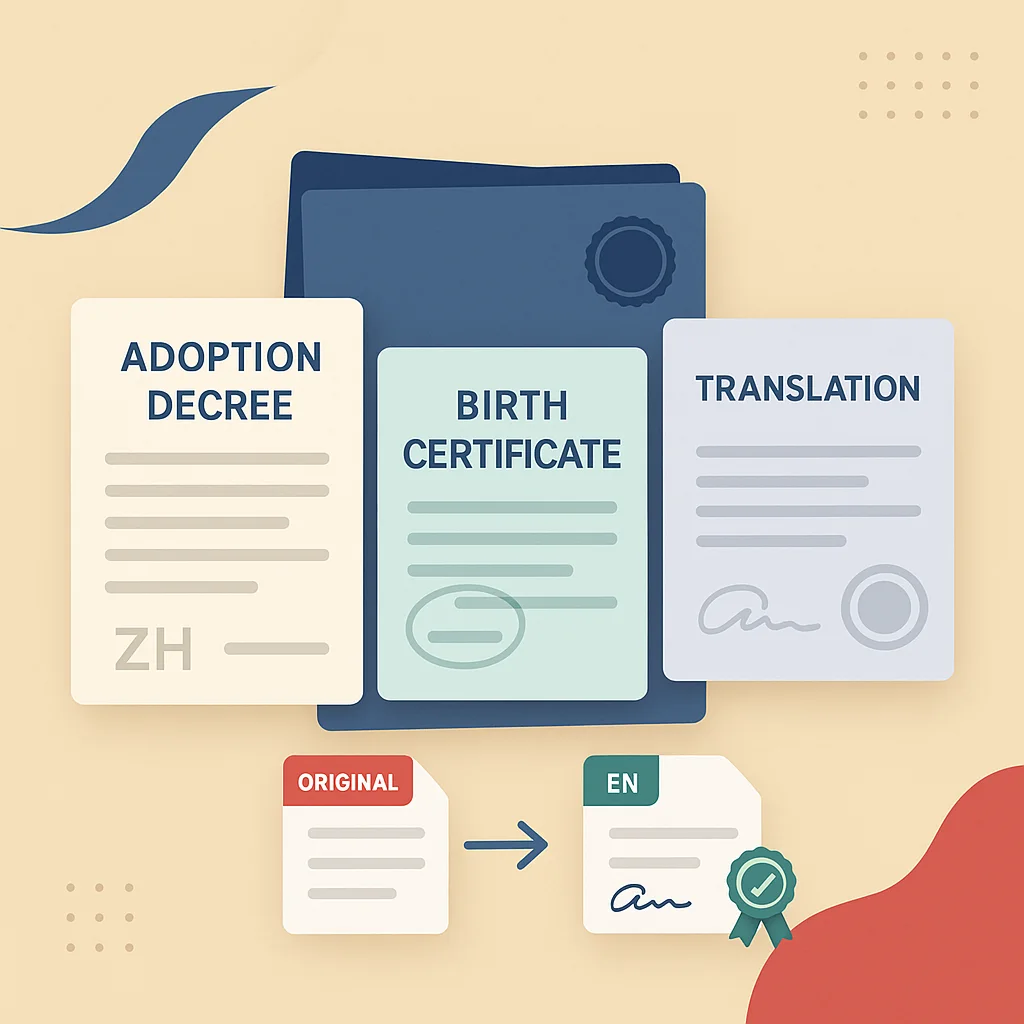
Key Takeaways
- Form I-600 and Form I-800 filings need a full English translation of every foreign-language record, and each translation must carry a certification of completeness, accuracy, and the translator's competence.
- Form I-800 is used for Hague Convention adoptions and Form I-600 for adoptions outside it, but the translation rules for the evidence are the same in both filings.
- A typical file includes the adoption or custody decree, original and amended birth certificates, abandonment or guardianship records, birth parent consent, and the child's medical records, each translated separately.
- One signed certification per document is the safer practice, because an officer can check each translation against its source and one record can be reused later without reissuing the set.
- An adoption decree is translated line by line, keeping the court's own legal term for the adoption and recording every stamp, seal, and signature in brackets.
- Both the original birth certificate and the amended post-adoption certificate belong in the file when both exist, and neither should borrow details from the other.
- Each name is spelled as that document spells it, using one transliteration rule across all records, and a short bracketed note records any source that writes the same name two ways.
- Handwritten orphanage and abandonment records are translated in place beside their printed field labels, with unreadable words marked illegible instead of guessed.
- Medical terms and abbreviations differ by country, so the translator keeps the original term, and machine translation alone carries no human certification and does not meet the requirement.
- Documents sent to a foreign central authority in the child's language follow that authority's written instructions, and an English translation is still required once the case is with USCIS.
An intercountry adoption case filed on Form I-600 or Form I-800 needs an English translation of every foreign-language record in the file, and each translation must carry a certification. The file typically includes the adoption or custody decree, the child's birth records, the papers that explain how the child came to be available for adoption, and any medical or consent documents written in another language. USCIS regulations require a full English translation, certified by the translator as complete and accurate, along with a statement that the translator is competent to translate from that language into English.
Form I-800 is used for adoptions under the Hague Convention, and Form I-600 is used for adoptions outside it. The two filings differ in procedure, but the translation rules for the evidence are the same. The adoption agency, the attorney, or the accredited representative decides which records go into the filing, and this article only describes how those records are translated.
Which documents in an I-600 or I-800 file need translation
The foreign records vary by the child's country, but most files contain some mix of the following.
- The foreign court decree of adoption, or the order that gave custody to the adoptive parents.
- The child's original birth certificate and, where one was issued after the adoption, the amended birth certificate.
- Abandonment, relinquishment, or guardianship records from the orphanage, the court, or the child welfare authority.
- Written consent from the birth parents, or a record showing why consent could not be obtained.
- The child's medical records and any vaccination record from the orphanage or hospital.
Each item is its own document, so each gets its own translation and its own certification. A single translated bundle with one certification at the front is harder for an officer to check against the originals. The usual practice with certified document translation for USCIS is one signed certification per document, which also lets a single record be reused later without reissuing the whole set.
Adoption decree translation: the court's wording stays as written
A foreign adoption decree is a court document, and the translation follows it line by line. The case number, the name of the court, the judge's name, the date of the order, the names of the adoptive parents, and the child's name before and after the adoption all appear exactly as the decree gives them. Stamps, seals, and signatures are described in brackets, and pages that are blank are marked as blank.
Courts in different countries use different terms for the same legal act. A decree may speak of a full adoption, a simple adoption, a transfer of guardianship, or a termination of parental rights, and each of these means something different in the file. The translator keeps the term the court used and does not replace it with a United States legal term that sounds close. A decree from China shows the point on dates: Chinese adoption documents translation converts the year-first dates to U.S. order without changing the day, month, or year.
Birth certificate translation before and after the adoption
Most adopted children have two birth records, one that shows the birth parents or an unknown parent and one issued after the adoption that shows the adoptive parents and a new name. Both belong in the file when both exist, and both are translated in full. A birth certificate translation for the amended record must not borrow details from the original one, and the original must not be corrected to match the amended one.
The difficulty is the child's name. The same child may appear under a birth name in the orphanage register, under a second spelling in the original birth certificate, and under the adoptive name in the decree and the passport. The translator spells each name the way that document spells it, using the same transliteration rules across every record, so an officer can see that the entries refer to one child. Where the same name is written two ways in the source, a short bracketed translator's note records both forms. Names should never be harmonized silently, because a translation that changes a name is a translation that no longer matches its source.
A record from Haiti shows where this matters. A Haitian Creole birth certificate translation carries the given names and surnames in the source spelling, and that same spelling then follows into the decree and every other record. Haitian Creole translation services cover the orphanage and court papers in the same file.
Handwritten orphanage and abandonment records
Orphanage registers and local welfare files are often handwritten, sometimes in pencil, on forms that were photocopied several times. The translator reads what is on the page and marks anything that cannot be read as [illegible] instead of guessing. A guessed word in a record about a child's origin can create a false statement in the file, which is a worse outcome than a visible gap.
Handwritten entries are translated in the position where they appear, next to the printed field label they belong to. Margin notes, stamps from different dates, and entries added later by another hand are each described, so the officer can see which information was recorded when the child arrived and which was added afterward. The back of a page is translated too when it carries a note, a stamp, or a signature.
Medical records and consent statements
The child's medical history may reach the file as hospital summaries, growth charts, test results, or a vaccination record kept by the orphanage. Medical terms, drug names, and abbreviations differ by country, so medical records translation is done by a translator who keeps the original term and adds a bracketed note only when the abbreviation would otherwise be unclear. Machine translation alone carries no human certification and mishandles abbreviations and dates, so it does not meet the requirement.
Consent from birth parents and statements from people who know the child's history are usually written as signed declarations. A foreign-language affidavit translation keeps the first person, the signer's own wording, the date, and every signature block. If a statement was written in English and signed by someone who does not read English, the filing may call for a separate certificate of interpretation, and an attorney can say whether that applies.
Translating United States documents into the child's language
Intercountry adoption also moves paper in the other direction. The foreign central authority or the foreign court may ask for the adoptive parents' home study, background documents, or approval letters in the language of the child's country. The same careful translation applies, but the target language changes, and the receiving authority decides whether it needs a certification and what form it must take. The translation company needs the foreign authority's written instructions before starting, because they can differ from what USCIS expects.
The NVC and consulates accept some civil documents in the official language of the country where the visa is processed, but USCIS has no such exception. Once a case is with USCIS, every foreign-language record needs an English translation, and a document translated only into the foreign language for the central authority does not meet that requirement.
What to prepare before ordering the translations
Gather every record in the child's file, including the ones that seem repetitive, and send clear scans of each page, front and back. Check the Department of State's Visa Reciprocity and Civil Documents by Country schedule for the child's country, since it names the accepted version of each civil record, and a translation of the wrong version wastes the fee. Make a list of the child's names as they appear on each document, so the translator can apply one spelling rule to all of them.
When the full set is ready, we prepare each translation with its own signed certification, matched to the original page by page, as part of our adoption documents translation service.