Key Takeaways
- Civil records from Mexico, Guatemala, Honduras, and El Salvador must be translated in full into English and carry a signed certification from the translation company, whatever form the filing is.
- Mexican actas de nacimiento come as older handwritten libro copies or newer standardized formats, and each field, stamp, and label on either version needs a faithful English rendering.
- The CURP and the book, page, and entry numbers are copied exactly as printed, because officers compare these numbers across the birth record, the passport, and the forms.
- Where handwriting or abbreviations leave the meaning uncertain, the translator keeps the text as written or marks it as illegible instead of guessing at an expansion.
- The Department of State Reciprocity Schedule shows which version of a civil record is acceptable for each country, so applicants should check it before ordering a translation.
- Guatemalan RENAP, Honduran RNP, and Salvadoran RNPN records each have their own layout, header, and seal, and the translation should follow that layout so every line matches the source.
- Both surnames stay in the order printed on the record, and municipality, state, and department names are kept in their original Spanish form.
- Marginal annotations such as reconocimiento and rectificación are part of the document and are translated in full, in their original position, with the date and authority they name.
- When a primary record is unavailable, the applicant shows that it is unavailable, submits secondary evidence, and has the constancia and every other foreign-language piece translated and certified.
- A finished packet pairs each translation with a certification naming the document and a copy of the original, with one spelling of each name used throughout the file.
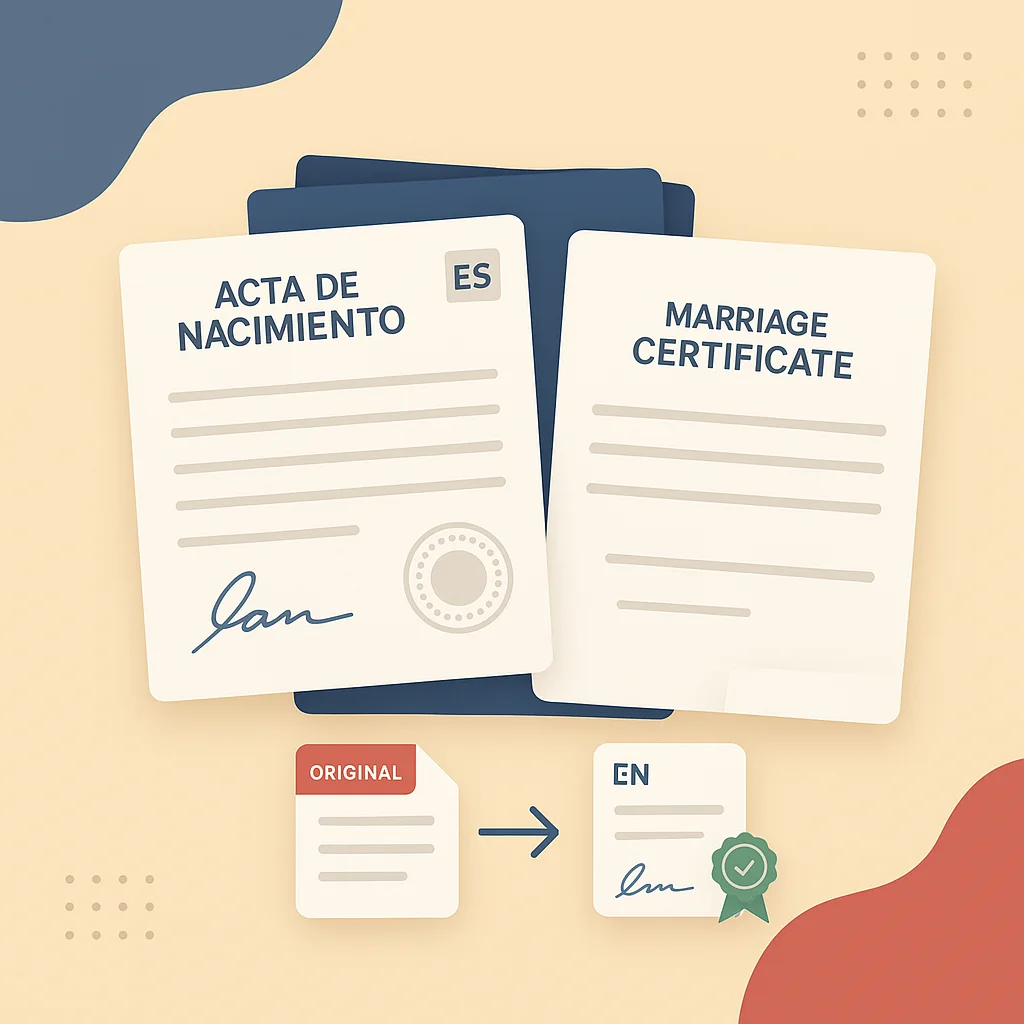
A civil record from Mexico, Guatemala, Honduras, or El Salvador has to be translated in full into English, with every stamp, annotation, and registry number, and it has to carry a signed certification from the translation company. The rule is the same for an I-130, an I-485, a DACA renewal, a TPS filing, or an N-400.
Mexican acta de nacimiento: older libro copies and the standardized format
The Mexican birth record is the acta de nacimiento. Copies taken from the older registry books (the libros) are often typed or handwritten on lined forms, with abbreviations, a registrar's signature, and sometimes a faded stamp. Newer copies use a standardized format with printed field labels and a registry identifier. The two look very different on the page, and each field and label on either one has to be carried into English.
Most actas also print the CURP, the 18 character population registry code. The CURP is copied exactly as it appears, with no spaces added and no characters corrected. Book, page, and entry numbers on older copies get the same treatment. Officers compare these numbers across the birth record, the passport, and the forms, so one transposed character in the translation creates a mismatch that was not in the source.
Handwritten copies add a second problem: abbreviations. A registrar may shorten a month, a title, or a place name, and the translator expands it only when the meaning is certain. Anything else is kept as written or marked "[illegible]".
Before ordering, check the Department of State's Reciprocity Schedule for civil documents. It names the version of each record that is acceptable for each country, and translating the wrong version wastes the order. Texliff's earlier post on the Spanish birth certificate translation process covers the general handling of the Spanish text.
Guatemalan RENAP, Honduran RNP, and Salvadoran RNPN records
Guatemalan certificates come from RENAP, the national registry of persons. Honduran certificates are issued by the RNP, and Salvadoran ones by the RNPN, which uses the term partida for a registry entry. Each agency has its own layout, header, and seal, and its own way of showing the registrar, the municipality, and the date of the entry. A Spanish birth certificate translation for one of these countries should follow the layout of that agency's form, so an officer can match every translated line to the source.
Dates need care. Some records spell the date out in words and others use numbers. The translation reproduces what the source shows and writes the English date in month, day, year order, so the officer never has to wonder whether 04/05 means April or May.
Two surnames and the municipality and state fields
A Spanish-speaking name carries two surnames: the father's first, then the mother's. The translation keeps both in the order printed on the record and never merges them or drops the second one. The parents' names sit in their own fields, and the officer uses them to confirm the family relationship that an I-130 or a DACA file relies on.
Place fields get the same literal treatment. Mexican records list the municipality (municipio) and the state (estado) of registration separately from the place of birth, and Central American records show the department or municipality in a similar way. Place names stay in their original Spanish form, and the registry office is named exactly as printed.
Marginal annotations: reconocimiento and rectificación
Many older copies carry a marginal note, and the note is part of the document. A reconocimiento records that a parent formally recognized the child after the original entry. A rectificación records a court or administrative correction to a name, a date, or another detail. Notes are usually short, handwritten or stamped, and set at the edge of the page, so they are easy to miss in a scan.
The translation reproduces each note in full, in the position where it appears, with the date and the authority named in it. Blank sections are marked as blank. If a correction changed a name, the change of name record and the translated passport should be read together so the spellings line up.
Marriage and divorce records, and constancias for missing records
An acta de matrimonio is translated the same way as the birth record: both spouses' full names with both surnames, the place and date of the marriage, witnesses where listed, and any marginal note. A divorce may appear as a note on the marriage entry or come as a separate acta de divorcio or court resolution. A marriage certificate translation and a divorce certificate translation belong in the same packet, so the officer can follow the history of each marriage.
When a primary record is unavailable, the applicant first shows that it is unavailable, usually with a constancia or another written statement from the issuing authority. Secondary evidence follows: baptismal or school records, medical records, or affidavits from people with personal knowledge of the event. Each foreign-language piece needs its own certified translation, and the constancia is translated too.
What a certified translation packet contains for a USCIS filing
For each record, a document translation service works from the full original, front and back. A summary or a page of extracts does not meet the requirement. USCIS regulations require a full English translation with a certification that it is complete and accurate and that the translator is competent in both languages. A certification for each document, rather than one for the stack, is the safer practice. USCIS keeps no list of approved translators or translation companies, so "USCIS-certified translation" means a translation that carries the certification USCIS asks for.
A finished packet for Mexican or Central American records holds these items:
- the English translation of each record, laid out to match the original page;
- a certification that names the document, with the translator's typed name, signature, date, and contact information;
- a copy of the original record attached behind its translation;
- one spelling of every name across all documents in the file.
A missing or incomplete translation can lead to a Request for Evidence or a Notice of Intent to Deny. Machine translation alone does not meet the requirement, because it mishandles names, dates, and registry terms. Consular and NVC cases follow their own rules, but once a case is with USCIS, everything must be in English. The attorney or accredited representative decides which records a filing needs.
Gather a full copy of each record, front and back, and check the Reciprocity Schedule entry for the country before ordering. We translate these records through our Spanish translation services, and the birth certificate translation is usually the first document to settle, since the other records are checked against its spellings.