Key Takeaways
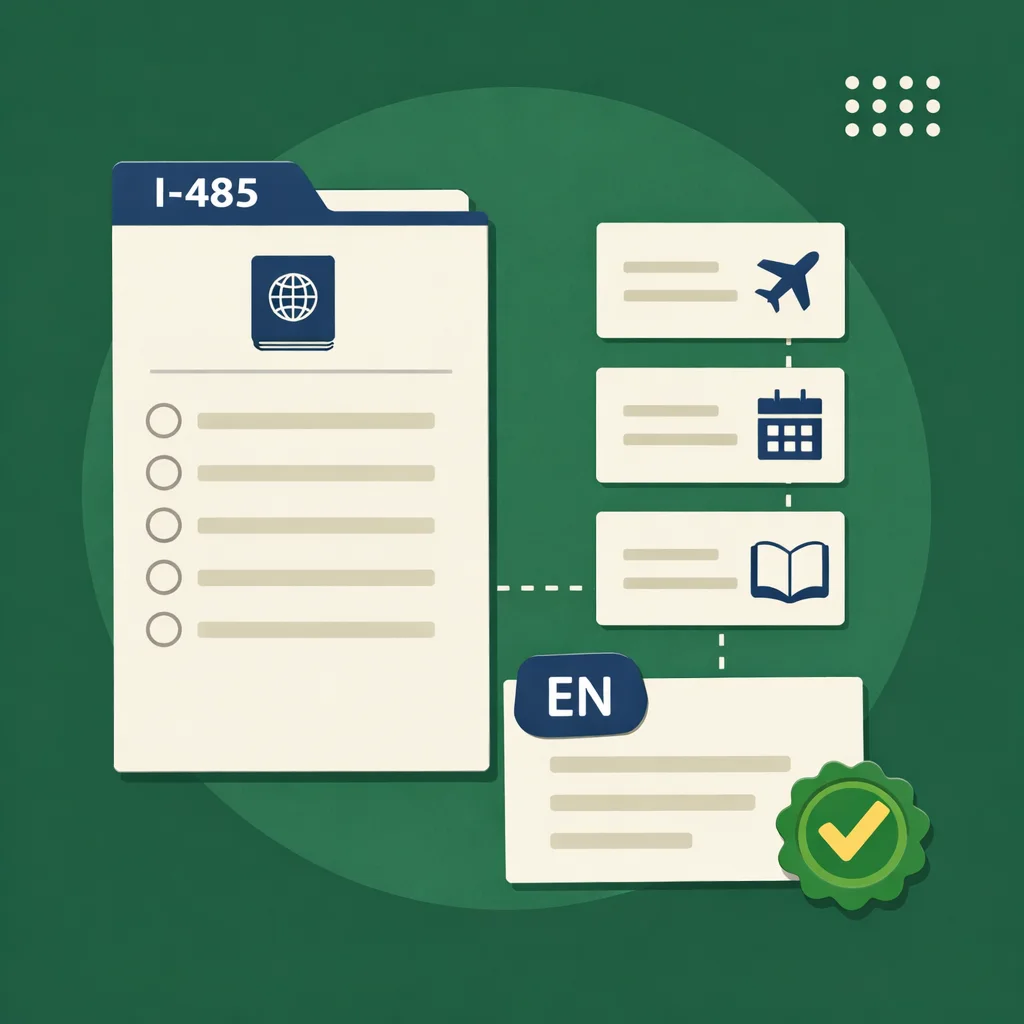
- A passport copy filed with USCIS needs a certified English translation of every copied page that contains Spanish, even when the data page also prints English.
- USCIS regulations require a full English translation with the translator's certification of competence, completeness and accuracy, and a passport is treated like any other document under that rule.
- If only the data page is copied into the filing, only that page is translated, but a whole booklet that is copied must be translated whole, with blank pages marked as blank.
- Passports appear in Form I-485, Form I-765, Form I-130 and Form I-131 filings as proof of identity and as the record of a visa and admission.
- Officers compare the passport name, date of birth and place of birth with the birth certificate, and the entry stamp dates with the Form I-94 and the dates on the form.
- Visa pages, entry and exit stamps and handwritten endorsements are described as well as translated, with unreadable words marked as illegible rather than guessed.
- Spanish dates are day first, so the translation converts them to month, day and year and writes out month abbreviations such as ENE and DIC.
- Two surnames in the passport surname field are kept exactly as printed and in the same order, and no second surname is dropped or reordered.
- Each passport, including an expired one with past entries, and each companion document such as a driver's license is translated and certified as its own document.
A passport copy filed with USCIS needs a certified English translation of every page that contains Spanish. The data page of many passports from Spanish-speaking countries is printed in Spanish and English, but the visa pages, entry and exit stamps, handwritten endorsements, amendments and the pages of older passports are often in Spanish only, and those pages are where the translation does most of its work.
Spanish passport pages that need a certified translation
USCIS regulations require a full English translation of any document that contains a foreign language, together with the translator's certification that the translation is complete and accurate and that the translator is competent in both languages. The certified document translation for USCIS rule is the same for every document, and a passport is no exception. Each page that is copied into the filing and carries Spanish text is translated, including the cover wording, printed field labels, the machine-readable lines at the bottom of the data page, stamps, seals and handwriting.
The applicant or the attorney decides which pages go into the filing. If only the data page is copied, only the data page is translated. If the whole booklet is copied, the translation covers the whole booklet, and pages that carry nothing are marked as blank rather than skipped. A Spanish passport translation that covers some of the copied pages and leaves others out does not meet the requirement, and the gap is the kind of thing that leads to a Request for Evidence. Stamps from a U.S. port of entry are already in English and need no translation.
The Texliff guide to which passport pages and stamps count covers the choice of pages in more detail.
Passports in I-485, I-765, I-130 and I-131 filings
A passport appears in a USCIS file as proof of identity and, for a person who came from abroad, as the record of a visa and an admission. A Form I-485, Application to Register Permanent Residence or Adjust Status, usually includes a copy of the biographic page and of the page carrying the visa or the entry stamp. A Form I-765 work permit application asks for a copy of a government identity document, and a passport is the most common one for applicants from Spanish-speaking countries. A Form I-130, Petition for Alien Relative, can include the beneficiary's passport, and a Form I-131 for travel permission carries an identity document as well.
The officer reads the passport against other things in the file. The name, date of birth and place of birth are compared with the birth certificate. The dates of the entry stamp and visa are compared with the Form I-94 and with the dates the applicant entered on the form. If the passport says one date of birth and the civil record says another, the officer sees an inconsistency before anyone has explained it. The official Form I-485 page lists the evidence a particular filing calls for, and the attorney or accredited representative decides what is submitted.
Visa pages, entry stamps and handwritten endorsements
Visa pages in a Spanish-language passport are issued by foreign consulates or immigration authorities, and the wording around the visa category, the number of entries and the validity dates can be in Spanish, English or both. Whatever appears is translated, and the visa dates are converted from the day-first order used in Spanish to the month, day and year order a U.S. officer expects. Month abbreviations such as ENE for January or DIC for December are written out so that nobody reads a day as a month.
An entry or exit stamp is described as well as translated, because the officer has to match each translated element to the source. A stamp description normally includes:
- the issuing authority and place exactly as printed, translated into English;
- the date and the word that marks it as an entry or an exit;
- the shape and ink of the stamp, written in brackets, such as a round stamp in blue ink;
- any handwritten number, initials or signature next to it, marked as handwritten.
Words that cannot be read are marked "[illegible]" and never guessed. A faint circular stamp from a land border is one of the most common cases, and a clear scan taken at full size is what allows the translator to read it. Handwritten endorsements on a visa page, extensions written by hand and corrections on the observations page of the booklet are transcribed in the same way, with a note that the original is handwritten. Older passports, including expired ones that hold past entries, are treated as separate documents with their own certification.
Two surnames and name order in a passport translation
Passports from Spanish-speaking countries print surnames and given names in separate fields, and the surname field usually holds the father's surname followed by the mother's. A translation keeps the names exactly as printed and in the same sequence. Names are not translated, a second surname is not dropped, and the given names are not moved into a different order. The Texliff article on double surnames, patronymics and name order explains how the same rule applies to other languages.
Problems tend to come from the other side of the file. A passport may print two surnames while a form lists only one, or a birth certificate translation may show the mother's name in a different spelling. Comparing the passport against the Spanish birth certificate translation before anything is filed shows whether the spellings agree. Where the original documents themselves disagree, the translation reproduces each as written, and any explanation goes in a separate statement from the person, not in the translation.
Spanish-language passports by country and year of issue
The booklets differ by country and by year of issue. Mexican, Guatemalan, Honduran and Salvadoran passports, Venezuelan and Colombian passports, Cuban and Dominican passports, and those of Ecuador, Peru and Spain all follow the same international layout for the data page, which is why the page tends to carry English alongside Spanish. The pages after it are set by each country and are often in Spanish only. Older machine-readable booklets and newer electronic ones can both turn up in one family's file.
The identity records behind the passport differ too. A Mexican passport rests on an acta de nacimiento from a Registro Civil, which also carries the CURP number, while Guatemala, Honduras and El Salvador record births through RENAP, the RNP and the RNPN. Because the officer checks the passport against such a record, the Department of State's Visa Reciprocity and Civil Documents by Country schedule should be checked for the right version of the civil document before it is translated. Translation of the wrong version costs the fee and does not help the case.
Place names, ministries and offices appear in the form used where the passport was issued. A certified Spanish to English translation treats each country's wording as the source and does not standardize it.
Preparing passport copies for translation
Other identity documents sometimes travel with the passport, such as a national identity card or a translated driver's license from the home country. Each of them is a separate document and gets its own translation and its own certification, even when the same person is named on all of them.
Texliff translates Spanish passports and birth certificates into English with a signed certification attached to each document, and the same process covers 82 languages. Certified translations start at $24.95; the price is calculated from the uploaded file and the total shows before payment, so there is no email exchange to get a quote, which is how many traditional agencies still work. The project starts as soon as the order is placed, and Texliff offers a fast turnaround.
Before ordering, scan every page that will go into the filing, in color and at full size, including the inside covers and pages with only a faint stamp. Check the name, date of birth and passport number against the birth certificate and the form, and note which pages the attorney wants included. A certified passport translation ordered for the full set of pages is certified as one document.