Key Takeaways
- Foreign-language boarding passes, receipts, and phone bills need a full English translation with a certification of completeness and accuracy, exactly as a longer civil document does, however short the item is.
- Only the foreign-language items in a relationship file need translation, and the attorney or accredited representative decides which items are submitted with the K-1, I-130, or I-751 filing.
- A boarding pass translation reproduces names, flight numbers, airport codes, dates, seats, and booking references as printed, without correcting a name to match a passport.
- Hotel invoices are translated with guest names, stay dates, totals, and tax lines, and stamps and signatures are described in brackets so the officer sees what appears on the page.
- Receipt abbreviations that the translator cannot confirm stay as printed with a bracketed note, and amounts are never converted into another currency.
- Phone bills with call logs are translated row by row, and every phone number is left exactly as printed, including country codes and spacing.
- Local dates such as 03/04/2025 are written out in words after the translator reads them in the issuer's format, so the officer cannot confuse day and month.
- A single certification can list a large set of small items by number, issuer, and date, but a separate certification for each item is the safer practice if the attorney requests it.
- Translations are delivered in the order of the attorney's timeline with the exhibit numbers the law office supplies, and the translation company does not build the timeline or draw conclusions from dates.
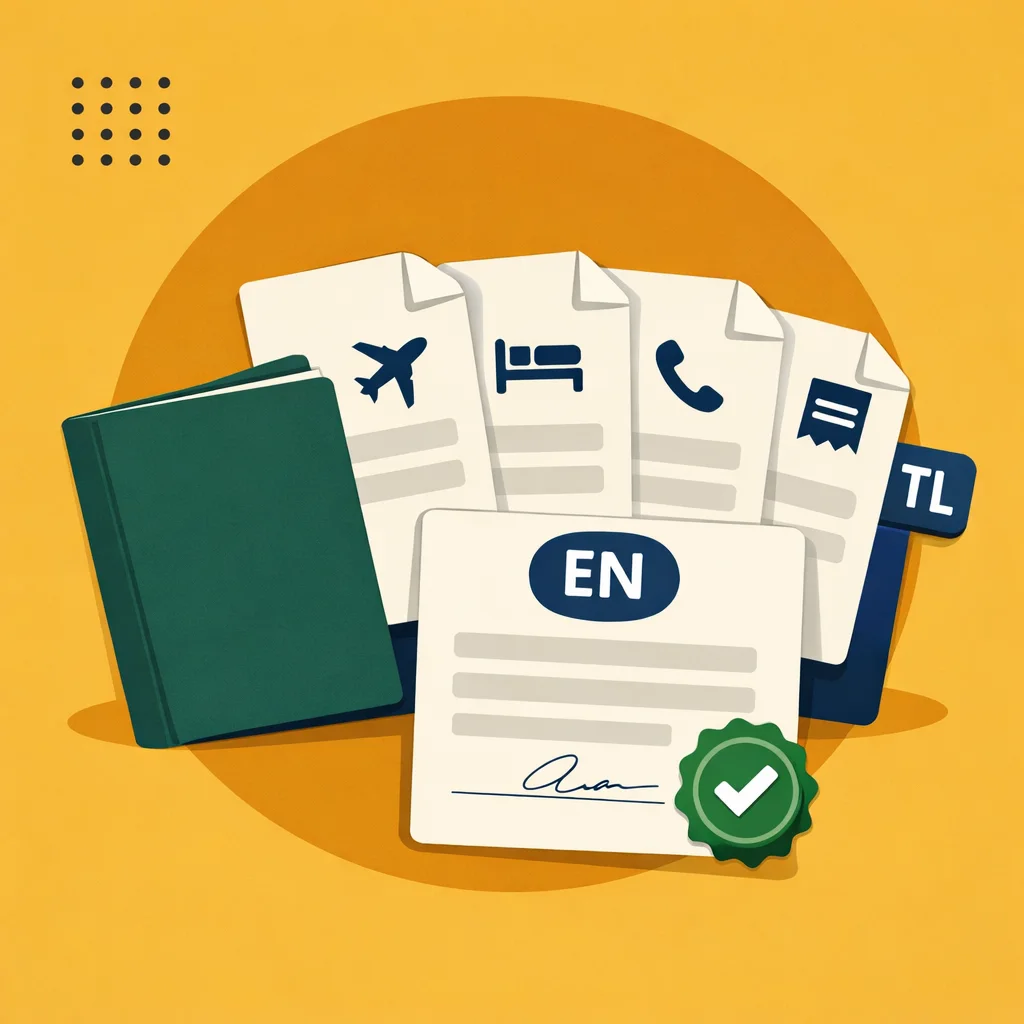
Boarding passes, hotel invoices, receipts, and phone bills written in a foreign language are translated in full and certified like any other document in a USCIS filing, however short they are. USCIS regulations require a full English translation with a certification that it is complete and accurate, and a one-line shop receipt falls under the same requirement as a marriage certificate.
Which travel and contact records need translation in K-1, I-130 and I-751 files
Couples usually show that a relationship is real with small records: boarding passes and e-tickets, bus and train tickets, hotel invoices, restaurant and shop receipts, passport stamps, phone bills with call logs, money transfer receipts, and tickets to events attended together. Only the items in a foreign language need translation. In a petition on Form I-129F, an I-130 filed with an I-485, or an I-751 to remove conditions, these items sit beside photographs and messages and show that two people met, traveled, and stayed in contact over time.
The attorney or accredited representative decides which items go into the filing. The translation company translates what it receives, item by item, and does not select or summarize. The articles on K-1 visa document translation and bona fide marriage evidence describe the larger evidence packet. Small items go through the same process as any longer record under certified document translation for USCIS.
What a boarding pass or hotel invoice contains that must be translated
The value of a travel record lies in its details: names, dates, places, amounts, and phone numbers. A boarding pass carries the passenger name as printed, often in capital letters with the surname first, the flight number, the departure and arrival airports, the date, the seat, and a booking reference. The translation reproduces each of these as printed. A name already in Latin script is not corrected to match the passport, and airport codes and booking references are copied character by character.
A hotel invoice adds the guest names, room type, check-in and check-out dates, the number of nights, the totals, the tax lines, and usually a stamp and a signature. All of it is translated, and the stamp and signature are described in brackets, for example "[stamp: hotel name, date]" and "[signature]". A booking confirmation that arrived by email is a separate item, and a Spanish confirmation goes through Spanish email translation in the same way, with Spanish translation services covering the other records from the same trip.
Receipts with abbreviations and local tax lines
Shop and restaurant receipts are short but full of abbreviations that only a local reader understands. The translator renders each line item. When an abbreviation is the shop's own and its meaning is uncertain, it stays as printed with a bracketed note instead of a guess. Local tax lines are translated by their printed label, and the amounts remain exactly as written. Currency is not converted, because a conversion is the translator's calculation and not part of the document.
The header and footer of a receipt are part of the page too: the business name, the address, the tax registration line, the cashier line, and the thank-you text. If a receipt is partly in English, the translation says which text was already in English.
Phone bills, call logs and money transfer receipts
A phone bill identifies the account holder, the number, the billing period, and, when itemized, each call with its date, time, duration, and the number called. Every row of the call log is translated, and every number is left exactly as printed, including country codes and spacing. A log that runs to many pages is translated page by page, since partial translations do not meet the requirement.
Money transfer slips list the sender, the recipient, the amount, the fee line, a reference number, and the date. A slip, or a statement page showing payments between the couple, is handled like a bank statement translation: every label and figure is carried over, and any English text on the page is noted as such.
Writing local date formats so that they cannot be misread
A date such as 03/04/2025 means the third of April in many countries and the fourth of March in the United States. Receipts, tickets, and bills use the order of the issuer's country, and a translation that copies the digits leaves the officer to guess. The translator reads the date in the issuer's format and writes it in words, for example "April 3, 2025". If the format cannot be determined from the page, the translation gives the date as printed with a bracketed note, and the attorney is told. Times on a 24-hour clock stay as printed.
One certification for a set of many small items
A relationship file may include dozens of tickets and receipts. A single certification that lists every item by number, issuer, and date can cover such a set. It contains the same statements as any other certification: the translator's competence in both languages, completeness and accuracy, name, signature, date, and contact information. A separate certification for each item is the safer practice, and some attorneys ask for it, so the law office should say which it wants before the work starts.
Matching translated items to the attorney's timeline
The attorney usually prepares a timeline or exhibit list that places each trip, stay, and call period in order. The translations are delivered in that order, each carrying the exhibit number the law office supplies, and each keeps the layout of the original so an officer can place every translated line against its source. The translation company does not build the timeline or draw conclusions from the dates.
Before sending items for translation, scan every page, including the back of tickets and the second page of bills, and sort them by date. A statement a relative wrote about a trip is a separate document that needs its own affidavit translation. We prepare each item against the exhibit number the law office provides, so the numbering in the filing matches the numbering on the translations.