Key Takeaways
- An RFE about a translation means USCIS found a foreign-language document without a complete English translation or without the translator's certification, and the response replaces that defect.
- RFE wording usually points to a missing certification, a certification without a required statement, an illegible copy, a partial translation, an untranslated stamp or back page, or a name mismatch.
- USCIS regulations require a full English translation certified as complete and accurate, with a statement that the translator is competent to translate from the source language into English.
- An RFE about the translation differs from an RFE about the document, which questions whether the record is the version the Reciprocity Schedule lists for that country.
- When the primary record is unavailable, the applicant shows that it is unavailable and sends secondary evidence, and each foreign-language piece of that evidence needs its own certified translation.
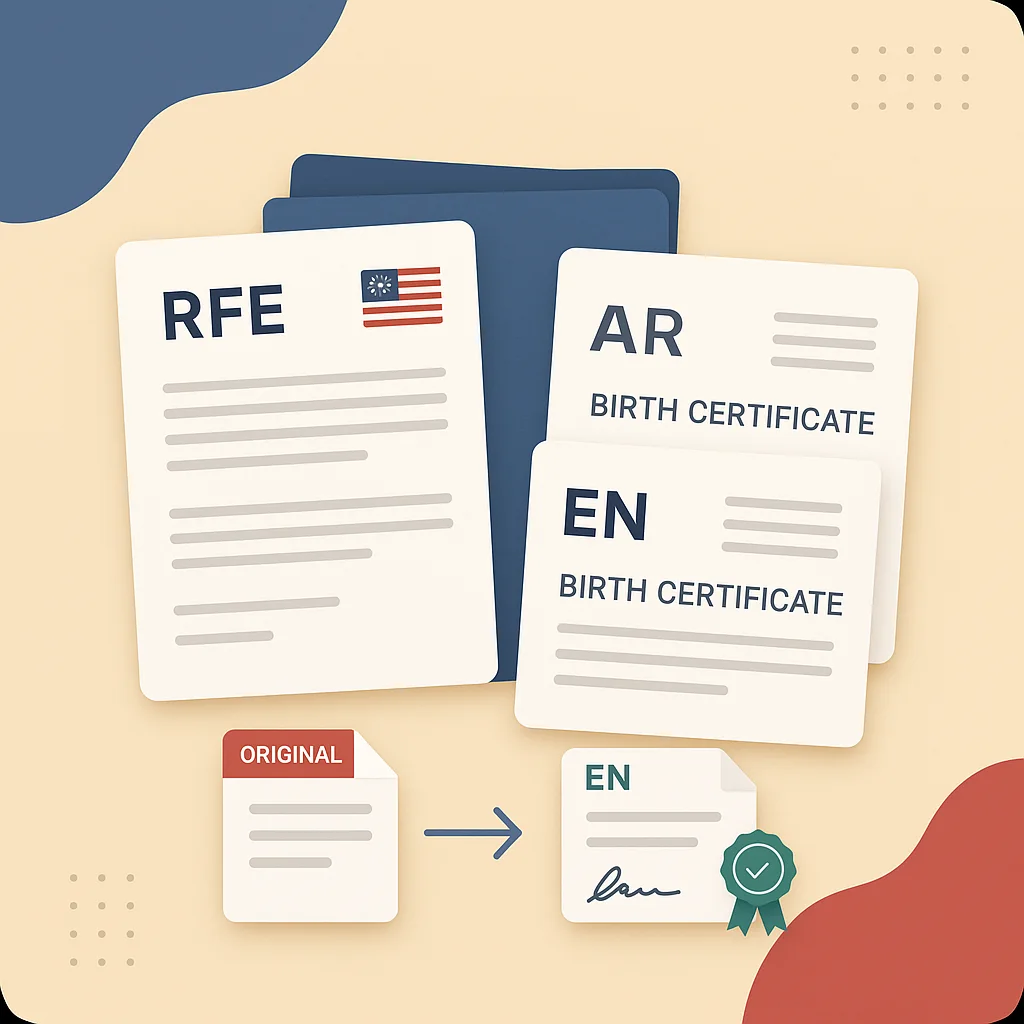
- A corrected packet holds a cover letter from the representative, a legible source copy, a new complete translation, and a separate certification for each document.
- A new translation should use the name spellings and date formats already in the filed form and passport, so fixing one document does not create a new inconsistency.
- Only the questioned document is replaced, and the attorney or accredited representative decides how to handle any error in the form itself.
- The notice sets the response deadline, and a response that repeats the defect or leaves out documents can lead to a NOID or a denial.
- USCIS policy allows a denial without a prior RFE when the initial evidence is insufficient, so a certified translation belongs in the first filing.
A USCIS request for evidence (RFE) caused by a translation problem is a notice saying that a foreign-language document in the filing arrived without a complete English translation or without the translator's certification. The usual answer is a legible copy of the source document, a new complete translation, and a certification for each document, all sent before the deadline written in the notice.
How an RFE describes a translation defect
The notice names the evidence the officer found lacking, and the wording differs from one notice to the next. The defects themselves fall into a small number of groups.
- The translation has no certification, so nothing shows who prepared it or whether the translator is competent in both languages.
- The certification is present but leaves out a required statement, or it lacks the translator's signature, date, or contact information.
- The copy of the original is illegible, so the officer cannot match the translation to the source.
- Only part of the document was translated, such as the body text without the headings or the form-field labels.
- A stamp, seal, marginal note, handwritten entry, or the back page was left untranslated.
- A name or date in the translation differs from the form or from other evidence in the file.
USCIS regulations require that any foreign-language document be accompanied by a full English translation that the translator has certified as complete and accurate, along with a statement that the translator is competent to translate from that language into English. An RFE restates that requirement because an officer cannot weigh evidence in a language the officer cannot read.
RFE about the translation versus RFE about the document
Two different problems can produce similar notices. In a translation RFE, the document is the right kind of record but the translation or its certification falls short. In a document RFE, the record itself is the wrong version, and a better translation will not help.
The Department of State's Visa Reciprocity and Civil Documents by Country schedule lists, country by country, which civil documents exist, who issues them, and which version is acceptable. A long-form certificate, for example, may be required where the applicant filed an abridged extract. Translating the extract a second time only repeats the mistake, so the applicant first obtains the correct version and then orders the translation.
When the primary record is unavailable, the applicant shows that it is unavailable, either through a written statement from the issuing authority or a schedule entry saying the record is generally unavailable. Secondary evidence then takes its place: church or baptismal records, school records, medical records, or a translated affidavit from people with personal knowledge of the event, commonly two. Every foreign-language piece of secondary evidence needs its own certified translation, and an RFE can arrive only because one of those pieces went in untranslated.
What a corrected response packet contains
The attorney or accredited representative decides what goes into the response. A packet that answers a translation defect usually holds four things, in this order.
- A cover letter from the representative that names each document the notice questioned and states what was corrected.
- A legible copy of the source document, including every page and the back of any page that carries text.
- A new complete English translation that follows the original layout closely enough for the officer to match each element to the source.
- A separate certification for each document, with the translator's typed name, signature, date, and contact information, a statement of competence in both languages, a statement of completeness and accuracy, and an identification of the document translated.
A certification for each document, rather than one for the stack, is the safer practice, because the officer can then read the translation and its certification together. Complete means everything on the page: stamps, seals, signatures described as "[signature]", handwritten entries, headers, footers, and numbering. Parts that cannot be read are marked "[illegible]" instead of guessed, and blank sections are marked as blank. A translation made with machine translation alone carries no human certification and mishandles names, dates, and legal terms, so it does not repair the defect.
Fixing one document without changing other facts
A new translation is evidence like the first one, and the officer will read it against everything already in the file. If the replacement spells a name differently from the form, the passport, or the earlier documents, the correction creates a new inconsistency. The spelling on the passport and on the filed form should guide the transliteration, and genuine differences in the source are reported as they appear.
Names written in Arabic show the risk clearly. A four-part name chain of given name, father, grandfather, and family name can be romanized in several accepted ways, and a record may be dated by the Hijri calendar. An Arabic birth certificate translation prepared for a response has to settle on the spelling the case already uses, and the certification identifies the document translated. The same applies to any filing that relies on Arabic translation services for several records.
Dates need the same care. A marriage certificate translation that gives day, month, and year in a different order from the form can look like a different date to a reader who is not checking the order. Only the defective document is replaced. Names, dates, and places in documents the notice did not question stay as they were filed, and if the form itself contains an error, the representative decides how to correct it.
Deadlines, NOIDs, and denials without an RFE
The notice states the response deadline, and the date printed there is the one that counts. The new translation should be ordered when the notice arrives, since the certification can only be signed after the translation is finished and checked. A response that repeats the defect, or that answers only some of the questioned documents, can lead to a Notice of Intent to Deny (NOID) or to a denial.
USCIS does not always issue an RFE first. USCIS policy allows officers to deny a filing without first issuing an RFE or a NOID when the initial evidence is insufficient, and a missing or uncertified translation is part of the initial evidence. A complete, certified translation filed with each foreign-language document at the start avoids that situation. The USCIS document translation requirements post covers the standard in more detail, and the certified document translation for USCIS service page lists the documents Texliff handles.
Checks before sending the response
Before the packet goes out, compare every name and date in each translation with the filed form, confirm that each certification is signed and dated, and check that no page or stamp was skipped. For a civil record, confirm against the Reciprocity Schedule that the version being translated is the one listed. We prepare each certified birth certificate translation with its own certification, and the representative then decides what to file.