Key Takeaways
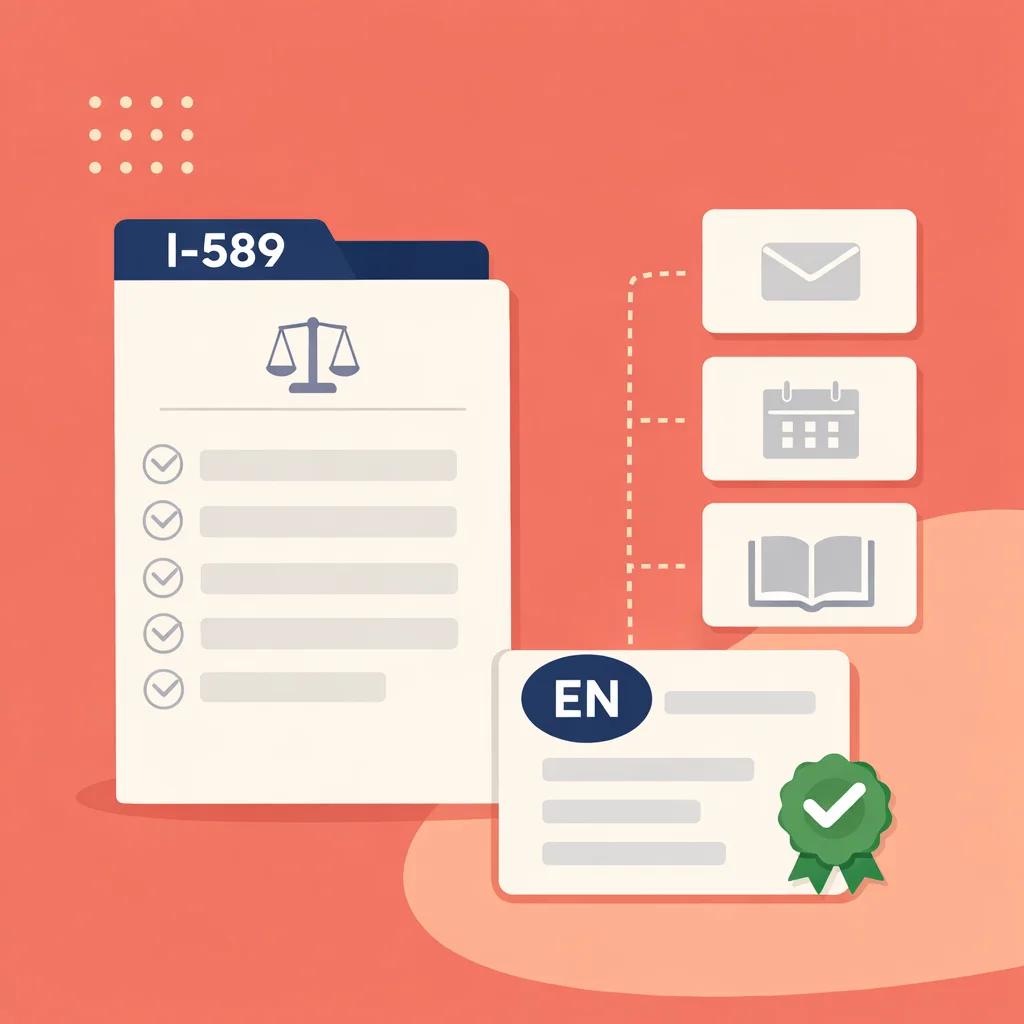
- Every Vietnamese document in an asylum filing needs a full English translation with a signed certification, whether the Form I-589 is filed with USCIS or in immigration court.
- The Immigration Court Practice Manual asks for a typed, signed certificate of translation with the translator's contact information and statements of competence and accuracy.
- A complete translation of a police summons reproduces the letterhead, document number, date line, signer, red seal and signature, with stamps and signatures described in brackets.
- Decision numbers, slashes and letter codes stay exactly as written, and sums in dong keep their figure while the separators are set so an English reader does not misread them.
- Land decisions usually come with annexes, plans and notices, and every attached page is translated because parcel numbers, areas and household names often appear only there.
- House church letters are translated line by line, including the group's name, the signer's title, the address and dates, and a description of the signature or stamp.
- Hospital records mix printed forms with handwritten doctor entries, so unreadable parts are marked as illegible and abbreviations get a translator's note instead of a guess.
- Message exports from Facebook or Zalo keep display names, timestamps and message order, with images and stickers described in brackets and dates stated in one unambiguous format.
- Vietnamese names are written family name first, and the same spelling and diacritics should be used for each person in every translation across the whole file.
Vietnamese asylum evidence is translated like any other foreign-language document in a filing: every page in full, in English, with a signed certification attached. The rule is the same whether the Form I-589 goes to USCIS or to an immigration court, and it covers police summonses, administrative decisions, land notices, religious group letters, hospital records and message exports alike.
Vietnamese asylum documents need a full English translation and a certification
USCIS regulations require that any document in a foreign language be accompanied by a full English translation that the translator has certified as complete and accurate, together with a statement that the translator is competent to translate from that language into English. The same rule applies to the evidence filed with the Form I-589, as the post on I-589 asylum evidence translation explains in general terms. USCIS keeps no approved list of translators or companies, so "USCIS-certified translation" only means a translation that carries the certification the agency asks for.
The Immigration Court Practice Manual, described in its chapter on filings, asks for the English translation plus a certificate of translation that is typed, signed, and gives the translator's contact information with statements of competence and accuracy. Court exhibits are paginated and indexed, so each translation should sit directly behind the source document it renders and follow its page order.
"Complete" means everything on the page: letterhead, form-field labels, stamps, seals, signatures, handwritten entries, margin notes, footers and the back of a page that carries anything. Parts that cannot be read are marked "[illegible]" instead of guessed, and blank sections are marked as blank. A summary or an extract does not meet the requirement, and neither does machine translation alone, which carries no human certification and tends to damage names, dates and legal terms. A certified document translation for USCIS is therefore a full rendering of the file, not a description of it.
Police summonses and administrative decisions: letterhead, seals and numbers
A police summons, called a giấy triệu tập in Vietnamese, orders a named person to appear at a stated place and time. The translation reproduces the document from top to bottom: the issuing agency lines at the head, the document number, the place and date line, the text of the order, the signer's title and name, and the round red seal. A stamp is described in brackets, with the words printed inside it translated, for example "[red round seal: ...]". A signature appears as "[signature]".
Administrative sanction decisions, known as quyết định xử phạt vi phạm hành chính, are issued by a People's Committee or by a police or inspection office, and they often cite articles of a regulation and state a fine or another measure. Decision numbers keep their exact form, including the slashes, letter codes and year. Sums in dong are copied with the figure as written, and the separators are set so that an English reader does not misread them, since Vietnamese writes 1.500.000 where English writes 1,500,000. The Vietnamese asylum documents translation follows the original line by line so an officer can match each translated element to the source.
Land seizure and compensation notices in Vietnamese
Land records tend to come as sets. A decision to recover land, called a quyết định thu hồi đất, may arrive with a compensation and resettlement plan, a notice from the ward or commune People's Committee, a measurement record and a table of parcels attached as an annex. Every attached page is translated, because the annex is where parcel numbers, map sheet numbers, areas and the names of affected households appear.
Place names are given in their Vietnamese form with diacritics, and the ward or commune, district and province appear in the order the original uses. Areas are copied as written with the unit stated in the source; if a translator adds a conversion, it goes in a bracketed note and never replaces the original figure. Handwritten receipts and household signatures are translated or described where they sit.
House church letters and hospital records in Vietnamese
Letters from a house church or another religious group vary a great deal in form. The translation keeps the name of the group as written, the name and title of the person who signed, the address, the dates, any membership or baptism details and every line of the body, with the signature described in brackets.
Hospital records in Vietnamese combine printed forms with handwritten entries by doctors, which are often the hardest part to read. A Vietnamese medical records translation includes admission and discharge dates, the diagnosis, the treatment, test results, the hospital stamp and the physician's signature. Abbreviations are translated when they have a meaning in English and are otherwise left as written with a short translator's note. Anything the translator cannot read is marked "[illegible]". These medical records translations are certified like every other exhibit in the file.
Facebook and Zalo message exports: names, timestamps and order
Messages from Facebook, Zalo or similar apps arrive as screenshots, exported files or printed pages. The translation keeps the sender's display name, the time of each message and the order of the conversation exactly as they appear, so that each line stays attached to its speaker. Images, stickers, voice notes and deleted-message placeholders are described in brackets, and the labels of the app interface that appear on screen are translated as well.
Vietnamese apps write the day first, so 04/03/2023 means March 4, and the translation states dates in one unambiguous English format, including the "ngày, tháng, năm" dates on summonses. A Vietnamese text message translation is attached to the screenshots it renders, page for page. The post on translating chats, emails and posts explains how pages like these are organized, and the general text message translation approach applies to Vietnamese threads as it does to other languages.
Vietnamese address terms such as anh, chị, em, bác and chú express age and family relationship as well as address. A translator picks one English rendering for each pair of speakers and keeps it through the whole thread, so that a cousin is not turned into an uncle halfway down the page.
Vietnamese diacritics and name order across the whole file
A Vietnamese name is written family name first, then the middle name, then the given name. A person called Nguyễn Văn An has the family name Nguyễn and the given name An. The same person may appear in a summons, a land notice, a church letter and a chat under the full name, the given name alone or a nickname, and the translations of all of them should match each other and the applicant's passport and birth record, the giấy khai sinh.
Diacritics are kept in names and places, since they separate one name from another. The applicant's own name follows the spelling used on the passport and the forms, and every other person's name follows the source document, with the same spelling used in every translation. When two spellings of one name exist in the file, the translation reproduces each as written and does not merge them.
The attorney or accredited representative decides which documents go into the filing; the Vietnamese translation services side is only the rendering of what is chosen.
Texliff translates Vietnamese police summonses and hospital records into English with a signed certification attached to each document, and the same process covers 82 languages. Certified translations start at $24.95; the price is calculated from the uploaded file and the total shows before payment, so there is no email exchange to get a quote, which is how many traditional agencies still work. The project starts as soon as the order is placed, with fast turnaround on single documents.
Before ordering, scan both sides of every page, keep the originals in the order of the planned exhibits, and note which messages and pages belong together. A file that is legible and in order can be matched page for page with the asylum documents translation that goes behind it.