Puntos clave
- Certified Turkish to English translation is often required for immigration, university admission, legal matters, financial applications, medical records, and international business.
- A certified Turkish translation must include the translated text, a copy of the source document, and a signed certification statement from the translation provider.
- For USCIS, the key requirement is a complete and accurate English translation with a signed certification confirming translator competence.
- USCIS generally does not require Turkish-specific formalities such as yeminli ceviri by default.
- Common Turkish documents requiring certified English translation include nufus kayit ornegi, evlilik cuzdani, Turkish ID cards, divorce decrees, powers of attorney, diplomas, transcripts, bank statements, and medical records.
- Turkish civil registry records require careful handling because they may include family relationships, marital status, annotations, registry details, stamps, and official notes.
- Legal Turkish translation requires subject-matter knowledge because Turkish legal concepts and court terminology may not map directly onto U.S., UK, or Australian legal systems.
- Academic translations must accurately reflect Turkish degree titles, grading scales, credit hours, course names, and Apostille details when applicable.
- Financial translations must handle Turkish banking terminology, account details, and comma-decimal differences accurately.
- Medical translations require precision because errors in diagnoses, lab results, prescriptions, allergies, or dosages can create serious consequences.
- Applicants should provide clear scans, include front and back pages, avoid cropping fine print, and make all stamps, seals, and marginal notes visible.
- Name spelling should be checked carefully, especially when Turkish characters are transliterated differently across passports, visas, and foreign records.
- A reliable certified translation company should offer USCIS-ready certification, quality review, official-document experience, clear requirements handling, and accountability.
- Professional Turkish to English certified translation helps reduce the risk of RFEs, rejected applications, processing delays, and costly resubmissions.
Whether you are applying for a visa, enrolling in an overseas university, or expanding your business internationally, the bridge between your past in Turkey and your future abroad is built on paperwork. However, immigration officers and university admissions boards do not just take your word for it—they require undeniable, legally valid proof of your credentials and life events. This is where a Certified Turkish into English Translation becomes an absolute necessity.
Navigating the bureaucratic maze of international institutions can be overwhelming. From deciphering apostilles to understanding what makes a translation official, the stakes are incredibly high. A single mistranslated term or missing certification statement can result in rejected applications, delayed timelines, or lost fees.
In this comprehensive guide, we will explore everything you need to know about certified language translation for Turkish documents. We will cover the specific requirements of global immigration authorities, how “yeminli çeviri” relates to “certified translation” in English, and how to ensure your documents are accepted without question—without getting sidetracked by processes that may not apply to your destination.
What Exactly is a Certified Translation?
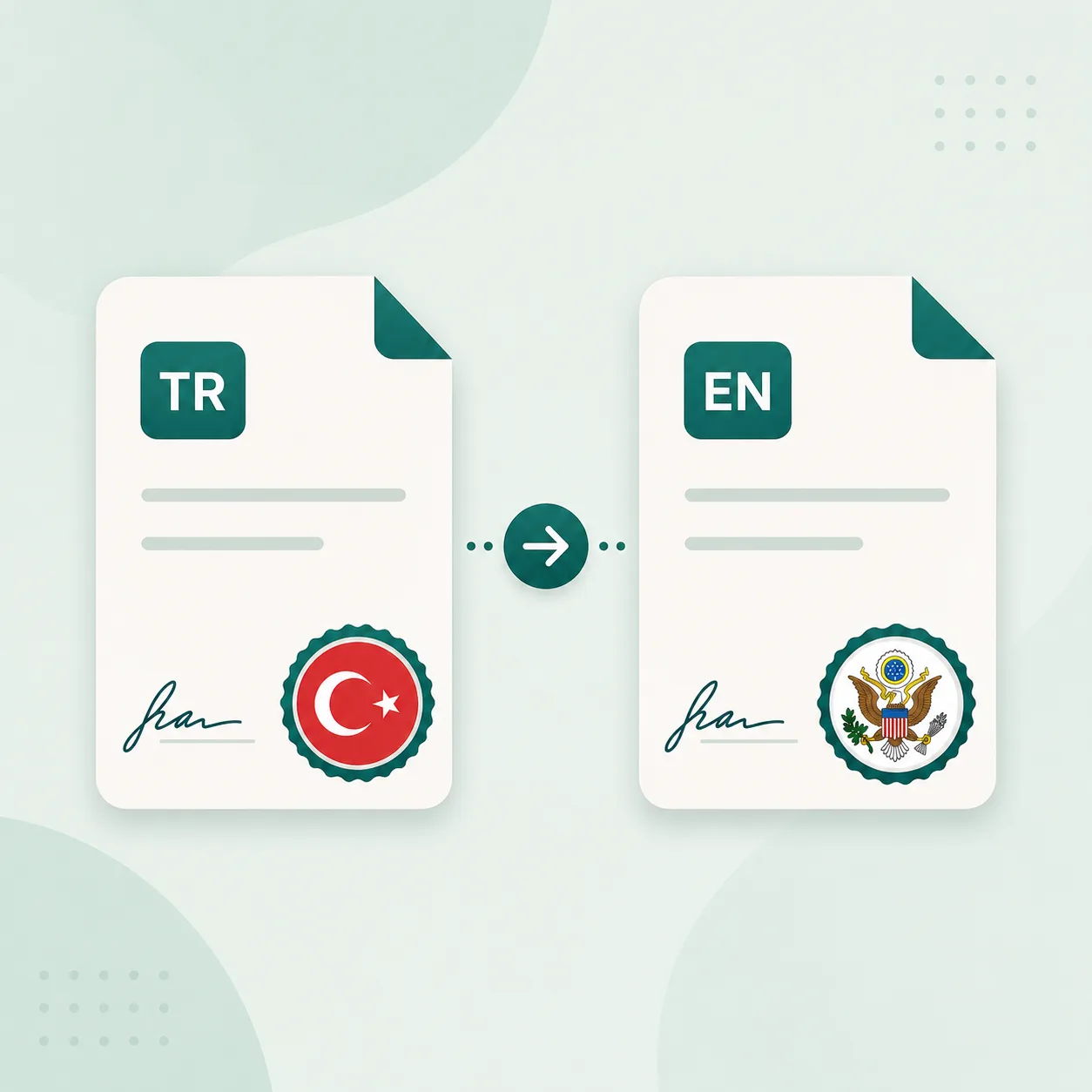
A turkish certified translation is not merely a word-for-word conversion from Turkish to English. It is a formal, legally binding document. When you submit a certified translation, it includes the original document (or a copy) attached to the translated text, accompanied by a signed certification statement from your certified translation services provider.
This signed statement acts as a certificate of accuracy for Turkish linguistic services. It formally attests that the translation is a true, complete, and accurate representation of the original document, and that the translation was completed by qualified Turkish–English professionals.
Depending on the country you are submitting your documents to, the exact requirements for a certified translation will vary, which brings us to one of the most common reasons people seek these services: United States immigration.
Navigating US Immigration: USCIS Requirements
If you are immigrating to the United States, adjusting your status, or applying for a green card, you will be dealing directly with the United States Citizenship and Immigration Services (USCIS). USCIS is notoriously strict about its paperwork.
Any supporting document that is not in English must be accompanied by a USCIS-compliant certified translation. If you fail to meet their exacting standards, you risk receiving a Request for Evidence (RFE). RFEs effectively hit the pause button on your application, and given current USCIS processing times, an RFE could delay your visa or green card by several months.
Essential Personal Documents for Immigration
When applying for visas or residency, you will almost certainly need a turkish to english translation for standard civil registry documents. Common examples include:
Birth Certificate: In Turkey, this is often the nüfus kayıt örneği (Vukuatlı Nüfus Kayıt Örneği), which is a comprehensive family identity register. While Turkey also issues a multi-language "Formül A" birth certificate, many immigration cases require the full family register. Obtaining a flawless Turkish birth certificate translation for USCIS ensures the immigration officer can clearly trace your familial lineage without confusion.
Marriage Certificate: Often referred to as the evlilik cüzdanı (the international family booklet) or a formal marriage registration document.
Identity Cards: Validating Turkish identity cards for global immigration requires translating both the front and back of your national ID (TC Kimlik Kartı), ensuring that all micro-text, issue dates, and security details are accounted for in the English version.
Demystifying Legal and Court Document Translations
Legal translation leaves zero room for error. The nuances of the Turkish legal system (which is heavily influenced by the Swiss civil code) do not always map perfectly onto the common law systems of the US, UK, or Australia. Therefore, accurate turkish document translation in the legal sphere requires domain-specific legal expertise and rigorous quality control.
Common Legal Documents Requiring Certification
Marriage Licenses and Divorce Decrees: The accurate legal translation of Turkish marriage licenses and divorce judgments is critical. If you are remarrying abroad, the foreign government must know your previous marriage was legally dissolved. The official translation of Turkish court decrees must reflect the exact judicial terminology used by the Turkish family courts.
Power of Attorney: Translating Turkish power of attorney for legal use is a high-stakes task. A Power of Attorney (Vekaletname) grants someone else the authority to manage your assets or make legal decisions. If the English translation is vague, a foreign bank or real estate agency will refuse to honor it.
When handling legal paperwork across borders, document reciprocity—the mutual recognition of legal documents between two countries—often hinges on the quality and official status of the translation provided.
“Yeminli Çeviri” vs. “Certified Translation” (and What USCIS Actually Needs)
People commonly use the phrase “yeminli çeviri” to describe an “official” translation in Turkey. In English-speaking contexts—especially in the United States—the phrase that matters is typically certified translation.
For USCIS purposes, the key requirement is not a Turkish domestic procedure, but the presence of a certification statement that includes:
a declaration that the assigned Turkish–English professional is competent to translate into English, and
a declaration that the translation is complete and accurate.
In other words, USCIS-compliant certified translation is primarily about the translation quality and the signed certification provided with it. USCIS does not require Turkish-specific formalities by default. If a separate authentication step is requested by a different institution (for example, a court, employer, or university), that will be stated explicitly in their instructions.
Academic Applications and Educational Records
Turkey has a robust educational system, and thousands of Turkish students apply to universities in the US, UK, Canada, and Europe every year. To gain admission or transfer credits, admissions offices need to understand your academic history.
Translating Turkish diplomas for international university admission involves more than just translating the degree title. Turkish academic transcripts contain specific credit hours, grading scales (often out of 4.0 or 100), and course descriptions that need to be accurately conveyed to foreign registrars.
Furthermore, students often run into Apostille requirements for Turkish educational records. An Apostille is an international certification under the 1961 Hague Convention. If a foreign university requests an Apostilled diploma, you must:
Obtain your original Turkish diploma.
Have it Apostilled by the local Turkish governorate (Kaymakamlık or Valilik).
Have both the diploma and the Apostille stamp subjected to a certified turkish translation.
Financial and Medical Document Translation
Moving abroad is not just about visas and diplomas; it requires proving your financial stability and maintaining your physical health.
Financial Translations
When applying for a visa, securing a mortgage abroad, or setting up a foreign business entity, you must prove your financial standing. The requirements for translating Turkish bank statements (Banka Hesap Özeti) are stringent. The translation team must accurately convert financial terminology, ensure all numerical values (especially comma and decimal placements, which differ between Turkish and English) are perfectly replicated, and translate any accompanying letters of good standing from Turkish banks.
Medical Translations
If you are moving abroad for medical treatment, or if you have a pre-existing condition, you will need your health records translated. Professional Turkish medical record translation standards require total precision. This work requires deep familiarity with medical terminology in both languages to translate lab results, surgical reports, and vaccination histories accurately. A mistake in translating a medical allergy or medication dosage can have life-threatening consequences.
How to Choose the Right Translation Partner
Given the complexities we have discussed, relying on automated translation software or a bilingual friend is a recipe for disaster. For official purposes, work with an accredited translation agency or a certified translation company that can take end-to-end responsibility for quality, formatting, and compliance.
But what should you look for when selecting a certified translation company?
1. Company-Level Credentials and Accountability
Choose a provider that can demonstrate clear standards, documented processes, and an established track record with official submissions.
ATA-aligned quality standards: If your documents are destined for US institutions, it helps to work with a company that follows recognized industry standards and can staff projects with appropriately qualified Turkish–English professionals.
UK-facing credibility when needed: If you are heading to the UK, it helps to work with a company that is experienced with UKVI expectations and can supply the required certification format and supporting details.
2. Experience with Official Bodies
Ensure the company explicitly offers certified turkish translation services tailored to your specific need. If you need a translation for a green card, ask whether they provide a USCIS-ready certification statement and whether they have experience handling RFE-related resubmissions.
3. Quality Assurance Processes
A robust translation company does not just translate and deliver. It uses a multi-step quality assurance process. The initial translation should be completed by a Turkish–English specialist, followed by a separate review against the source document to catch typographical errors, formatting issues, or mistranslated nuances.
Actionable Tips for a Smooth Translation Process
To ensure your transition goes as smoothly as possible, follow these practical steps before ordering your certified translation services:
Clarify the Requirements First: Never assume what a foreign government or university wants. Check their official website. Do they need a standard certified translation, or do they explicitly request an additional authentication step?
Provide Clear Copies: If you provide a blurry scan of a 1980s birth certificate, the finished translation may need to mark sections as "[illegible]," which might trigger a rejection from immigration authorities. Ensure all stamps, seals, and marginal notes are clearly visible.
Explain Name Variations: Turkish naming conventions and recent changes in the alphabet (such as the use of specific Turkish characters like ç, ğ, ı, ö, ş, ü) can cause confusion. If your name has been spelled a specific way on an existing passport or foreign visa, tell your translation provider so they can maintain consistency across all your documents.
Translate Everything: Do not crop out the back of your ID card or the fine print on a bank statement. Official translations must reflect the entire original document.
The True Value of Professional Translation
Ultimately, investing in a high-quality certified turkish translation is an investment in your peace of mind. Whether you are submitting a translated birth certificate, a finalized divorce decree, or a university transcript, that paperwork represents your identity and your future goals.
Attempting to cut corners with unofficial translations can lead to stress, financial loss, and bureaucratic delays. By understanding the distinct requirements of the institutions you are applying to, preparing your original documents carefully, and partnering with an accredited, professional translation company, you can navigate the complexities of global immigration, academia, and international law with confidence.
