Key Takeaways
- Foreign documents translated for the K-1 stage can usually be filed again with the I-485 when the translation is complete, matches the needed version, and still carries its certification.
- USCIS regulations require a full English translation with a signed certification for every foreign-language document in the I-485, whatever was accepted earlier for the fiancé(e) petition.
- Birth certificates, divorce decrees, death certificates of a former spouse, and police certificates describe past facts, so their existing certified translations often carry over to the adjustment filing.
- A reused translation must cover the same document in the same version and account for every stamp, seal, and handwritten note on the page.
- A translation separated from its signed certification counts as uncertified, so the certification page must stay attached to each reused translation.
- A police certificate is dated at a point in time, so an I-485 filed months later may need a current certificate with its own certified translation.
- A birth certificate translated as a short extract for the consulate may need to be replaced with a translation of the long-form record, and the Reciprocity Schedule shows which version to order.
- The marriage certificate is usually a US record in English, but any foreign-language part of the marriage record needs a certified translation.
- A foreign-language vaccination record needs an English translation because the civil surgeon must read it to transfer the data onto the Form I-693.
- The beneficiary's name should follow the spelling in the passport and K-1 visa across every translation, with real differences in a source reproduced as they are written.
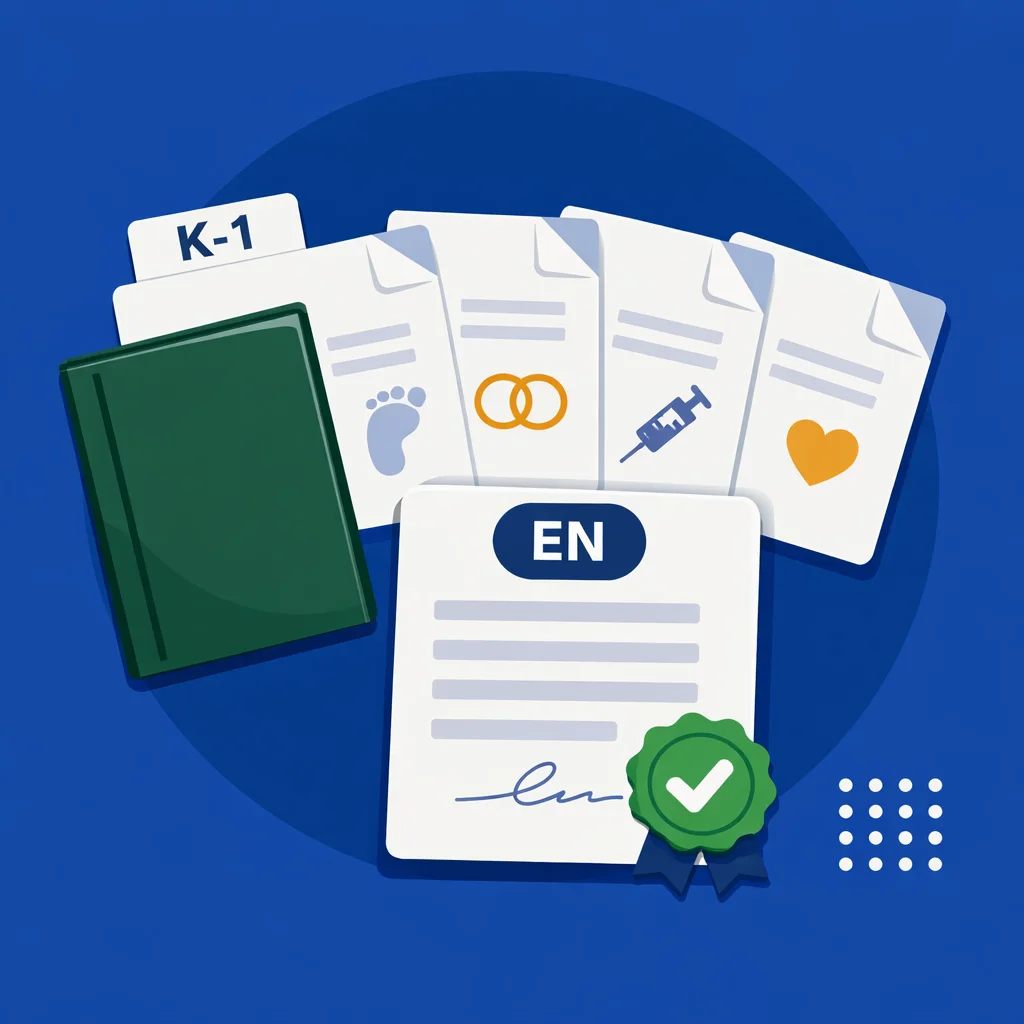
Most foreign documents translated for the K-1 stage can be filed again with the Form I-485, but only when the translation is complete, matches the version of the record the officer now needs, and still carries its certification. Documents created after the K-1 visa was issued, such as the marriage record and the medical exam, are new and are handled on their own terms.
The I-485 is the Application to Register Permanent Residence or Adjust Status that the K-1 entrant files after marrying the petitioner. USCIS regulations require every foreign-language document in that filing to come with a full English translation and a signed certification of completeness, accuracy, and the translator's competence. The earlier approval of the fiancé(e) petition does not remove this requirement, and the officer reviewing the adjustment reads the file as a new case. The same certified document translation for USCIS rules apply to the K-1 documents filed again. The attorney or accredited representative decides what goes into the filing. Texliff's article on K-1 document translation covers the earlier petition and consulate stage.
Which K-1 documents carry over to the I-485
Civil records that describe the past do not change after the visa interview. A birth certificate, a divorce decree ending an earlier marriage, a death certificate for a former spouse, and a police certificate from a country where the applicant lived are the same facts the second time around. If a certified translation of each already exists, the same translation can usually go into the I-485 packet.
Three conditions have to hold. The translation must be of the same document, in the same version, with nothing added to the source since. It must be complete, meaning every stamp, seal, handwritten entry, and marginal note on the page is accounted for. And the translator's certification must still be attached to the translation, with the signature, date, and contact details intact. A translation separated from its certification is an uncertified translation as far as USCIS is concerned. The longer discussion of when an old translation still works is in the article on reusing a certified translation in a new filing.
Police certificates need a second look. The certificate that went to the consulate was issued on a particular date, and an I-485 filed months later may call for a newer one. Whichever certificate is filed, it needs its own certified translation when it is not in English.
Birth certificate extracts that need replacing with the full record
A frequent gap in an adjustment file is a foreign birth certificate that was translated as a short extract for the consulate and is now needed in full. The Department of State's Visa Reciprocity and Civil Documents by Country schedule says, country by country, which version of a civil document is acceptable, and officers at USCIS and at consulates both rely on it. Some countries issue an abridged extract and a long-form copy that carries the parents' details and the registration entries, and the long form is the version a file usually needs.
Checking the schedule before ordering saves the fee for a translation of the wrong version. If the K-1 packet holds an extract only, the applicant obtains the long-form record from the issuing authority and has it translated as a new document. The translation of the full record follows the layout of the original, so the officer can match each translated line to the source. Vietnamese records show the difference clearly: the giấy khai sinh is the birth certificate, and the trích lục is an extract from the register. A Vietnamese birth certificate translation of the extract alone leaves the parents' registration details out of the file, and the Vietnamese translation services page covers other records in that language.
New records the I-485 adds
The marriage certificate is the clearest new document. The wedding normally takes place in the United States, so the record is issued in English and needs no translation. If any part of the marriage record, or of a religious ceremony record that accompanies it, is in another language, it needs a certified marriage certificate translation like any other foreign-language item.
The Form I-864 Affidavit of Support brings the sponsor's documents into the file. The sponsor's documents are mostly US tax and employment records in English. Foreign-language items occur when the sponsor or a joint sponsor has income or assets abroad, in which case the bank statements and tax papers are translated in full.
Children listed on the K-1 petition travel as K-2 entrants and file their own I-485 applications. Each child's birth certificate and any adoption or custody record needs the same treatment as the parent's records: full version, certified translation, and a spelling of the name that matches the rest of the file.
The I-693 medical exam and foreign vaccination records
The Form I-693 medical exam is completed by a civil surgeon designated by USCIS. Applicants bring their vaccination records, and the civil surgeon has to read them to transfer the data onto the form. A vaccination record written in another language therefore needs an English translation before the visit. A certified vaccination record translation keeps dates, vaccine names, and dose numbers in the order the clinic recorded them.
Records of past treatment that are submitted as evidence, for a waiver for example, are a separate matter. They are translated in full and certified like any other document in the file.
One spelling of the beneficiary's name across both filings
The I-485 file will contain the K-1 petition approval, the visa, the passport, the birth certificate, and the marriage certificate. Each is a separate source for the beneficiary's name, and they often disagree in small ways: a transliterated vowel, a dropped middle name, a surname order that differs between the birth record and the passport. A translation company working from a new document should check the earlier translations and follow the spelling that appears in the passport and on the K-1 visa, while reproducing any real difference in the source as it is written.
Dates need the same attention. The translation writes dates in one format throughout, and an unusual calendar or a day and month order that differs from US practice is stated in the translation, so the date in the packet stays consistent with the earlier one.
What to prepare before filing
Pull the K-1 packet and lay the earlier certified translations beside the originals. Mark which are in the full version, which are extracts, and which police certificates are out of date. Confirm each reused translation still has its certification attached. Order new translations only for the gaps. Texliff attaches a separate certification to each translation, including a new birth certificate translation of a full record.