Key Takeaways
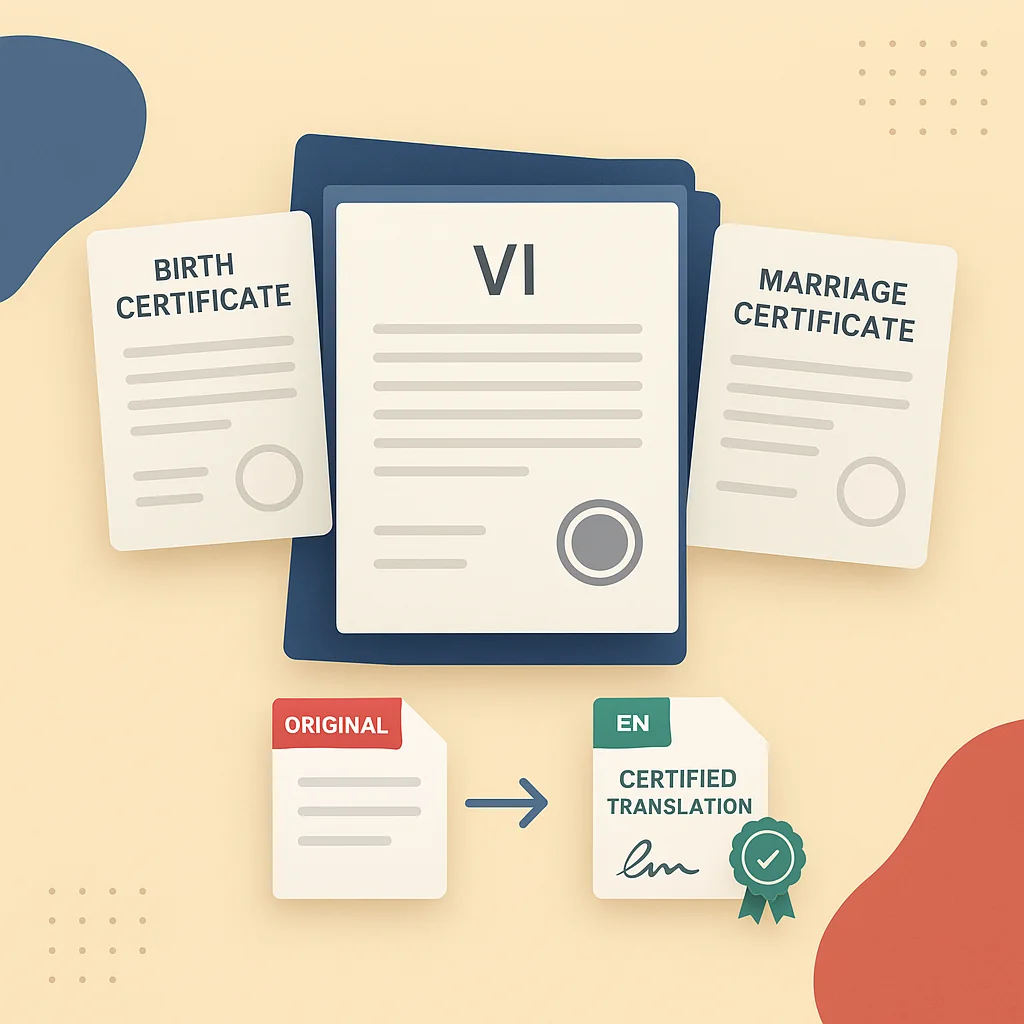
- A citizen petitioning for a parent or sibling proves the relationship with civil records from two generations, and each foreign-language record needs its own full certified English translation.
- For a parent petition, the petitioner's birth certificate has to name the parent, and the parents' marriage record may be added when the petition is for a father.
- When parents were not married, the file may call for legitimation or paternity records, which are translated in full and certified as separate documents.
- A sibling petition rests on two birth certificates that show at least one common parent, and the two translations are read against each other.
- Half-sibling cases add the parents' marriage record or legitimation evidence, because the common parent must be shown on both children's birth records.
- A short birth extract or abridged copy that leaves out the parents cannot prove a parent or sibling relationship, so the full record should be ordered and translated.
- The Department of State's Visa Reciprocity and Civil Documents by Country schedule shows which version of a civil document is acceptable, and it should be checked before a translation is ordered.
- Older handwritten registers are translated completely, with stamps, seals, and marginal notes described in brackets and unreadable parts marked as illegible rather than guessed.
- One spelling should be settled for each person at the start and used in every translation, following the passport or the identity document in use.
- When a primary record is unavailable, the petitioner shows that and files secondary evidence, and each foreign-language item among it also needs a certified translation.
A citizen who files Form I-130 for a parent or a sibling proves the relationship through civil records from two generations, and every one of those records that is not in English needs a full certified translation. For a parent petition the central record is the petitioner's own foreign birth certificate, which has to name the parent. For a sibling petition it is two birth certificates that show at least one common parent.
Texliff's guide to certified document translation for I-130 applications covers the general steps of the form, so this article deals only with the records that belong to parent and sibling petitions. USCIS publishes the form and its instructions on its Form I-130 page, and the petitioner's attorney or accredited representative decides which evidence to file.
Birth certificate for a parent petition must name the parent
When a citizen petitions for a mother, the petitioner's birth certificate shows her name as the mother. When the petition is for a father, the same certificate has to show him as the father, and the relationship evidence often adds the parents' marriage certificate translation to show that the parents were married when the petitioner was born. If the parents were not married, the file may call for legitimation or paternity records, such as a court order, a recognition entry on the birth record, or a signed acknowledgment of paternity. In a step-parent case, the marriage record of the petitioner's parent and the step-parent joins the file together with the birth certificate.
Each of these records is translated as its own document with its own certification. The translator reproduces the names exactly as the source writes them, including every parent's full name and any later marginal entry that recognizes a father or corrects a name.
Sibling petitions need two birth certificates and the parents' records
A sibling petition rests on a comparison. The petitioner's birth certificate and the sibling's birth certificate must show at least one parent in common, and the two translations are read against each other. A mother's name spelled one way on the first translation and another way on the second can look like two different women, even when the source documents agree.
Half-siblings add a step. If the two share only one parent, the file shows the common parent on both certificates. If the common parent is the father and the mothers differ, the petition may also depend on evidence that the father was married to each mother or legally recognized each child. The parents' marriage record, or the legitimation evidence, is translated in full and filed with the two birth certificates.
Why an abridged birth extract is the wrong version
Some registries issue more than one version of a birth record. One version is a full copy of the register entry, with the parents' names, ages, places of birth, and the registration details. Another is a short extract or abridged copy that gives only the child's name, date, and place of birth. Poland separates the full copy (odpis zupełny) from the abridged copy (odpis skrócony), and Vietnam issues both a giấy khai sinh and a trích lục. An extract that leaves out the parents cannot prove a parent or sibling relationship, however well it is translated.
The Department of State's Visa Reciprocity and Civil Documents by Country schedule lists, country by country, which civil documents exist, who issues them, and which version is acceptable. Checking it before ordering a translation saves the fee for a document that would have to be redone. A Spanish birth certificate translation for a Mexican record, for example, should be made from the full acta de nacimiento that names both parents.
Older handwritten and re-issued records
Records from the parents' generation are often old. Registers from decades ago may be handwritten in cursive, with faded stamps, corrections between lines, and a clerk's marginal notes added years later. The translator marks anything unreadable as "[illegible]" and does not guess, and describes stamps, seals, and signatures in brackets. Complete means the whole page, including headers, numbering, and the back when it carries text.
A re-issued certificate raises a different problem. It may be a modern copy of an old entry and carry a new issue date, a new registrar, and sometimes less detail than the original. Each translation identifies the document it covers by title, issuing authority, and date, so the officer can tell which record is which. A Vietnamese birth certificate translation is a common example, because a household may hold an old giấy khai sinh, a later extract, and a household registration book (sổ hộ khẩu) that Vietnam has been phasing out.
Keeping names consistent across two generations
A parent petition has the petitioner's name on one record and the parent's name on several others. Spelling has to match across every one of them. A name romanized one way on a passport, another way on a birth certificate, and a third way on a marriage record gives the officer a reason to ask whether these are the same person. The translation company should settle one spelling per person at the start, follow the passport or the identity document in use, and apply it in every translation in the packet.
Source languages add their own conventions. Vietnamese translation services have to handle diacritics and the order of family, middle, and given names. Arabic name chains of given name, father, grandfather, and family name often have several accepted English spellings, and the translator picks one and keeps it.
How a two-generation packet is organized
A family packet works best when it is built around the people rather than the documents, and a translation company that provides certified document translation for USCIS can group it that way: the petitioner first, then each parent, then the sibling where there is one. Each document carries its own certification, which includes the translator's typed name, signature, date, contact information, and statements of competence and accuracy.
- The petitioner's full birth record, translated with every parent's name and every marginal entry.
- The sibling's full birth record, where the petition is for a brother or sister.
- The parents' marriage record, or the legitimation or paternity record when the parents were not married.
- A written statement from the issuing authority, when a record is not available.
When a primary record cannot be obtained, the petitioner shows that it is unavailable and files secondary evidence instead, such as church or baptismal records, school records, or an affidavit translation from people with personal knowledge of the birth. Each foreign-language item among them also needs a certified translation. Machine translation alone does not meet the requirement, because it carries no human certification and often misreads names and dates.
Ordering the full records first and translating them together keeps the spellings consistent, and a missing, incomplete, or uncertified translation can lead USCIS to issue a Request for Evidence or a Notice of Intent to Deny. Before ordering, check that each record shows the parents' names and carries the issuing authority's stamp. Texliff prepares a certified birth certificate translation with the full parent entries and a separate certification for each record.