Key Takeaways
- Form I-131 covers several travel documents, and the foreign-language records attached to it depend on whether the request is for advance parole, a reentry permit, or humanitarian parole.
- USCIS requires a full English translation with a signed certification of competence and accuracy for every foreign-language record filed with Form I-131, and a separate certification for each document is the safer practice.
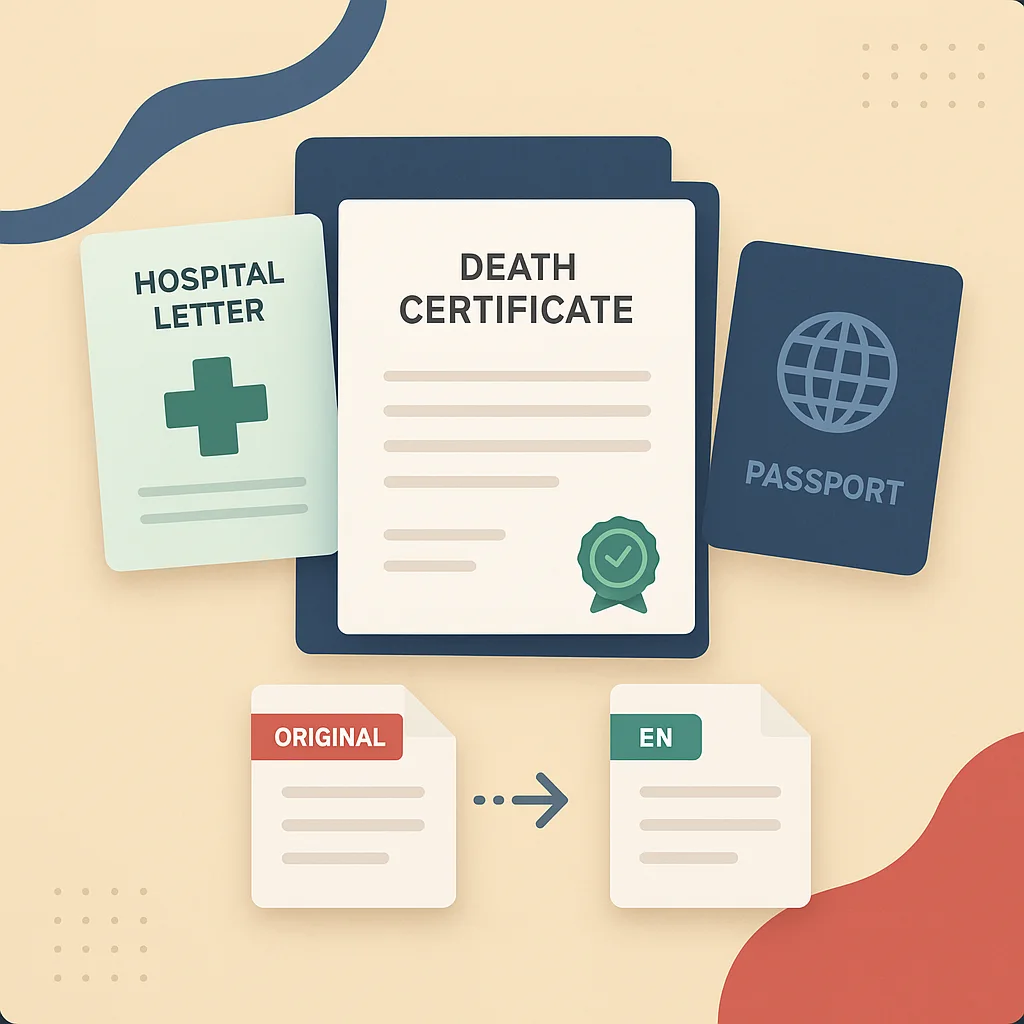
- Advance parole requests for a family emergency are usually supported by a foreign death certificate, a hospital letter, and sometimes a doctor's statement, each translated in full.
- Reentry permit evidence such as foreign employment contracts is translated clause by clause, including schedules, signature blocks, and stamps, with page numbers that match the original.
- Humanitarian parole evidence comes from outside the United States and includes identity documents, relatives' letters, and records of the urgent situation, all of which need certified English translations.
- Medical letters are translated exactly as the foreign doctor wrote them, without explaining the diagnosis, converting clinical terms, or commenting on how serious the condition is.
- Unreadable handwriting on a medical or civil record is marked as illegible in the translation instead of being guessed, so the officer sees the limit of the source.
- Records that establish the reason for travel or for the parole request should be translated first, followed by identity documents and then supporting letters.
- Names in the translation should follow the passport spelling, and any different spelling in a foreign record should be shown as written so the attorney can decide how to address it.
- Machine translation alone does not meet the USCIS requirement because it carries no human certification and mishandles names, dates, drug names, and abbreviations.
Form I-131 is one application that covers several travel documents, and each of them is supported by different foreign-language records. USCIS requires a full English translation with a signed certification for every one of those records, so the translation plan depends on which travel document the form is asking for.
Form I-131 supporting documents that need translation
The Form I-131 page on uscis.gov lists the travel documents the form can request. Three matter here. Advance parole lets certain applicants, such as a person with a pending Form I-485, ask for permission to return after travel. A reentry permit is for a permanent resident who expects to stay abroad for an extended period. Humanitarian parole is a request made for a person who is outside the United States.
The form itself is in English, but the evidence behind it often is not. A death record from another country, a hospital letter, a foreign employment contract, or an enrollment letter from a university abroad all have to be filed with an English translation. USCIS asks for the translation to be complete, to carry the translator's statement of competence in both languages, and to be certified as accurate. The attorney or accredited representative decides which records to attach. A translation company that provides certified document translation for USCIS prepares each record as its own certified document.
Advance parole: death certificates and hospital letters
An applicant with a pending Form I-485 who must travel for a family emergency usually needs to show the emergency. The records are typically a foreign death certificate translation, a letter from the hospital that treated the relative, and sometimes a statement from the treating doctor. Each is a separate document and receives its own certification, which is the safer practice. Before ordering, check the country's entry in the Visa Reciprocity and Civil Documents by Country schedule, which says which version of a death record the issuing authority provides, so the fee is not spent on the wrong one.
Death certificates carry details that are easy to lose. They show the registry number, the place and date of death, the cause of death where the registry records it, and the names of the parents or spouse. When the certificate comes from an Arabic-speaking country, the dates may be in the Hijri calendar and the person's name may be a four-part chain of given name, father, grandfather and family name. A careful Arabic death certificate translation keeps each date as written and puts any Gregorian equivalent in brackets, so the officer sees both. Hospital letters and relatives' letters from the same country go through the same process under Arabic translation services.
Reentry permit: contracts, enrollment letters and business records
A permanent resident who will stay abroad has to explain why. The supporting records tend to be an employment contract with a foreign employer, a university enrollment letter, a lease or property deed, or business registration papers. A foreign employment agreement is translated like any other legal contract translation: every clause, every schedule, the signature blocks, and the company stamp are rendered, and the page numbers match the original so that an officer can follow along.
Enrollment letters and property records are short, but they contain names, dates, and registration numbers that will be compared with other parts of the filing. A missing stamp or an untranslated footer makes the translation incomplete, because complete means everything printed or written on the page, including the back if it carries anything.
Humanitarian parole: evidence from outside the United States
A request for humanitarian parole is made on behalf of a person who is abroad, so most of the evidence is in a foreign language: identity documents, letters from relatives in the United States and abroad, and records that show the urgent situation. Identity documents, usually the passport and a birth certificate, are translated in full. A passport translation covers the data page, any visa or entry stamps, and every endorsement or amendment page that carries text.
Letters from relatives are translated as written. Their tone, their order, and any statement the writer is unsure about stay as they are. A hurried or emotional letter stays hurried or emotional in English, and a writer's hesitation or uncertain statement is carried over as it stands. Polishing the wording would change what the officer reads.
Translating medical letters without adding interpretation
Medical diagnoses, treatment plans, and doctors' statements are the records most likely to be attached to an urgent request. The translation reproduces the diagnosis as the foreign doctor wrote it, along with test names, drug names, dosages, dates, hospital letterhead, and signatures. The translator does not explain a diagnosis, convert it to a different clinical term, or comment on how serious the condition is. Where a handwritten note cannot be read, it is marked "[illegible]" rather than guessed.
Foreign hospitals use abbreviations that differ from American ones, and a wrong guess can change the meaning of a line. A Spanish discharge summary may use a shorthand with no direct English equivalent, so the translator keeps the abbreviation with a bracketed note and writes out the full term only when the source makes the meaning certain. The same care applies to a Spanish medical records translation. Machine translation alone does not meet the requirement because it carries no human certification and mishandles drug names, dates, and abbreviations.
Which Form I-131 documents to translate first
Urgent requests leave little room for slow assembly, so the order of preparation matters. The records that establish the reason for travel or for the request should be translated first, because the rest of the packet depends on them. After those come the identity documents, and then the supporting letters and background records.
- The records that prove the emergency or the reason for the stay abroad, such as the death record, the hospital letter, or the foreign contract.
- The identity documents of the person who will travel or be paroled.
- Letters from relatives, employers, or institutions that describe the situation.
- Background records that add detail but do not carry the main reason.
Working in that order also helps a law office spot a missing page early, while there is still time to ask the client for a better scan.
Matching names and dates to Form I-131 and the passport
Every translated record is compared with the form and with the passport. The spelling of a name in the translation should follow the passport, since the passport is the identity document the officer already has. If a foreign record spells the same name differently, the translation shows the spelling in the source and the attorney decides how to address the difference. Dates follow the U.S. month, day, year format in the translation, and the original calendar date is preserved where the source uses a different calendar.
Before ordering, send clear scans of every page, including the backs, together with the passport data page and a copy of the draft form. With the whole packet in hand, a translation company can match names and numbers across every record, and we prepare the certified translations of the medical records and the other supporting documents as one consistent set.