Key Takeaways
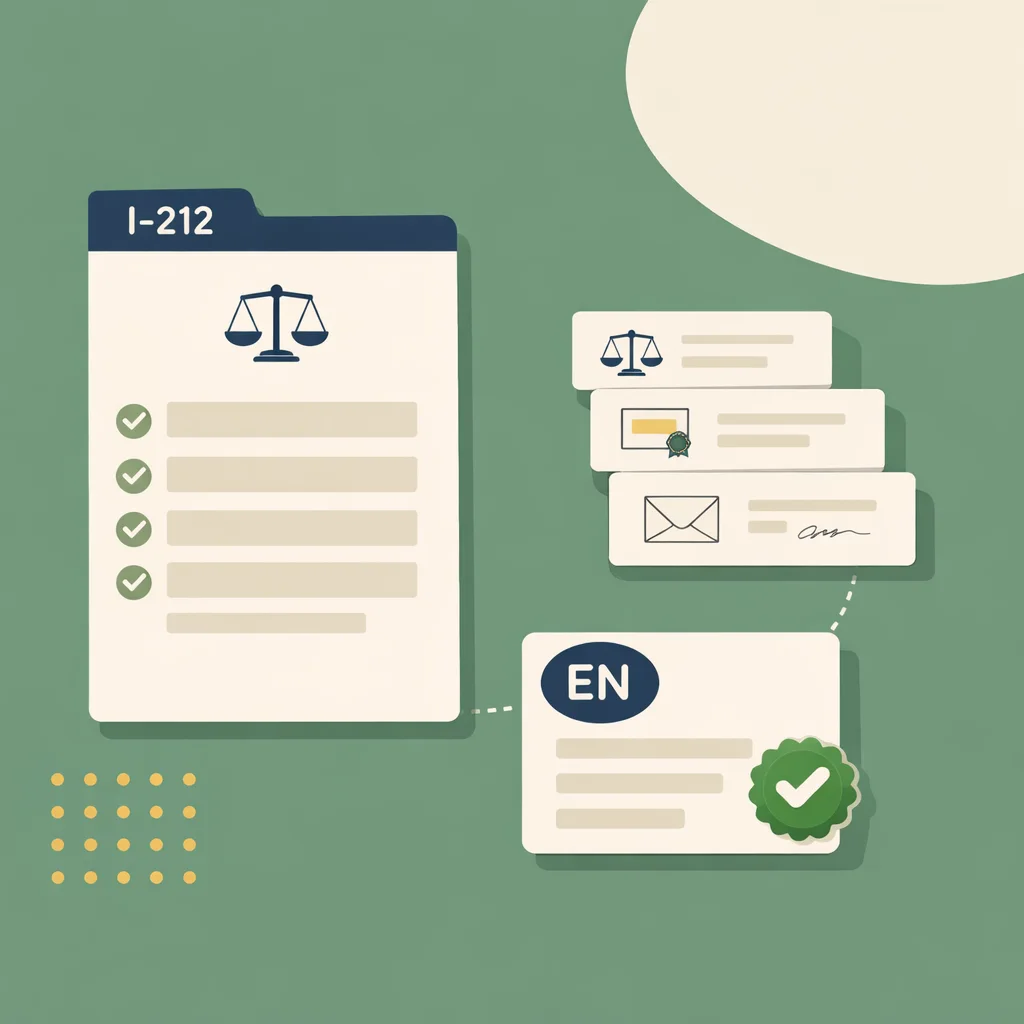
- A packet for Form I-212 or Form I-192 is translated document by document, and every foreign-language record, certificate and letter in it needs a full English translation with a signed certification.
- The attorney or accredited representative decides what goes into the packet, and the translation company works only from the words on the pages that were chosen.
- A foreign court record is translated literally, from the case caption to the last stamp, with statute and article numbers kept exactly as printed rather than matched to a United States offense.
- Terms with no direct English counterpart are translated by meaning with the original term kept in brackets, and a vague phrase in the source stays vague in the English.
- A certificate of completed sentence or probation keeps its issuing office, full name, dates and file numbers so an officer can match it to the court record in the same packet.
- Police certificates are translated entry by entry, and dropping an entry that looks minor makes the translation incomplete.
- Treatment and counseling records keep their clinical terms, diagnoses and medication names as written, and blank or illegible pages are marked as such.
- Letters from employers, relatives and religious communities stay in the writer's own voice, with letterhead, signature and stamps included, and without polished grammar or added emphasis.
- The translation reports what the record says and never adds a label such as serious or minor that the source document does not use.
- A separate certification for each document is the safer practice, and the applicant or a relative should not sign the certification for their own evidence.
A packet for Form I-212 or Form I-192 is translated document by document, and every foreign-language piece in it needs a full English translation with a signed certification, exactly as in any other USCIS filing. Court records, sentence certificates, treatment records and letters of support all follow that rule, and each translation reports what the record says without describing the offense in new words.
Form I-212 is the application for permission to reapply for admission after removal, and Form I-192 is the application for advance permission to enter as a nonimmigrant. In both, the officer weighs the applicant's history against evidence of rehabilitation and ties to the United States. The attorney or accredited representative decides what goes into the packet, and the translation company works only from the pages chosen. USCIS describes the process on its Form I-212 page, and the certified document translation for USCIS service covers every record type discussed below.
Court records and sentencing documents in an I-212 packet
A foreign court record is translated literally, from the case caption to the last stamp. The translation includes the court's name, the case number, the names of the judge and the parties, the charge as the record words it, the date of the decision and the sentence. The Texliff article on court records translation for USCIS covers judgments and dispositions in more detail.
Statute and article numbers stay exactly as printed. If the record says a person was convicted under a numbered article of a penal code, the translation gives the number and the article's wording, and does not replace it with the nearest United States offense. Naming an equivalent offense would be the translator's legal opinion, and a certification covers only what the document says.
Terms with no direct English counterpart are translated by meaning, and the original term is kept in brackets at first use. Words such as suspended sentence, conditional discharge or archived case differ from one legal system to another, so the translator reads the term in the context of the whole document before choosing the English phrase. When the court uses a deliberately vague phrase, the English is equally vague.
Certificates of completed sentence, probation and police clearance
A certificate stating that a sentence was served, a fine paid or a probation period finished is short, but every field matters. The translation keeps the issuing office, the person's full name as printed, the dates of the sentence and of completion, and any file number. If the certificate refers back to a judgment by date and number, those references are copied exactly so that an officer can match the certificate to the court record in the same packet.
Police certificates are handled the same way. A line such as "no record found" is translated as written, and a certificate with a list of entries is translated entry by entry, including entries the applicant would prefer not to repeat. Dropping an entry because it looks minor makes the translation incomplete. The article on police certificate translation for green card cases describes how these certificates are laid out.
Rehabilitation evidence from clinics, counselors and programs
A certificate of completion from a treatment program is translated like any other certificate, with the program's name, the dates of attendance, the signer's title and each stamp described in brackets. Longer records, such as a discharge summary or a counselor's report, keep their clinical terms as written. A diagnosis, a medication name or a test result is not simplified for the reader, because the officer needs to see the same terms the clinician used.
Such reports are medical records in the ordinary sense, and a certified medical records translation treats them with the same completeness. Abbreviations are expanded only where the source expands them, handwritten notes are translated or marked "[illegible]", and every page is accounted for. A blank page, or one that carries only a form heading, is marked as such.
Letters of support from employers, relatives and religious communities
Letters of support are personal statements, so the translation stays in the writer's voice. A pastor who writes in a warm, formal style is translated in a warm, formal style, and a neighbor who writes short plain sentences is translated the same way. The translator does not polish grammar, strengthen a recommendation or delete a repeated phrase.
The letterhead, the date, the writer's address and telephone number, the signature and any stamp belong to the translation as well. A statement made abroad in the form of a declaration is translated with its wording unchanged, and the article on affidavit translation for USCIS covers that handling. A writer's own words about the applicant's offense, remorse or family are never shortened.
Translating a record without characterizing the offense
The translator reports what the record says and stops there. If a judgment calls the act "fraud," the English says "fraud." If it uses a general term, the English uses a general term. A word such as "serious," "minor" or "violent" appears in the translation only when it appears in the source.
Names, dates and numbers get the same treatment. A name is spelled as in the passport, a date is written in United States format with the original noted where the source uses another calendar, and amounts keep their original currency. Court, police and community documents often spell one name three different ways, so the translation company works from a single spelling list for the whole packet. For packets in Spanish, the Spanish criminal record translation page shows how court and police wording is handled, and Spanish translation services cover the supporting letters.
Certification for each I-212 or I-192 translation
USCIS requires a complete English translation with the translator's certification that it is accurate and that the translator is competent in both languages. In practice the certification carries the translator's typed name, signature, date and contact information, a statement of competence, a statement that the translation is complete and accurate, and an identification of the document translated. One certification per document is the safer way to file, because a packet with a dozen letters and records is often reviewed one piece at a time.
The applicant, the petitioner and their relatives should not sign the certification for their own documents. A certification from a translation company is independent of the case, so an officer has no reason to give it less weight. Machine translation does not meet the requirement either, since it carries no human certification and mishandles names, dates and legal terms. A missing or uncertified translation can lead to a Request for Evidence or a Notice of Intent to Deny, or to a denial without either when the initial evidence is insufficient.
Before ordering, gather the records in final form: full copies of every court document, every page of each certificate, the letters with their signatures, and the treatment records including the back of any page that carries stamps. Mark which pieces the attorney has chosen to file, then send them together for certified criminal record translation and the related records, so one team keeps names and terms consistent from the first page to the last.