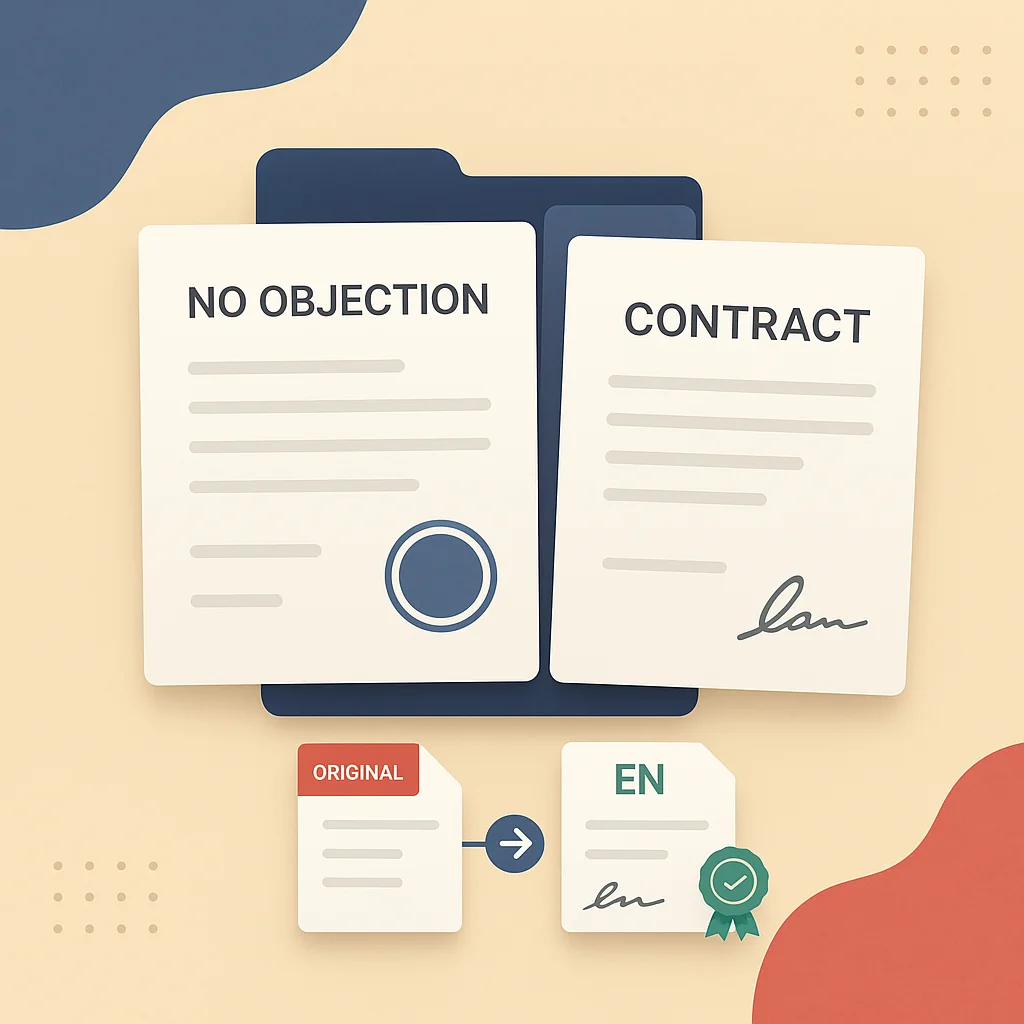
Key Takeaways
- A J-1 waiver file needs a full English translation with a signed certification for every foreign-language page, from home-government letters to school and medical records.
- The waiver application goes to the Department of State on Form DS-3035, and hardship or persecution cases also file Form I-612 with USCIS.
- USCIS keeps no list of approved translators, and a certification signed by the applicant or a relative may carry less weight than one from a translation company.
- A no-objection statement from the home government is translated in full, including any cover page, the reference number, the signing official, stamp wording, and seal descriptions.
- The name in a translated letter should follow the passport spelling where the source allows it, and any real difference between letter and passport is shown exactly as written.
- A scholarship contract's repayment clause is translated literally, with amounts, conditions, deadlines, guarantors, and defined terms kept consistent from the first page to the last.
- Statements from relatives and colleagues stay in the first person and are not corrected, and unreadable words are marked as illegible instead of guessed.
- Medical records for a hardship claim need literal translation of diagnoses, medications, test results, visit dates, handwritten notes, and the physician's signature and stamp.
- School records and transcripts are translated with the grading key, and grades are never converted to another scale.
- Machine translation and partial translations do not meet the USCIS requirement, so each document needs a complete translation with its own certification.
Every foreign-language document in a J-1 two-year home residency waiver file needs a full English translation with the translator's signed certification. That covers the home government's letter, scholarship contracts, employer letters, school records, and medical reports alike. The file is read in English, and a page that arrives untranslated or with an uncertified translation can bring a Request for Evidence.
J-1 waiver documents that need a certified translation
Exchange visitors who are subject to the two-year home residency requirement apply for a waiver through the Department of State on Form DS-3035. Applicants who rely on exceptional hardship to a U.S. citizen or permanent resident spouse or child, or on a fear of persecution, also file Form I-612 with USCIS. The other bases are a statement from the home government that it has no objection, and a request from an interested U.S. government agency. The attorney or accredited representative decides which basis fits and which evidence to send.
Whatever the basis, the foreign-language papers fall into a few groups: the home government's no-objection statement, funding and scholarship contracts, employer release letters, school and medical records for hardship, and statements from relatives or other witnesses. USCIS requires each of them to come with a complete English translation and a signed certification of competence and accuracy. USCIS keeps no list of approved translators and certifies no companies. When an applicant or a relative signs the certification, an officer may give it less weight, because that person is certifying evidence in their own case. A certified document translation for USCIS from a translation company avoids that question and follows the same rules for every group below.
No-objection statement translation and official stamps
A no-objection statement is a letter from the exchange visitor's home government saying it does not object to the person staying in the United States. It is normally delivered through the home country's embassy in Washington. Some governments write the statement in English, some write it in the national language, and some send the national language with a short English cover page. Any part that is not in English has to be translated, including the cover page if it carries text of its own.
Government letters are full of elements that are easy to lose. The letterhead, the file or reference number, the name and title of the signing official, the date, the ministry stamp, the seal, and the handwritten initials all belong in the translation. A stamp is described in brackets with its wording translated, for example "[stamp: Ministry of Foreign Affairs, Consular Department]", and a signature appears as "[signature]". Dates keep the order of the original, and a date in a non-Gregorian calendar is shown as written, with the Gregorian equivalent added only where the translator can verify it.
Names need the most care. The exchange visitor's name in the letter should match the DS-2019 and the passport, and the translator follows the passport spelling when the source script allows more than one. When the letter spells the name differently from the passport, the translation shows the letter's spelling exactly, and the law office decides whether an explanation is needed.
Scholarship and funding contracts: translating the repayment clause
Many exchange visitors come on a home-government or university scholarship that carries a service obligation and a repayment clause. The contract is a legal text, and its wording matters to the officer reading the file. The repayment clause, the amount, the conditions that trigger it, the deadlines, and the named guarantors are translated as written and in the same order. A translator does not turn "shall repay" into "may be asked to repay" or merge two conditions into one.
Defined terms stay consistent from the first page to the last. If the contract uses one term for the sponsoring ministry and another for the university, the translation uses one English term for each and keeps it throughout. Amounts stay in the original currency, with both the numerals and the written-out words reproduced when the source has both. A legal contract translation also covers annexes, schedules, signature blocks, and the stamp on each page. A Chinese legal contract translation has to follow the year-first date order and show the company or institution seals. The letters and forms from the same office usually need Chinese translation services as well.
Employer release letters and statements from witnesses
Employer release letters show that a position at home was held and that the employer knows about the exchange program. They are short, but they usually carry a letterhead, a stamp, a signature, and a reference number, and each of those is translated or described. Job titles are rendered literally, with the original title added in parentheses when the English term could be read in more than one way.
Statements from relatives, colleagues, and other people with personal knowledge of the situation are translated as affidavits, in the first person and in the voice of the writer. The translation does not correct grammar, fix dates that look wrong, or add detail, and an unreadable word is marked "[illegible]" rather than guessed. An affidavit translation includes the signature, the date, and any attached identification page.
Medical and school records used as hardship evidence
Hardship evidence often comes from a spouse's or child's medical file or school records. Medical records need a literal translation of diagnoses, test results, medication names, dosages, doctors' notes, and the date of each visit. Abbreviations stay as written, with an expansion in brackets only when the translator is certain of it, and handwritten notes are translated or marked "[illegible]". Hospital stamps and the physician's signature are recorded. A Portuguese medical records translation follows the same approach, with drug names and clinical terms rendered in their standard English forms.
School evidence works the same way. Report cards, enrollment letters, and special-education assessments are translated in full, including the grading scale and the legend that explains it. A transcript from a university abroad follows the rules of an academic transcript translation: course titles stay as written, grades are not converted, and the grading key is translated beside the grades. The translator adds no opinion on what a record proves for the hardship claim.
What the certification and the filing should contain
Each translated document should have its own certification with the translator's typed name, signature, date, and contact details, a statement of competence in both languages, a statement that the translation is complete and accurate, and a line identifying the document. Each document is safer with its own certification. Four habits help when the packet is assembled:
- Send the complete original page set, including the back of any page that carries stamps or notes.
- Give the translator the passport and DS-2019 spelling of every name in the file.
- Keep the translated pages in the same order as the source pages.
- Match each certification to the document it covers.
Machine translation does not meet the requirement, because it carries no human certification and mishandles names, dates, abbreviations, and legal terms. Partial translations and summaries do not meet it either.
Before ordering, the law office can list every foreign-language page in the waiver file and mark which ones the filing will rely on, then send the full set at once so names stay consistent across the contract, the letters, and the hardship records. We prepare a certified medical records translation and the other document types above in one consistent format for the packet.