Key Takeaways
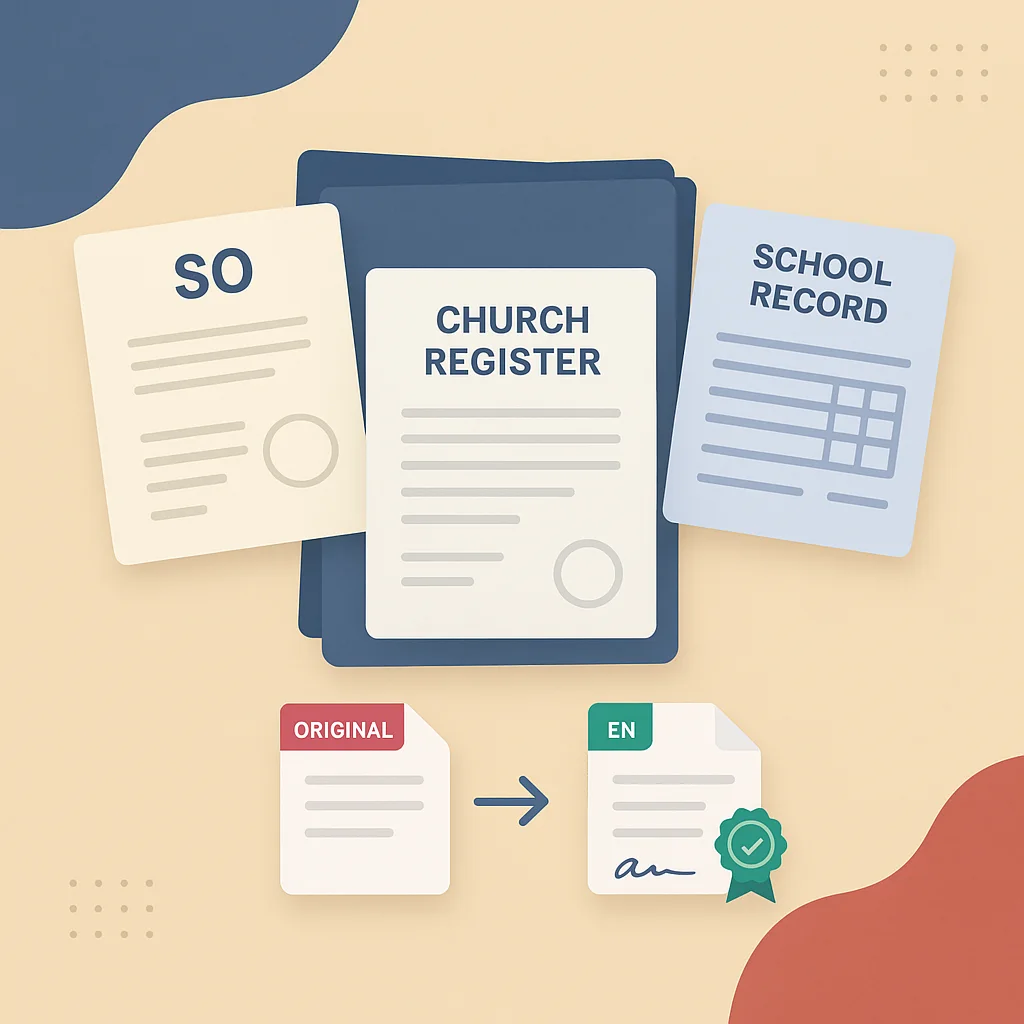
- When a civil authority cannot issue a birth certificate, the applicant shows the record is unavailable and files secondary evidence, and each foreign-language piece needs its own certified English translation.
- The Department of State Reciprocity Schedule lists which civil documents each country issues and which are generally unavailable, so the entry for the applicant's country should be read before ordering any translation.
- A written statement from the issuing authority can show that no birth record exists, and its translation must reproduce the office name, search date, searched names, reference number, stamps, and signatures.
- Baptismal, school, hospital, census, and military records can serve as secondary evidence, and each is translated in full with its issuing body, letterhead, and registration numbers exactly as written.
- Dates stay in the form shown on the source page, handwritten entries and back-of-page text are translated, unreadable words are marked as illegible, and blank fields are shown as blank.
- School records with grading tables are translated with their codes and printed key intact, and grades are not converted, since the record serves to show a date of birth and a school.
- An affidavit of birth is usually signed by two people with personal knowledge, and its translation must keep the affiant's name, relationship to the applicant, and stated basis of knowledge exactly as written.
- A separate certification for each document is the safer practice, giving the translator's typed name, signature, date, contact details, competence statement, accuracy statement, and an identification of the document covered.
- A certification from a translation company stands apart from the case, while one signed by the applicant or a relative may be given less weight or questioned by the officer.
- Applicants should gather the schedule entry, the authority's statement, and scans of every secondary record, then send the complete set together so names and dates can be checked against each other.
When a civil authority cannot issue a birth certificate, the applicant shows that the record is unavailable and files secondary evidence in its place, and every piece written in another language needs its own certified English translation. The set usually contains a statement from the issuing authority, one or more records made close to the time of birth, and affidavits from people who know the facts.
USCIS regulations require a full English translation, certified as complete and accurate by a translator who states competence in both languages, for any foreign-language document in a filing. That rule applies to a church register or a handwritten affidavit exactly as it applies to a government certificate. Texliff prepares this kind of certified document translation for USCIS, and the sections below describe what each piece of a secondary evidence set looks like once it is translated.
How the Reciprocity Schedule shows a birth record is unavailable
The Department of State publishes the Visa Reciprocity and Civil Documents by Country schedule, which lists for each country which civil documents exist, who issues them, and which version is acceptable. Some entries say that a birth record is generally unavailable, for example because registration was never universal or because the archives were lost. USCIS adjudicators and consular officers both rely on the schedule, so the entry for the applicant's country is the first thing to read.
An entry that describes a document as unavailable does not replace the filing evidence. It tells the officer why a primary record is missing, and the secondary evidence then proves the facts of the birth. The post on civil documents and the Reciprocity Schedule explains how to read an entry in more detail.
The statement from the civil authority
If the schedule does not settle the question, a written statement from the issuing authority can. It is usually a short letter or a stamped form saying that a search was made and no birth record was found, or that the register for that year no longer exists. Some countries issue a formal negative certificate for this purpose, such as the Philippine statistics authority's certification that no record is on file.
Short as it is, the statement needs a complete translation. The translated version carries the name of the office, the date of the search, the names and dates the office searched under, the reference number, and every stamp and signature, each described in brackets such as [stamp] or [signature]. The searched name matters most. If the office searched under a different spelling or date than the one in the application, the officer can see that difference only when the translation reproduces the original wording.
Baptismal, school, and medical records as secondary evidence
Secondary evidence comes in several forms. A baptismal or church record is often a register entry or a certificate extracted from a parish book, and older ones may be in Latin or Spanish. A school enrollment record shows a date of birth and the parents' names, and a hospital or clinic record shows where the birth took place. A census or family register extract and a military record can also state a birth date.
Whatever the record type, the translation follows the same handling rules:
- The issuing body is named in full, with its letterhead, address, and any registration number exactly as written.
- Dates stay in the form shown on the page, and a note gives the calendar when the source does not use the Gregorian one.
- Names appear as spelled in the source, with transliteration following the spelling in the passport when the two differ only in script.
- Handwritten entries, marginal notes, and anything on the back of the page are translated, and unreadable words are marked [illegible].
- Blank fields are shown as blank rather than left out.
School records add a grading table or a coded system of marks. The translation reproduces the codes and the key to them as printed, and it does not convert grades, because the purpose of the record is to show a date of birth and a school, not an academic result. A school file can be handled like any set of translated academic transcripts. A hospital or clinic note follows the same rules as other translated medical records, with names, dates, and doctors' signatures kept exactly as they appear.
Affidavits of birth from two people with personal knowledge
An affidavit of birth is a signed statement by a person who has personal knowledge of the event, such as a relative who was present or an older neighbor who knew the family. Two affidavits from different people are common. The affiant states a full name, the relationship to the applicant, and how the affiant knows the date and place of birth. These three points are what the officer reads to judge the statement, so the translation keeps them exactly as written, including a phrase like "my sister-in-law" or "I was present in the house."
An affidavit signed abroad may be in the affiant's own language, handwritten, or typed by a local clerk, and it usually includes signature blocks, stamps, and an identification number. A certified affidavit translation reproduces all of it. If the affidavit is written in English but the signer does not read English, a certificate of interpretation may also be needed, and the attorney or accredited representative decides what to submit.
Language adds its own details. A statement or affidavit written in Somali needs a translator who keeps names, places, and any approximate dates exactly as the source gives them. Texliff's Somali birth certificate translation and its Somali translation services cover this kind of evidence.
How the whole set is certified
Each document is safer with its own certification. Each certification carries the translator's typed name, signature, date, and contact information, a statement of competence in both languages, a statement that the translation is complete and accurate, and an identification of the document it covers. A single sheet that vouches for a stack of unrelated records leaves the officer to match certification and document by guesswork.
The certification should also come from someone independent of the case. When an applicant or a relative signs it, that person is certifying evidence in the applicant's own case, and officers may give it less weight or question it. A translation company provides a certification that stands apart from the filing. Machine translation does not meet the requirement, because it carries no human certification and mishandles names, dates, and abbreviations, which is a serious problem in a set where those exact details are the evidence.
An incomplete or uncertified translation can lead USCIS to issue a Request for Evidence or a Notice of Intent to Deny, and officers can also deny a filing without first asking for more evidence when the initial evidence is insufficient. In a case already built on substitutes for the primary record, a translation defect gives the officer a second reason to doubt the file.
What to prepare before ordering the translations
Collect the Reciprocity Schedule entry, the authority's statement, and every secondary record in the original, with scans of both sides of each page. Decide with the attorney or accredited representative which records belong in the set, then send the full set at once so names and dates can be checked against each other before the certifications are signed. If the case also depends on a primary record that does exist, we can prepare a certified birth certificate translation to go in the same filing.