Key Takeaways
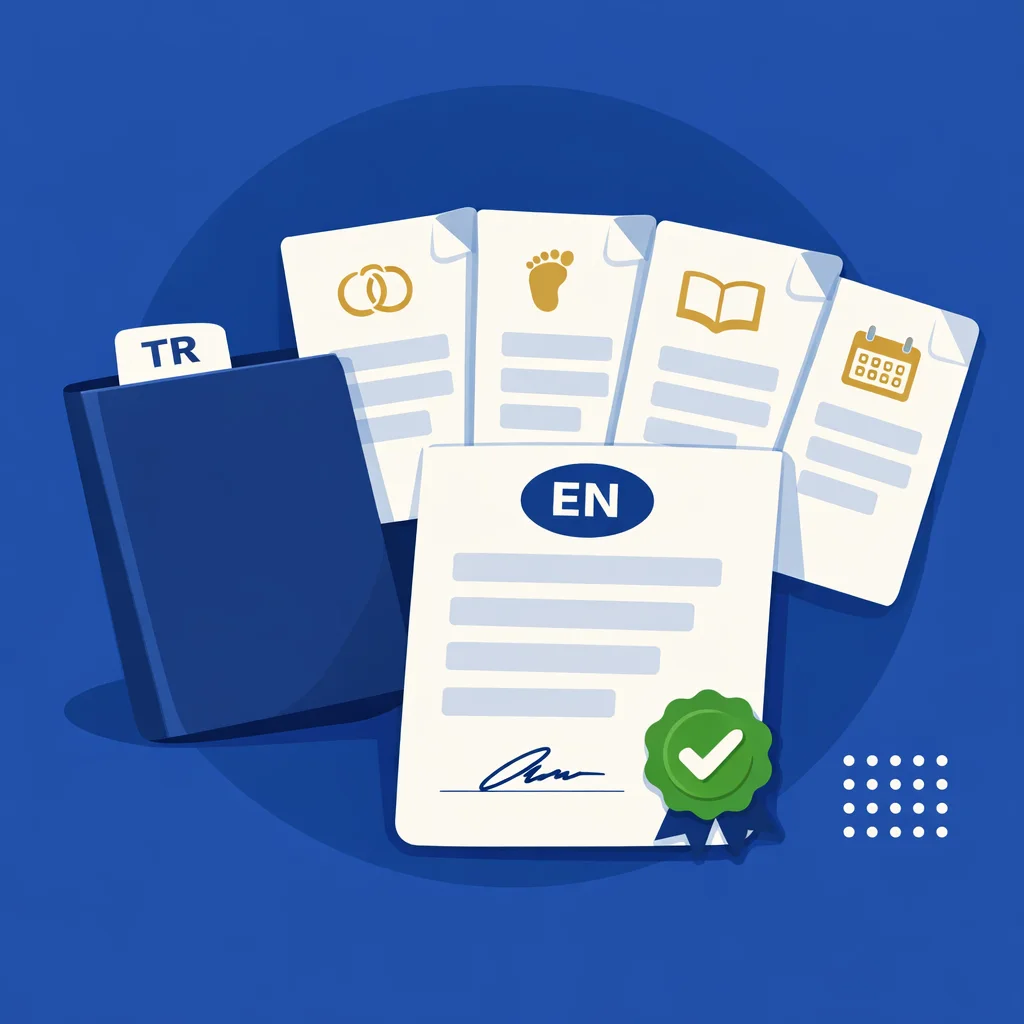
- A Turkish marriage is documented with the marriage registry extract or the international marriage certificate, and USCIS regulations require a full certified English translation of whichever record is filed.
- A religious ceremony without civil registration creates no civil record in Turkey, so the registered record is the document that is translated for the filing.
- The registry extract, the international marriage certificate and the older marriage booklet are separate documents, and each one needs its own translation and its own certification.
- Every page of the international marriage certificate is translated, including printed headings, stamps, signatures, annotations, and entries that are blank.
- An e-Devlet printout is translated in full, including the barcode or QR code, the issue date and the name of the issuing population directorate.
- A divorce is documented by the court judgment with its finalization annotation and by the updated registry entry, and both need a certified translation.
- Names keep the Turkish letters of the source, including the dotless ı and the dotted capital İ, and differences from the passport spelling should be visible in the file.
- Dates on Turkish records run day first, so the translation writes them in U.S. order and keeps the original date string visible where the source prints it.
- The single-status certificate for a K-1 case is translated in full, and a copy that is too old for the interview date should be replaced before translation.
- The NVC and the consulate accept documents in English or in the official language of the country where the applicant applies, while USCIS accepts English only.
A Turkish marriage is proved to USCIS with the evlenme kayıt örneği (marriage registry extract) or the uluslararası aile cüzdanı (international marriage certificate), and every page of the record that is filed needs a full English translation with the translator's signed certification. The same records serve a Form I-130 petition for a spouse, a K-1 case built on the Form I-129F, a later Form I-485, and a CR-1 spouse visa case. The attorney or accredited representative decides which records to submit, and the translation company works from what the filing contains.
USCIS regulations require a complete English translation of any foreign-language document, accompanied by the translator's statement that the translation is accurate and that the translator is competent in both languages. A certified document translation for USCIS therefore covers the whole Turkish record, not a summary of the marriage details.
Turkish marriage records: the registry extract, the international marriage certificate and the older marriage booklet
In Turkey a marriage has legal effect only when it is performed and registered by the civil authorities. A religious ceremony without that registration creates no civil record, so an imam's ceremony alone leaves nothing for an immigration office to translate as proof of marriage. The civil record sits with the population directorate (nüfus müdürlüğü), which issues the registry extract, and couples receive an international marriage certificate at the wedding.
Three documents appear in immigration files. The evlenme kayıt örneği is the registry extract that states the spouses, the date and the place of the marriage. The uluslararası aile cüzdanı is the international marriage certificate, a booklet printed in a standard layout with headings in more than one language. The evlenme cüzdanı is the older marriage booklet that many couples married before the newer booklet still hold. Each is a separate document, and a file that contains two of them needs two translations, each with its own certification.
How the international marriage certificate pages are translated
The booklet is a small book, and a page that looks empty is not skipped. Every printed heading, every filled entry, each stamp, signature and seal, and the blank entries all appear in the English translation, with stamps and signatures described in brackets and blank fields marked as blank. The headings in a second language are translated as well, since the officer should be able to match each translated line to a line of the source.
The booklet is also where later events are written. Children are entered on their own pages, and a divorce or a death is added as an annotation. A booklet that was filled in over several years can carry different handwriting, different offices and different stamps, and the translation keeps that order so the officer sees the record the way the registry kept it.
When the couple holds both a booklet and a registry extract, the two should agree on names, dates and the place of registration. A person who needs a marriage certificate translation for an I-130 can use the Turkish marriage certificate translation page to see how each document type is handled.
What the marriage registry extract shows about the marriage and any divorce
The extract is printed from the population register, and recent copies come from the e-Devlet portal with a barcode or QR code that the receiving office can use to verify the record. The printout is translated in full, including the verification code, the date of issue and the line that names the issuing directorate. Marital status (medeni hâl) appears as an entry on the person's own record, and a divorce is reflected there once it has been processed.
A prior marriage matters in a petition because the officer needs to see that each earlier marriage ended before the current one began. The divorce is documented by the court judgment (boşanma kararı) with the finalization annotation (kesinleşme şerhi) added by the court, and by the updated registry entry. Both need a divorce certificate translation of their own, and the Turkish divorce certificate translation page covers the court records in more detail.
Before ordering a translation, check the Department of State's Visa Reciprocity and Civil Documents by Country schedule for Turkey. Ordering the wrong version of a record wastes the fee, and the schedule states which civil documents exist and which versions are accepted. Applicants who married outside Turkey should read the guidance on marriage abroad and the I-130.
Turkish names, characters and dates in the English translation
Turkish uses the letters ç, ğ, ı, İ, ö, ş and ü, and names on a registry extract are spelled with them. The translation keeps each name as written on the source, including the dotless ı and the dotted capital İ, because changing them creates a second spelling of the same person. Turkish passports print names in capitals and can drop the special letters, so the registry may show Şahin where the passport shows Sahin. If the spellings differ between documents, the file should show it and not leave it for the officer to find.
A woman's previous surname, entered under her maiden name, is translated as written, and the mother's and father's names that appear on the extract are kept in the same order as the source. Dates on Turkish records run day, month, year with dots, so 03.05.2019 is the third of May. The translation writes dates in the U.S. order, and the original string stays visible in the layout where the source prints it.
The single-status certificate for K-1 and consular cases
A K-1 petitioner or beneficiary in Turkey commonly shows that the person is free to marry with a single-status certificate (bekarlık belgesi), which the registry office issues. The certificate is short, but it carries the issue date, the stamp and the statement of marital status, and all of them are translated. The consular officer may look at the date of issue, so a copy that is stale for the interview date should be replaced before translation, not after. The post-specific rules are described in the post on the single-status certificate for K-1 and consular cases.
Each filing tends to attach a different set of Turkish records.
- An I-130 for a spouse usually attaches the marriage record and, when either spouse was married before, the record of each earlier divorce.
- An I-129F usually attaches evidence of the relationship and, for a beneficiary who was married before, the divorce records.
- An I-485 filed by a spouse usually attaches the marriage record and a birth certificate for the applicant.
- A CR-1 case processed through the National Visa Center and the consulate adds the civil documents uploaded to the CEAC portal.
The NVC and the consulate accept documents in the official language of the country where the applicant applies for the visa, or in English. Once a case is with USCIS, every Turkish document must be in English. Whatever the filing, a certified Turkish to English translation follows the same rules for every record in the packet.
Texliff translates Turkish marriage certificates and divorce judgments into English with a signed certification attached to each document, in 82 languages. Certified translations start at $24.95. The price is calculated from the uploaded file and the total shows before payment, so there is no email exchange to get a quote, which is how many traditional agencies still work. The project starts as soon as the order is placed, and delivery is quick, with fast turnaround for single documents.
Before ordering, gather the registry extract, the international marriage certificate and any divorce records, and check each name against the passport. A certified birth certificate translation can be ordered in the same account.