Key Takeaways
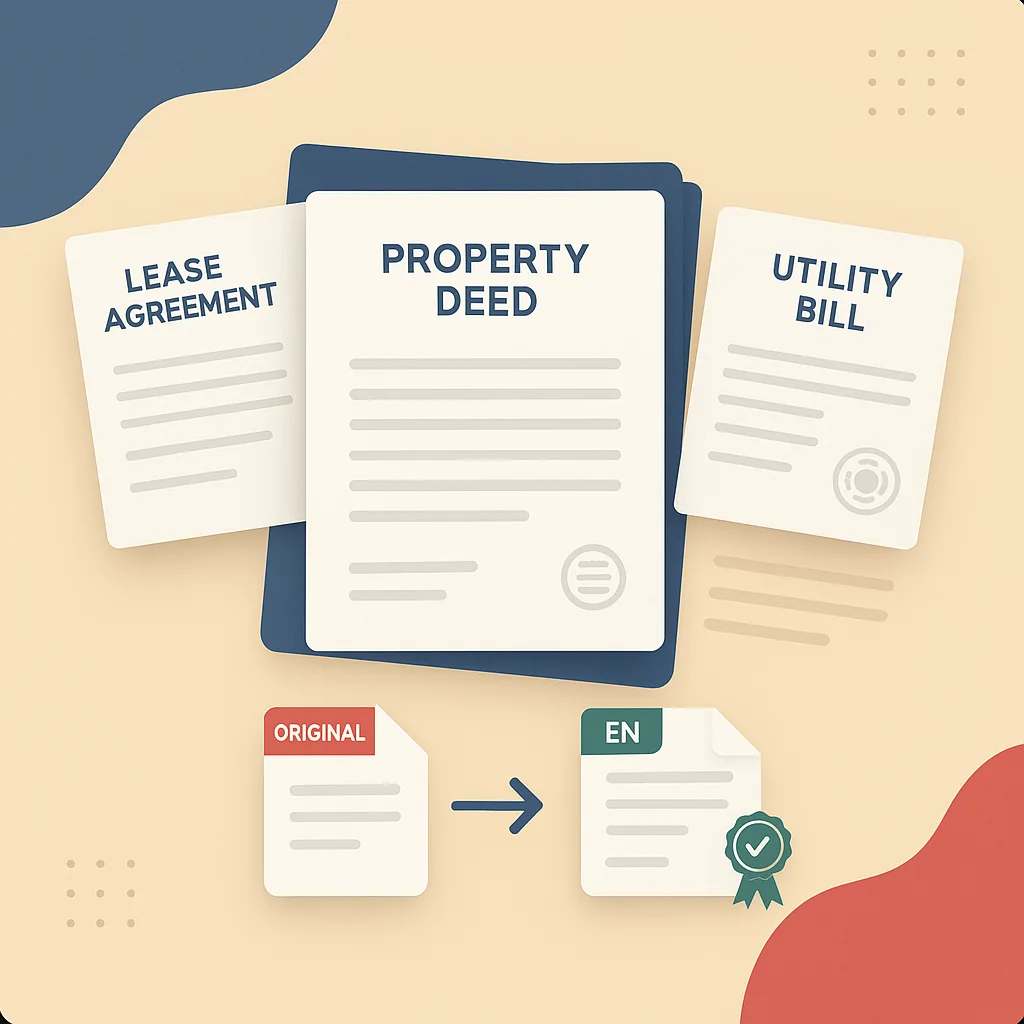
- Foreign-language leases, property deeds, and utility bills filed with USCIS need a complete English translation with the translator's signed certification of competence and accuracy.
- Residence and property records appear in marriage-based cases such as I-751 and I-130, in EB-5 source of funds, in hardship waivers, and in TPS or asylum files.
- A lease is translated as a whole, including identity numbers, rent and term clauses, attached inventories, signature and witness lines, registry stamps, margin notes, and anything printed on the back.
- A property deed from a civil-law country is called a deed in English, and its preamble, boundary description, price clause, and registry endorsements all need translation.
- Translating only the page that names the buyer and seller is a common gap, because the boundary and price clauses show what was transferred and when.
- Loan, bank, and tax records that support a property story are separate documents, and a separate certification for each one is the safer practice.
- A utility bill is translated in full, including the account holder, service address, billing period, amounts, meter readings, payment stamps, and the notes on the back.
- Street and building names stay in their original spelling, descriptive words are translated consistently, and parcel numbers, postal codes, and cadastral references are copied exactly as written.
- Dates are written so they cannot be misread, and names follow the spelling in the applicant's passport across the lease, the deed, and every bill.
- A missing or uncertified translation can lead to a Request for Evidence or a denial, and machine translation or a self-signed certification does not meet the requirement.
A foreign-language lease, deed, or utility bill that goes into a USCIS filing needs a complete English translation with the translator's certification. The translation has to cover the whole record, because the lines that show a name or an address are only part of it. Residence and property records are supporting evidence, so a gap in one of them can weaken a filing that is otherwise in order.
Where residence and property records appear in USCIS filings
In marriage-based cases, such as an I-751 petition to remove conditions on residence or an I-130 petition, couples often send a joint lease, a mortgage statement, or utility bills in both names to show a shared household. In EB-5 filings (I-526E and I-829), a deed of sale or a land registry extract can show where investment funds came from. A hardship waiver under I-601 or I-601A may rely on a deed or a municipal tax receipt to show property that a family member would lose. TPS and asylum files sometimes carry rental or utility records that tie a person to a place and a date, and an N-600 filing can call for records of where a parent lived.
USCIS regulations require every one of these documents to be accompanied by a full English translation that the translator has certified as complete and accurate. A certified document translation for USCIS follows that rule for each record separately. The attorney or accredited representative decides which records belong in the filing; the translation company only prepares the ones chosen.
Lease agreement translation for USCIS: the whole contract
A lease contains more than the names of the tenant and the landlord. It usually has identity numbers, the property description, the rent and deposit clauses, the term, rules on repairs and termination, signature lines, witness lines, and sometimes an inventory or a floor plan attached at the end. All of it is part of the document. A Spanish lease agreement translation that stops after the first page leaves the officer unable to confirm the term or to see who signed.
Stamps matter as well. If a lease carries a registry or tax office stamp, the stamp is translated or described like any other text on the page. Handwritten additions in the margin, initials at the bottom of each page, and any text on the back are translated too, and a part that cannot be read is marked "[illegible]" instead of guessed.
Property deeds and land registry extracts from civil-law countries
In many civil-law countries a property sale is recorded in a formal deed that a public official prepares or witnesses and that is then entered in a land registry. English has no single matching document, so the translation calls it a deed or a deed of sale and keeps the original title in brackets when the title itself matters. The deed has a preamble naming the parties and their identification, a description of the property with boundaries and area, the price, the payment terms, statements about earlier owners, and the signatures with the official's stamp. The registry extract that follows shows the owner of record, any mortgage or lien, and the date of entry.
Translating only the page that lists the buyer and seller is the most common gap. The boundary description, the price clause, and the registry endorsements are the parts that prove what was owned and when it was transferred. A legal contract translation approach fits here, because every clause is translated in the order it appears. A sale contract written in Vietnamese, for example, goes through Vietnamese translation services clause by clause, with the original numbering kept.
Mortgage, bank, and tax records that support the same story
Property evidence rarely stands alone in a filing. A loan contract or mortgage application translation shows who carries the debt, and a bank statement translation can show the sale proceeds arriving in an account or the rent leaving it each month. Municipal tax receipts show who paid the property tax and when. Each of these is a separate document and gets its own certification, which is the safer practice even though USCIS does not set it as a rule.
Utility bills: the header and the account holder fields
A utility bill is short, so people tend to translate only the name and the address. The bill is stronger evidence when the entire page is translated: the company name and logo text, the account number, the account holder, the service address, the billing period, the amounts, the meter readings, and any payment stamp or bank slip attached to it. The tear-off payment section and the notes on the back, often a tariff table or contact details, are part of the bill as well.
When a couple sends bills from several months, the translations should treat the same company, the same account holder, and the same address in the same way each time. A bill that shows a different spelling of a name from one month to the next invites a question the translation could have avoided.
How addresses and cadastral references are rendered in English
Street names, district names, and the names of buildings are proper names, so they stay in the original spelling, written in Latin letters when the source uses another script. Descriptive words such as street, apartment, floor, and district are translated into English once and used the same way across the lease, the deed, and the bills. Postal codes, house numbers, parcel numbers, and cadastral references are copied exactly as written, including dots, slashes, and letters, because they are what ties the translated page to the original record.
Dates need the same care. A date on a lease from China may start with the year, and a bill from another country may place the day before the month, so the translation writes dates in a form that cannot be misread and keeps the original order visible where the format could mislead. Names follow the spelling in the applicant's passport. The certification states that the translator is competent in both languages and that the translation is complete and accurate, with the translator's name, signature, date, and contact information.
What happens when a property or residence record is incomplete
When a translation is missing, incomplete, or uncertified, USCIS may issue a Request for Evidence or a Notice of Intent to Deny, and policy also allows an officer to deny a filing without first asking for more. Machine translation alone does not meet the requirement, because it carries no human certification and often mishandles names, dates, and legal terms. A certification signed by the applicant or a relative is certifying evidence in the applicant's own case, and officers may give it less weight, which is why an independent translation company supplies it.
Before ordering, check that each page is legible, that all attachments and the reverse sides are scanned, and that every document is the version the attorney wants to file. Texliff prepares a rental agreement translation for the full contract, with a separate certification, and matches the address and name spellings across the deed, the bills, and the lease.